 Add to Chrome
 Add to Firefox
 Add to Edge
Automated ECG Interval Measurement and Wave Delineation Using Fast Fourier Convolution ResNet
Jul 27, 2026
Accurate measurement of ECG intervals, including PR, QRS duration, and QT/QTc, is central to cardiac diagnosis, yet the published ECG delineation literature evaluates performance almost exclusively as fiducial-point timing errors on small curated databases, rather than as clinical interval accuracy on large unselected cohorts. We bridge this gap by evaluating a complete end-to-end pipeline on 10,646 clinical 12-lead ECGs and reporting the first large-scale interval measurement accuracy study with full statistical characterisation, including bias, 95% limits of agreement (Bland-Altman), bootstrap confidence intervals, and rhythm-stratified error analysis. The underlying delineation is performed by a Fast Fourier Convolution ResNet (FFCResNet), adapting local temporal convolutions with global spectral processing via FFT and augmented with register tokens for contextual feature learning. Three per-wave models (P, QRS, and T) are trained on six public databases with ECG-specific augmentation. On 10,646 ECGs, the system achieves a QT MAE of 17.5 ms [95% CI: 16.9-18.2], with a Bland-Altman bias of +8.5 ms (LoA: -68.5 to +85.5 ms); a QRS duration MAE of 14.8 ms [95% CI: 14.6-15.0], with a bias of +12.6 ms (LoA: -12.3 to +37.6 ms); and a ventricular rate MAE of 0.8 beats/min. All biases are statistically significant by the Wilcoxon signed-rank test (p < 0.001) but remain within or near published inter-observer variability bounds for sinus rhythms. Rhythm-stratified analysis reveals substantially higher QT errors for supraventricular tachycardias (SVT MAE: 75.0 ms; AVRT MAE: 85.3 ms) than for sinus bradycardia (SB MAE: 9.3 ms) and sinus rhythm (SR MAE: 8.9 ms), providing an honest characterisation of the deployment scope. Wave segmentation achieves internal Dice scores of 95.5%, 98.2%, and 96.1% for P, QRS, and T waves, respectively, and cross-database Dice scores of 78.1%, 85.5%, and 74.2%.

Within-basket Recommendation via Neural Pattern Associator
Jan 25, 2024
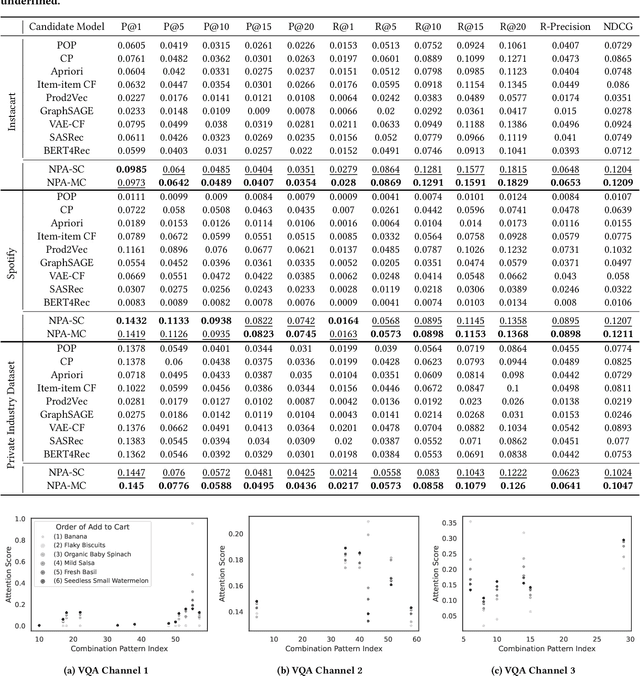
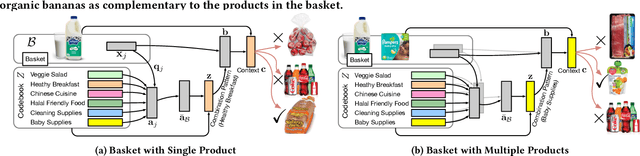
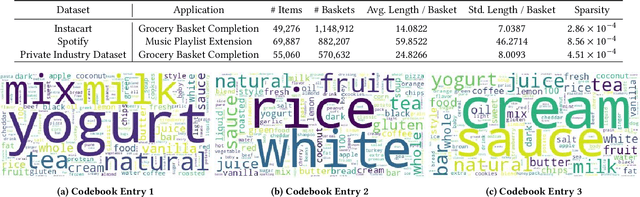
Within-basket recommendation (WBR) refers to the task of recommending items to the end of completing a non-empty shopping basket during a shopping session. While the latest innovations in this space demonstrate remarkable performance improvement on benchmark datasets, they often overlook the complexity of user behaviors in practice, such as 1) co-existence of multiple shopping intentions, 2) multi-granularity of such intentions, and 3) interleaving behavior (switching intentions) in a shopping session. This paper presents Neural Pattern Associator (NPA), a deep item-association-mining model that explicitly models the aforementioned factors. Specifically, inspired by vector quantization, the NPA model learns to encode common user intentions (or item-combination patterns) as quantized representations (a.k.a. codebook), which permits identification of users's shopping intentions via attention-driven lookup during the reasoning phase. This yields coherent and self-interpretable recommendations. We evaluated the proposed NPA model across multiple extensive datasets, encompassing the domains of grocery e-commerce (shopping basket completion) and music (playlist extension), where our quantitative evaluations show that the NPA model significantly outperforms a wide range of existing WBR solutions, reflecting the benefit of explicitly modeling complex user intentions.