 Add to Chrome
 Add to Firefox
 Add to Edge
Improving Regret Approximation for Unsupervised Dynamic Environment Generation
Jan 21, 2026
Unsupervised Environment Design (UED) seeks to automatically generate training curricula for reinforcement learning (RL) agents, with the goal of improving generalisation and zero-shot performance. However, designing effective curricula remains a difficult problem, particularly in settings where small subsets of environment parameterisations result in significant increases in the complexity of the required policy. Current methods struggle with a difficult credit assignment problem and rely on regret approximations that fail to identify challenging levels, both of which are compounded as the size of the environment grows. We propose Dynamic Environment Generation for UED (DEGen) to enable a denser level generator reward signal, reducing the difficulty of credit assignment and allowing for UED to scale to larger environment sizes. We also introduce a new regret approximation, Maximised Negative Advantage (MNA), as a significantly improved metric to optimise for, that better identifies more challenging levels. We show empirically that MNA outperforms current regret approximations and when combined with DEGen, consistently outperforms existing methods, especially as the size of the environment grows. We have made all our code available here: https://github.com/HarryMJMead/Dynamic-Environment-Generation-for-UED.

Return Capping: Sample-Efficient CVaR Policy Gradient Optimisation
Apr 29, 2025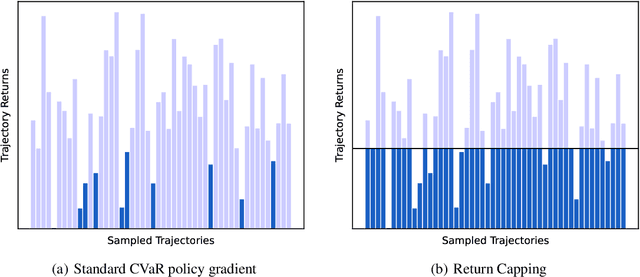
When optimising for conditional value at risk (CVaR) using policy gradients (PG), current methods rely on discarding a large proportion of trajectories, resulting in poor sample efficiency. We propose a reformulation of the CVaR optimisation problem by capping the total return of trajectories used in training, rather than simply discarding them, and show that this is equivalent to the original problem if the cap is set appropriately. We show, with empirical results in an number of environments, that this reformulation of the problem results in consistently improved performance compared to baselines.