 Add to Chrome
 Add to Firefox
 Add to Edge
Neptuna: A Comprehensive Machine Learning Framework for Benchmarking Complex Multiphase Flows
Jul 27, 2026
Compressible multiphase flows involving shocks and material interfaces arise in applications such as bubble collapse and droplet breakup, where strong nonlinear interactions produce complex interface deformation, mixing, and multiscale dynamics. Developing reliable machine learning surrogates for these flows remains challenging due to the simultaneous presence of compressibility, sharp discontinuities, and multiphase effects. In this work, we introduce the first large-scale benchmark specifically designed for shock-driven compressible multiphase flows, comprising 2.4 TB of high-fidelity 2D and 3D datasets featuring shock-induced bubble collapse and droplet breakup. We evaluate diverse surrogate model families on our benchmarking framework: Neptuna {https://github.com/tumaer/Neptuna}, including convolutional, spectral, transformer-based, and pre-trained PDE foundation models. Beyond standard MSE training, we investigate composite losses combining MSE with Sobolev, interface-aware, and structure-aware terms, together with adaptive loss balancing using SoftAdapt and GradNorm. Evaluation includes pointwise, spectral, feature-focused, structural, and physics-informed metrics. Results show that no single model performs best across all datasets and metrics, while composite losses significantly improve interface preservation and spectral fidelity. Among adaptive weighting strategies, SoftAdapt provides the most consistent improvements with almost no overhead compared to MSE-only training.

JAX-SPH: A Differentiable Smoothed Particle Hydrodynamics Framework
Mar 07, 2024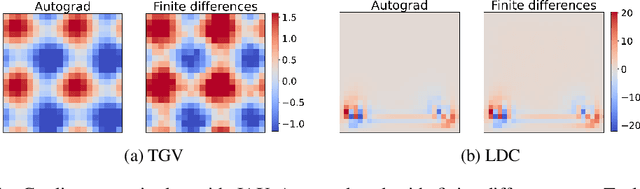
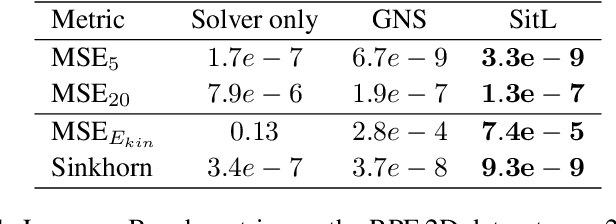
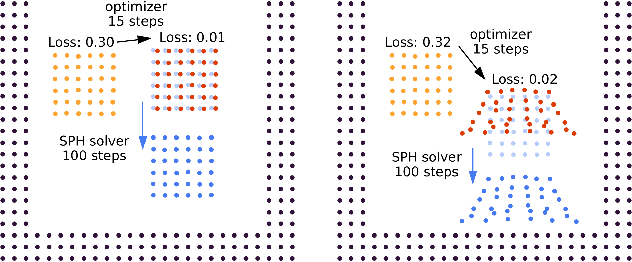
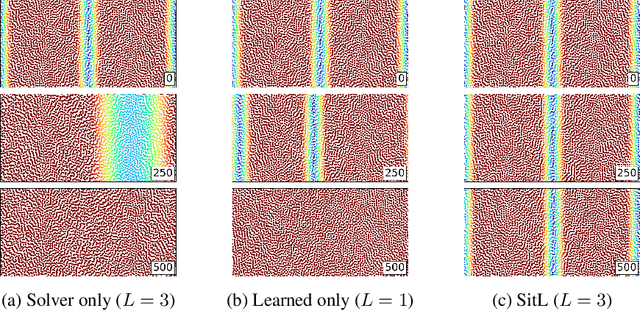
Particle-based fluid simulations have emerged as a powerful tool for solving the Navier-Stokes equations, especially in cases that include intricate physics and free surfaces. The recent addition of machine learning methods to the toolbox for solving such problems is pushing the boundary of the quality vs. speed tradeoff of such numerical simulations. In this work, we lead the way to Lagrangian fluid simulators compatible with deep learning frameworks, and propose JAX-SPH - a Smoothed Particle Hydrodynamics (SPH) framework implemented in JAX. JAX-SPH builds on the code for dataset generation from the LagrangeBench project (Toshev et al., 2023) and extends this code in multiple ways: (a) integration of further key SPH algorithms, (b) restructuring the code toward a Python library, (c) verification of the gradients through the solver, and (d) demonstration of the utility of the gradients for solving inverse problems as well as a Solver-in-the-Loop application. Our code is available at https://github.com/tumaer/jax-sph.