 Add to Chrome
 Add to Firefox
 Add to Edge
Neptuna: A Comprehensive Machine Learning Framework for Benchmarking Complex Multiphase Flows
Jul 27, 2026
Compressible multiphase flows involving shocks and material interfaces arise in applications such as bubble collapse and droplet breakup, where strong nonlinear interactions produce complex interface deformation, mixing, and multiscale dynamics. Developing reliable machine learning surrogates for these flows remains challenging due to the simultaneous presence of compressibility, sharp discontinuities, and multiphase effects. In this work, we introduce the first large-scale benchmark specifically designed for shock-driven compressible multiphase flows, comprising 2.4 TB of high-fidelity 2D and 3D datasets featuring shock-induced bubble collapse and droplet breakup. We evaluate diverse surrogate model families on our benchmarking framework: Neptuna {https://github.com/tumaer/Neptuna}, including convolutional, spectral, transformer-based, and pre-trained PDE foundation models. Beyond standard MSE training, we investigate composite losses combining MSE with Sobolev, interface-aware, and structure-aware terms, together with adaptive loss balancing using SoftAdapt and GradNorm. Evaluation includes pointwise, spectral, feature-focused, structural, and physics-informed metrics. Results show that no single model performs best across all datasets and metrics, while composite losses significantly improve interface preservation and spectral fidelity. Among adaptive weighting strategies, SoftAdapt provides the most consistent improvements with almost no overhead compared to MSE-only training.

L2M: Practical posterior Laplace approximation with optimization-driven second moment estimation
Jul 09, 2021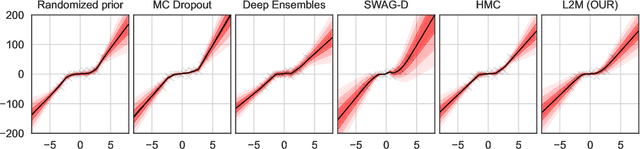
Uncertainty quantification for deep neural networks has recently evolved through many techniques. In this work, we revisit Laplace approximation, a classical approach for posterior approximation that is computationally attractive. However, instead of computing the curvature matrix, we show that, under some regularity conditions, the Laplace approximation can be easily constructed using the gradient second moment. This quantity is already estimated by many exponential moving average variants of Adagrad such as Adam and RMSprop, but is traditionally discarded after training. We show that our method (L2M) does not require changes in models or optimization, can be implemented in a few lines of code to yield reasonable results, and it does not require any extra computational steps besides what is already being computed by optimizers, without introducing any new hyperparameter. We hope our method can open new research directions on using quantities already computed by optimizers for uncertainty estimation in deep neural networks.