 Add to Chrome
 Add to Firefox
 Add to Edge
LEO-based Carrier-Phase Positioning for 6G: Design Insights and Comparison with GNSS
Mar 18, 2026
The integration of non-terrestrial networks (NTN) into 5G new radio (NR) enables a new class of positioning capabilities based on cellular signals transmitted by Low-Earth Orbit (LEO) satellites. In this paper, we investigate joint delay-and-carrier-phase positioning for LEO-based NR-NTN systems and provide a convergence-centric comparison with Global Navigation Satellite Systems (GNSS). We show that the rapid orbital motion of LEO satellites induces strong temporal and geometric diversity across observation epochs, thereby improving the conditioning of multi-epoch carrier-phase models and enabling significantly faster integer-ambiguity convergence. To enable robust carrier-phase tracking under intermittent positioning reference signal (PRS) transmissions, we propose a dual-waveform design that combines wideband PRS for delay estimation with a continuous narrowband carrier for phase tracking. Using a realistic simulation framework incorporating LEO orbit dynamics, we demonstrate that LEO-based joint delay-and-carrier-phase positioning achieves cm-level accuracy with convergence times on the order of a few seconds, whereas GNSS remains limited to meter-level accuracy over comparable short observation windows. These results establish LEO-based cellular positioning as a strong complement and potential alternative to GNSS for high-accuracy positioning, navigation, and timing (PNT) services in future wireless networks.

LEO-based Positioning: Foundations, Signal Design, and Receiver Enhancements for 6G NTN
Oct 23, 2024
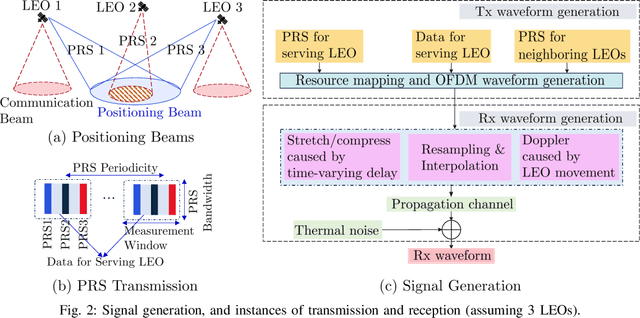
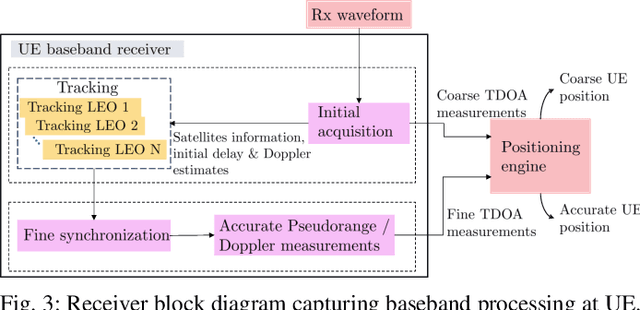
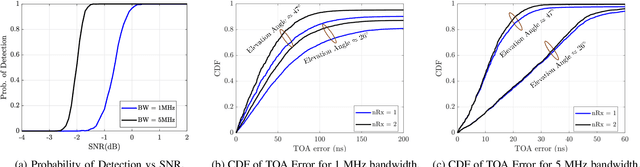
The integration of non-terrestrial networks (NTN) into 5G new radio (NR) has opened up the possibility of developing a new positioning infrastructure using NR signals from Low-Earth Orbit (LEO) satellites. LEO-based cellular positioning offers several advantages, such as a superior link budget, higher operating bandwidth, and large forthcoming constellations. Due to these factors, LEO-based positioning, navigation, and timing (PNT) is a potential enhancement for NTN in 6G cellular networks. However, extending the existing terrestrial cellular positioning methods to LEO-based NTN positioning requires considering key fundamental enhancements. These include creating broad positioning beams orthogonal to conventional communication beams, time-domain processing at the user equipment (UE) to resolve large delay and Doppler uncertainties, and efficiently accommodating positioning reference signals (PRS) from multiple satellites within the communication resource grid. In this paper, we present the first set of design insights by incorporating these enhancements and thoroughly evaluating LEO-based positioning, considering the constraints and capabilities of the NR-NTN physical layer. To evaluate the performance of LEO-based NTN positioning, we develop a comprehensive NR-compliant simulation framework, including LEO orbit simulation, transmission (Tx) and receiver (Rx) architectures, and a positioning engine incorporating the necessary enhancements. Our findings suggest that LEO-based NTN positioning could serve as a complementary infrastructure to existing Global Navigation Satellite Systems (GNSS) and, with appropriate enhancements, may also offer a viable alternative.