 Add to Chrome
 Add to Firefox
 Add to Edge
Kamera: Unified Position-Invariant Multimodal KV Cache for Training-Free Reuse
Jun 22, 2026
Multimodal agents repeatedly re-examine the same video frames, UI screenshots, and rendered artifacts as their context window slides and reasoning iterates, yet every look-back re-encodes from scratch, because prefix caches serve reuse only at a fixed leading position. We show this recompute is avoidable, and identify exactly what naive KV reuse loses: the cross-chunk conditioning a chunk absorbs from its neighbours. This loss is asymmetric. The direct readout of a cached chunk is recovered exactly and for free by the standard state-merge. What remains is a diffuse, low-rank residue concentrated in deep layers, invisible to single-hop retrieval but precisely what multi-hop reasoning binds on. Blind reuse therefore leaves single-hop recall intact while halving multi-hop accuracy; this is the failure mode prior position-independent caches, designed for single-context or single-image reuse, do not address. We repair it with a small, training-free low-rank conditioning patch stored alongside each position-free chunk. Reuse reduces to one operator across MLA, GQA, and MHA: exact RoPE re-rotation to any target position, plus the patch that restores cross-chunk binding. This makes three window operations cheap: reorder (one patch serves every ordering of a cached set), sliding-window survival (surviving chunks relocate via rotation only, zero re-encode), and recall (an evicted chunk is rehydrated by its patch, never re-encoded). A rank-m patch recovers full task accuracy on cross-chunk-binding benchmarks, MM-NIAH across two attention families and two-page doc-QA, at a fraction of the KV footprint, and reconstructs re-prefill KV to within bf16 rounding in a production SGLang kernel across six backbones. The conditioning signal is strongest in redundant vision and video streams, making our solution most impactful where multimodal agents spend their recompute budget.

Leyline: KV Cache Directives for Agentic Inference
May 31, 2026Modern KV cache management assumes the chatbot workload: prompts arrive once and the cache grows append-only, so prefix caching and forward-only eviction are correct by construction. Agentic LLMs break this assumption. Their conversations evolve through policy-driven editing: failed tool calls are retried, stale outputs dropped, trajectories pivoted. Two distinct cache problems result. First, identical content moves to new positions between turns, invalidating exact-prefix caches even though the underlying KV would still be valid; recent work on position-independent caching for MLA addresses this reuse problem. Second, and this paper's focus, a policy may need to direct the serving system to actively remove or replace a span of cached content and continue without re-prefilling everything that came after. No existing primitive offers this. Production agentic harnesses fall back to re-prefill on every edit, paying full prefix-recomputation cost; kernel-level eviction methods make their own decisions and cannot accept policy directives from outside the kernel. We introduce Leyline, a serving-side primitive that closes this gap. A declarative directive 4-tuple separates what to edit from how to preserve position correctness. The policy declares the edit and its mode (in-place splice or prefix-trimmed re-prefill for semantic forgetting); an architecture-agnostic interface routes to a per-architecture kernel that restores attention math via a closed-form RoPE-rotation correction. The splice kernel lifts replay cache-hit by +11.2 pp and cuts latency by up to 241 ms. A ten-line truncation rule routed through the same interface lifts agentic solve rate by +14.3 pp on debug-gym. The mechanism is open; the policy space it enables is the agenda.
Diagnosing Overhead in Dispatch Operations: Cross-architecture Observatory
May 20, 2026AlltoAll dispatch is the dominant bottleneck of MoE expert parallelism, and the interconnect community has responded with four families of mitigations: predictive sample placement, adaptive expert relayout, hierarchical collectives, and EP-aware topology. All four rest on two assumptions about the workload. The first is that routing imbalance is correctable by the system layer. The second is that the mock-token benchmarks evaluating them faithfully represent production routing. We introduce DODOCO to test both assumptions. We instrument five MoE checkpoints spanning five sequence-mixer designs (DeepSeek-V2-Lite MLA, DeepSeek-MoE-16B MHA, Qwen3-30B GQA, Nemotron-30B Mamba-2, Qwen3.5-35B GDN) under a 5 by 6 grid of data conditions plus a matched EP scan from 4 to 32 ranks on H100s; both assumptions fail. Scaling EP changes the per-expert max/mean token ratio by at most 5% within every architecture's measurable range: the straggler is intrinsic to the routing decision the model makes, not to how its experts land on ranks. Mock tokens overestimate routing Gini by up to a factor of 2.35 and fabricate a batch-size scaling trend that vanishes the moment real text replaces random IDs. A third pattern, unexpected, emerges from the same matrix: the five architectures cleave into two stable bands. MHA and Mamba-2 (data-resilient) drop to Gini 0.105 and 0.150 on wikitext. MLA and GDN (persistently concentrated) stay above 0.24 on every real-text condition and reach 0.29 to 0.38 on mock. GQA is the intermediate case. These bands, not the EP degree or the mock-data profile, are the right workload input to AlltoAll-aware interconnect and dispatch design.
ChannelFlow-Tools: A Standardized Dataset Creation Pipeline for 3D Obstructed Channel Flows
Sep 17, 2025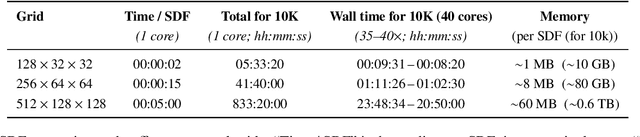
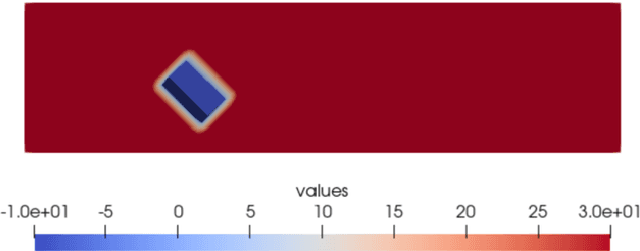
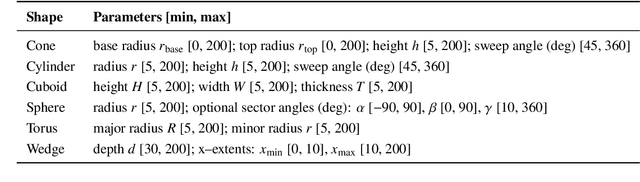
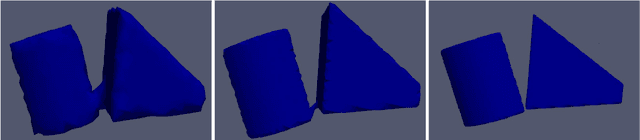
We present ChannelFlow-Tools, a configuration-driven framework that standardizes the end-to-end path from programmatic CAD solid generation to ML-ready inputs and targets for 3D obstructed channel flows. The toolchain integrates geometry synthesis with feasibility checks, signed distance field (SDF) voxelization, automated solver orchestration on HPC (waLBerla LBM), and Cartesian resampling to co-registered multi-resolution tensors. A single Hydra/OmegaConf configuration governs all stages, enabling deterministic reproduction and controlled ablations. As a case study, we generate 10k+ scenes spanning Re=100-15000 with diverse shapes and poses. An end-to-end evaluation of storage trade-offs directly from the emitted artifacts, a minimal 3D U-Net at 128x32x32, and example surrogate models with dataset size illustrate that the standardized representations support reproducible ML training. ChannelFlow-Tools turns one-off dataset creation into a reproducible, configurable pipeline for CFD surrogate modeling.