 Add to Chrome
 Add to Firefox
 Add to Edge
Defake-o3: From Speculative Rationales to Verifiable Evidence for Explainable AIGI Detection
Aug 17, 2026
The rapid progress of image generation models calls for AI-generated image (AIGI) detectors that are not only accurate but also explainable and reliable. While MLLM-based detectors can provide natural language explanations, existing methods often generate speculative rationales: they rely on vague or hallucinated artifacts, miss subtle localized flaws from the latest generators, and fail to provide evidence that can be visually verified. We present Defake-o3, an explainable AIGI detector that moves from speculative rationales to verifiable evidence. It combines interactive visual search with verifier-guided evidence alignment: the model iteratively zooms into suspicious regions to inspect fine-grained details, while an Evidence Verifier, trained from human verification annotations, provides reinforcement learning rewards that favor grounded evidence and penalize baseless claims. To support this objective, we construct GroundFake, a dataset designed for grounded explainable detection, with localized bounding-box evidence, human verification based on visual grounding and artifact specificity, corrected reasoning trajectories, and valid/invalid evidence supervision. We further introduce FakeFrontier, an out-of-distribution benchmark built from real images and outputs of 10 recent generators, together with an MLLM-based protocol for evaluating evidence quality and persuasiveness. Experiments on GroundFake, FakeFrontier, and additional out-of-distribution benchmarks show that Defake-o3 improves both detection accuracy and explanation quality, producing more localized, verifiable, and persuasive evidence.

COCO-Inpaint: A Benchmark for Image Inpainting Detection and Manipulation Localization
Apr 25, 2025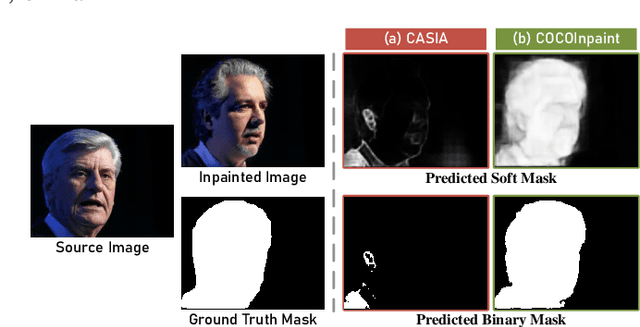
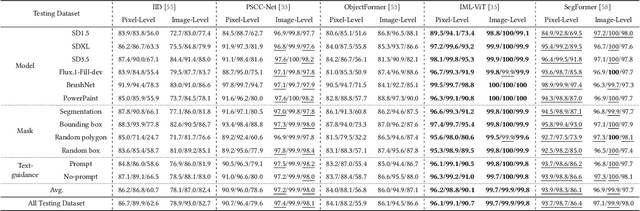
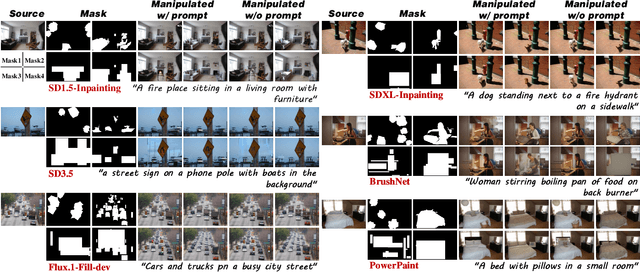

Recent advancements in image manipulation have achieved unprecedented progress in generating photorealistic content, but also simultaneously eliminating barriers to arbitrary manipulation and editing, raising concerns about multimedia authenticity and cybersecurity. However, existing Image Manipulation Detection and Localization (IMDL) methodologies predominantly focus on splicing or copy-move forgeries, lacking dedicated benchmarks for inpainting-based manipulations. To bridge this gap, we present COCOInpaint, a comprehensive benchmark specifically designed for inpainting detection, with three key contributions: 1) High-quality inpainting samples generated by six state-of-the-art inpainting models, 2) Diverse generation scenarios enabled by four mask generation strategies with optional text guidance, and 3) Large-scale coverage with 258,266 inpainted images with rich semantic diversity. Our benchmark is constructed to emphasize intrinsic inconsistencies between inpainted and authentic regions, rather than superficial semantic artifacts such as object shapes. We establish a rigorous evaluation protocol using three standard metrics to assess existing IMDL approaches. The dataset will be made publicly available to facilitate future research in this area.