 Add to Chrome
 Add to Firefox
 Add to Edge
AEF-Econ: Toward Plug-and-Play Socioeconomic Foundation Embeddings from AlphaEarth for Urban Remote Sensing
Jun 15, 2026
AlphaEarth Foundations (AEF) unify global remote sensing foundation embeddings through multimodal self-supervised learning, but their pretraining focuses on physical land-surface signals, limiting plug-and-play use in socioeconomic tasks. We integrate seven heterogeneous data streams across 36 Chinese cities over eight years - AEF embeddings, population, nighttime lights, remote sensing indices, points of interest (POIs), urban morphology, and cross-lingual text - and construct CHN-Econ, a socioeconomic benchmark with 16 labels in three categories. We conduct 31 controlled experiments along five axes: fusion architecture, self-supervised objective, text integration, embedding dimensionality, and normalization. Used alone as a linear probe, AEF achieves R2 values of only 0.301 for cross-region and 0.160 for cross-tier evaluation. The five-axis ablated backbone improves these scores to 0.832 and 0.671, respectively, but reveals that low-dimensional semantic streams are consistently suppressed by high-dimensional streams under shared reconstruction. To address this bottleneck, we propose Capacity-Adaptive Reconstruction (CAR), replacing shared reconstruction with per-stream decoders and stream-level losses to mitigate inter-stream capacity competition. CAR further raises cross-region and cross-tier R2 to 0.848 and 0.693, and restores collapsed labels from negative R2 to a stable range. Using CAR, we infer 14.4 million pixels across 36 cities and eight years and release AEF-Econ, including 128d and 64d compressed versions. Self-diagnostics and case studies show that AEF-Econ captures cross-city hierarchies and intra-urban spatial organization under unsupervised settings, providing a socioeconomic remote sensing foundation embedding complementary to AEF physical embeddings.

Slum Detection and Density Mapping with AlphaEarth Foundations: A Representation Learning Evaluation Across 12 Global Cities
May 11, 2026Pixel-level slum mapping has long been constrained by limited cross-city generalisation, the absence of continuous density estimation, and weak global comparability. AlphaEarth Foundations (AEF), a globally consistent 64-dimensional annual surface embedding at 10 m, offers a new analysis-ready basis for lightweight slum monitoring, but its applicability to slum detection - an indirectly coupled task shaped by both built form and socio-economic processes - remains untested. We evaluate AEF on slum classification and sub-pixel density estimation across 12 cities and 69 city-year pairs (2017-2024), using GRAM pseudo-masks as supervisory labels. The evaluation spans four training strategies, two protocols (random split and 3x3 spatial block cross-validation), six auxiliary feature configurations, and five baseline models, complemented by representation-level analyses (PCA, SHAP) and full-AOI mapping. Five findings emerge. (1) Same-city cross-year training is optimal under both protocols (median spatial F1 = 0.616, R^2 = 0.466); temporal expansion outperforms cross-city transfer, indicating city-scale representational drift. (2) Regression R^2 is driven primarily by zero/non-zero boundary discrimination: positive-pixel R^2 is consistently negative across all cities, revealing limited capacity to model intra-pixel density gradients at 10 m. (3) PC36 is consistently top-ranked across tasks; classification saturates at k = 32 while regression remains unsaturated at k = 64. (4) POI features yield the largest density gain (Delta R^2 = +0.064). (5) For six cities meeting dual-task usability thresholds, full-AOI inference across 2017-2024 preserves slum cluster structure (mean SSIM = 0.926). The study delineates the capabilities and complementarity needs of foundation-model embeddings for slum monitoring.
AutoGEEval: A Multimodal and Automated Framework for Geospatial Code Generation on GEE with Large Language Models
May 19, 2025Geospatial code generation is emerging as a key direction in the integration of artificial intelligence and geoscientific analysis. However, there remains a lack of standardized tools for automatic evaluation in this domain. To address this gap, we propose AutoGEEval, the first multimodal, unit-level automated evaluation framework for geospatial code generation tasks on the Google Earth Engine (GEE) platform powered by large language models (LLMs). Built upon the GEE Python API, AutoGEEval establishes a benchmark suite (AutoGEEval-Bench) comprising 1325 test cases that span 26 GEE data types. The framework integrates both question generation and answer verification components to enable an end-to-end automated evaluation pipeline-from function invocation to execution validation. AutoGEEval supports multidimensional quantitative analysis of model outputs in terms of accuracy, resource consumption, execution efficiency, and error types. We evaluate 18 state-of-the-art LLMs-including general-purpose, reasoning-augmented, code-centric, and geoscience-specialized models-revealing their performance characteristics and potential optimization pathways in GEE code generation. This work provides a unified protocol and foundational resource for the development and assessment of geospatial code generation models, advancing the frontier of automated natural language to domain-specific code translation.
Chain-of-Programming (CoP) : Empowering Large Language Models for Geospatial Code Generation
Nov 16, 2024

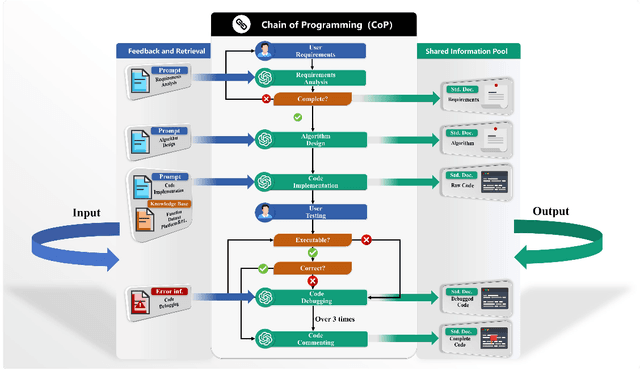

With the rapid growth of interdisciplinary demands for geospatial modeling and the rise of large language models (LLMs), geospatial code generation technology has seen significant advancements. However, existing LLMs often face challenges in the geospatial code generation process due to incomplete or unclear user requirements and insufficient knowledge of specific platform syntax rules, leading to the generation of non-executable code, a phenomenon known as "code hallucination." To address this issue, this paper proposes a Chain of Programming (CoP) framework, which decomposes the code generation process into five steps: requirement analysis, algorithm design, code implementation, code debugging, and code annotation. The framework incorporates a shared information pool, knowledge base retrieval, and user feedback mechanisms, forming an end-to-end code generation flow from requirements to code without the need for model fine-tuning. Based on a geospatial problem classification framework and evaluation benchmarks, the CoP strategy significantly improves the logical clarity, syntactical correctness, and executability of the generated code, with improvements ranging from 3.0% to 48.8%. Comparative and ablation experiments further validate the superiority of the CoP strategy over other optimization approaches and confirm the rationality and necessity of its key components. Through case studies on building data visualization and fire data analysis, this paper demonstrates the application and effectiveness of CoP in various geospatial scenarios. The CoP framework offers a systematic, step-by-step approach to LLM-based geospatial code generation tasks, significantly enhancing code generation performance in geospatial tasks and providing valuable insights for code generation in other vertical domains.