 Add to Chrome
 Add to Firefox
 Add to Edge
Progressive Reasoning with Primitive Correction for Compositional Zero-Shot Learning
Jul 07, 2026
Compositional Zero-Shot Learning (CZSL) aims to combine known attributes and objects as primitives for recognizing previously unseen attribute-object pairs. Prior works either predict attributes and objects independently, missing their strong contextual dependency, or use unidirectional conditional modeling (e.g., object-guided attribute prediction), which is prone to error propagation. We propose PRPC, a Progressive Reasoning framework with Primitive Correction, which explicitly models the bidirectional dependency between attributes and objects via step-wise inference. PRPC performs mutual correction of primitives to suppress prediction errors in earlier steps. Specifically, we formulate CZSL as structured, Q&A-style Chain-of-Thought reasoning process and constrain the MLLM to follow predefined semantic steps to generate intermediate decisions. To further enhance the reliability and logical consistency of intermediate reasoning, we introduce reinforcement learning post-training with a GRPO-based objective, providing step-level rewards aligned with the progressive inference procedure. Extensive experiments on three CZSL benchmarks demonstrate that PRPC achieves state-of-the-art performance, validating the effectiveness of progressive reasoning and bidirectional correction for robust compositional generalization.

When Swin Transformer Meets KANs: An Improved Transformer Architecture for Medical Image Segmentation
Nov 06, 2025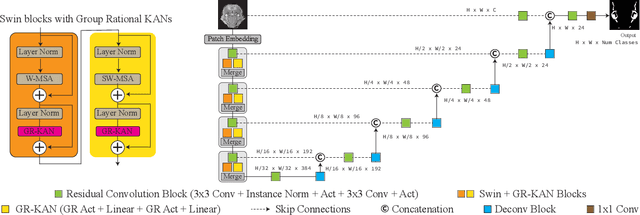
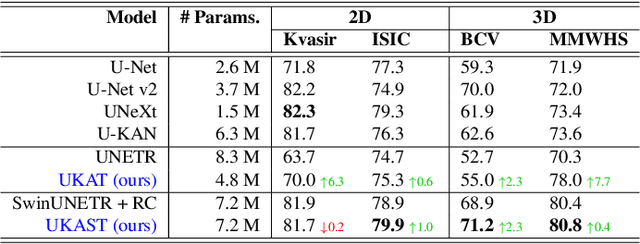
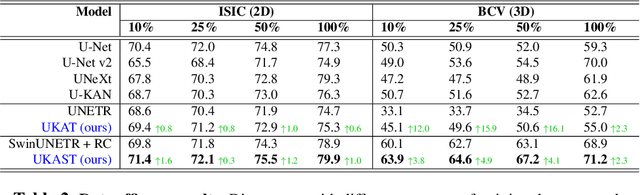
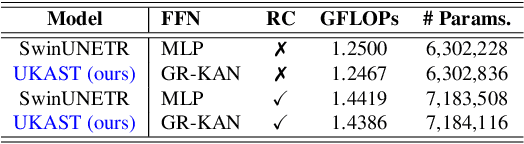
Medical image segmentation is critical for accurate diagnostics and treatment planning, but remains challenging due to complex anatomical structures and limited annotated training data. CNN-based segmentation methods excel at local feature extraction, but struggle with modeling long-range dependencies. Transformers, on the other hand, capture global context more effectively, but are inherently data-hungry and computationally expensive. In this work, we introduce UKAST, a U-Net like architecture that integrates rational-function based Kolmogorov-Arnold Networks (KANs) into Swin Transformer encoders. By leveraging rational base functions and Group Rational KANs (GR-KANs) from the Kolmogorov-Arnold Transformer (KAT), our architecture addresses the inefficiencies of vanilla spline-based KANs, yielding a more expressive and data-efficient framework with reduced FLOPs and only a very small increase in parameter count compared to SwinUNETR. UKAST achieves state-of-the-art performance on four diverse 2D and 3D medical image segmentation benchmarks, consistently surpassing both CNN- and Transformer-based baselines. Notably, it attains superior accuracy in data-scarce settings, alleviating the data-hungry limitations of standard Vision Transformers. These results show the potential of KAN-enhanced Transformers to advance data-efficient medical image segmentation. Code is available at: https://github.com/nsapkota417/UKAST