 Add to Chrome
 Add to Firefox
 Add to Edge
Olbedo: An Albedo and Shading Aerial Dataset for Large-Scale Outdoor Environments
Feb 24, 2026
Intrinsic image decomposition (IID) of outdoor scenes is crucial for relighting, editing, and understanding large-scale environments, but progress has been limited by the lack of real-world datasets with reliable albedo and shading supervision. We introduce Olbedo, a large-scale aerial dataset for outdoor albedo--shading decomposition in the wild. Olbedo contains 5,664 UAV images captured across four landscape types, multiple years, and diverse illumination conditions. Each view is accompanied by multi-view consistent albedo and shading maps, metric depth, surface normals, sun and sky shading components, camera poses, and, for recent flights, measured HDR sky domes. These annotations are derived from an inverse-rendering refinement pipeline over multi-view stereo reconstructions and calibrated sky illumination, together with per-pixel confidence masks. We demonstrate that Olbedo enables state-of-the-art diffusion-based IID models, originally trained on synthetic indoor data, to generalize to real outdoor imagery: fine-tuning on Olbedo significantly improves single-view outdoor albedo prediction on the MatrixCity benchmark. We further illustrate applications of Olbedo-trained models to multi-view consistent relighting of 3D assets, material editing, and scene change analysis for urban digital twins. We release the dataset, baseline models, and an evaluation protocol to support future research in outdoor intrinsic decomposition and illumination-aware aerial vision.

Localized Gaussian Splatting Editing with Contextual Awareness
Jul 31, 2024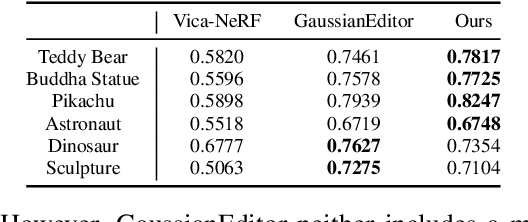
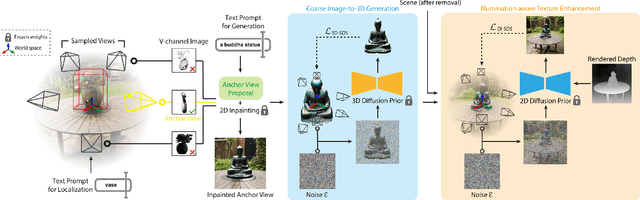

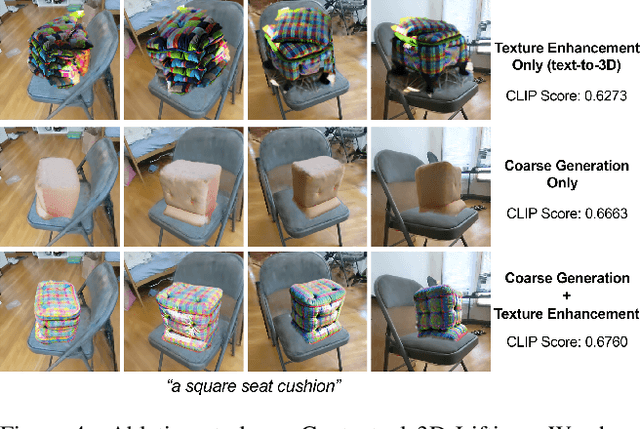
Recent text-guided generation of individual 3D object has achieved great success using diffusion priors. However, these methods are not suitable for object insertion and replacement tasks as they do not consider the background, leading to illumination mismatches within the environment. To bridge the gap, we introduce an illumination-aware 3D scene editing pipeline for 3D Gaussian Splatting (3DGS) representation. Our key observation is that inpainting by the state-of-the-art conditional 2D diffusion model is consistent with background in lighting. To leverage the prior knowledge from the well-trained diffusion models for 3D object generation, our approach employs a coarse-to-fine objection optimization pipeline with inpainted views. In the first coarse step, we achieve image-to-3D lifting given an ideal inpainted view. The process employs 3D-aware diffusion prior from a view-conditioned diffusion model, which preserves illumination present in the conditioning image. To acquire an ideal inpainted image, we introduce an Anchor View Proposal (AVP) algorithm to find a single view that best represents the scene illumination in target region. In the second Texture Enhancement step, we introduce a novel Depth-guided Inpainting Score Distillation Sampling (DI-SDS), which enhances geometry and texture details with the inpainting diffusion prior, beyond the scope of the 3D-aware diffusion prior knowledge in the first coarse step. DI-SDS not only provides fine-grained texture enhancement, but also urges optimization to respect scene lighting. Our approach efficiently achieves local editing with global illumination consistency without explicitly modeling light transport. We demonstrate robustness of our method by evaluating editing in real scenes containing explicit highlight and shadows, and compare against the state-of-the-art text-to-3D editing methods.
SparseGS: Real-Time 360° Sparse View Synthesis using Gaussian Splatting
Nov 30, 2023



The problem of novel view synthesis has grown significantly in popularity recently with the introduction of Neural Radiance Fields (NeRFs) and other implicit scene representation methods. A recent advance, 3D Gaussian Splatting (3DGS), leverages an explicit representation to achieve real-time rendering with high-quality results. However, 3DGS still requires an abundance of training views to generate a coherent scene representation. In few shot settings, similar to NeRF, 3DGS tends to overfit to training views, causing background collapse and excessive floaters, especially as the number of training views are reduced. We propose a method to enable training coherent 3DGS-based radiance fields of 360 scenes from sparse training views. We find that using naive depth priors is not sufficient and integrate depth priors with generative and explicit constraints to reduce background collapse, remove floaters, and enhance consistency from unseen viewpoints. Experiments show that our method outperforms base 3DGS by up to 30.5% and NeRF-based methods by up to 15.6% in LPIPS on the MipNeRF-360 dataset with substantially less training and inference cost.