 Add to Chrome
 Add to Firefox
 Add to Edge
Empowering LLMs for Structure-Based Drug Design via Exploration-Augmented Latent Inference
Jan 25, 2026
Large Language Models (LLMs) possess strong representation and reasoning capabilities, but their application to structure-based drug design (SBDD) is limited by insufficient understanding of protein structures and unpredictable molecular generation. To address these challenges, we propose Exploration-Augmented Latent Inference for LLMs (ELILLM), a framework that reinterprets the LLM generation process as an encoding, latent space exploration, and decoding workflow. ELILLM explicitly explores portions of the design problem beyond the model's current knowledge while using a decoding module to handle familiar regions, generating chemically valid and synthetically reasonable molecules. In our implementation, Bayesian optimization guides the systematic exploration of latent embeddings, and a position-aware surrogate model efficiently predicts binding affinity distributions to inform the search. Knowledge-guided decoding further reduces randomness and effectively imposes chemical validity constraints. We demonstrate ELILLM on the CrossDocked2020 benchmark, showing strong controlled exploration and high binding affinity scores compared with seven baseline methods. These results demonstrate that ELILLM can effectively enhance LLMs capabilities for SBDD.

A Collaborative Framework Integrating Large Language Model and Chemical Fragment Space: Mutual Inspiration for Lead Design
Jul 17, 2025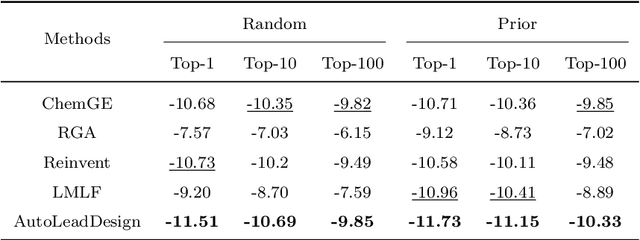
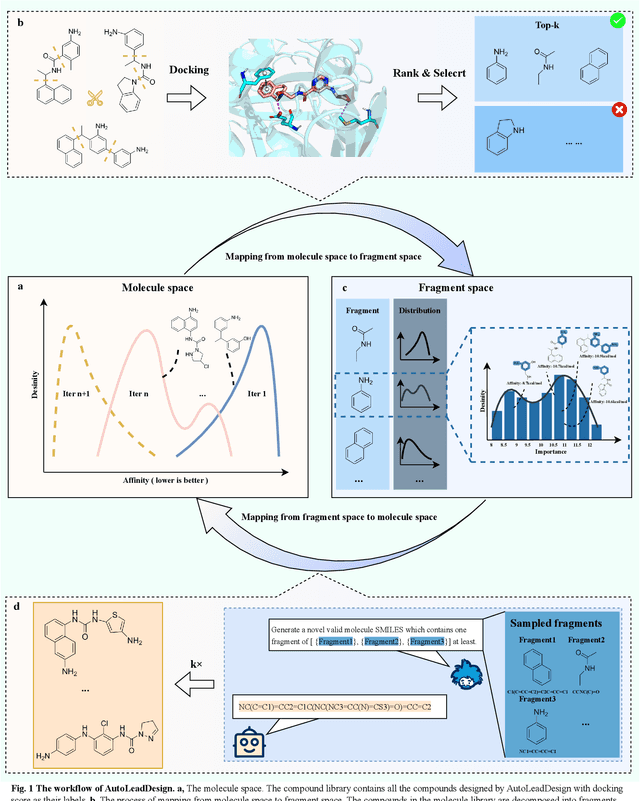
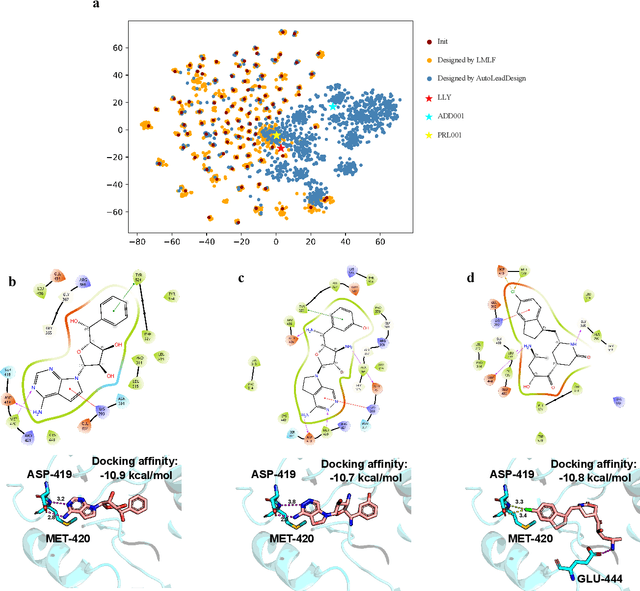
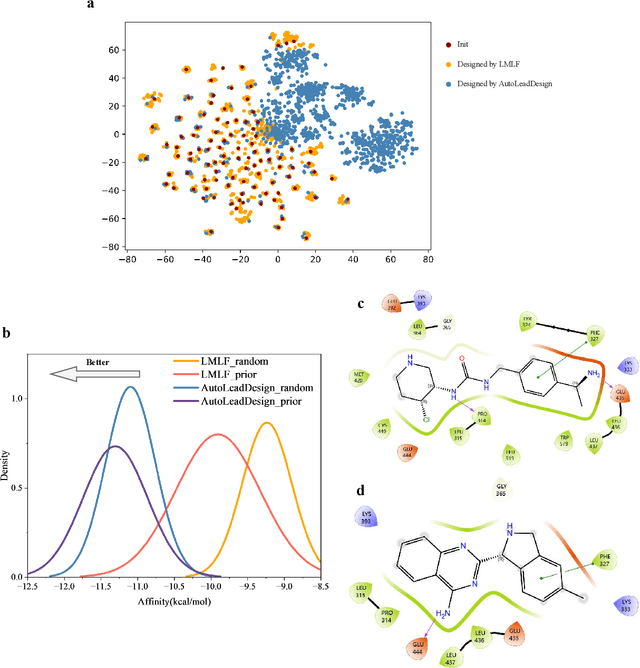
Combinatorial optimization algorithm is essential in computer-aided drug design by progressively exploring chemical space to design lead compounds with high affinity to target protein. However current methods face inherent challenges in integrating domain knowledge, limiting their performance in identifying lead compounds with novel and valid binding mode. Here, we propose AutoLeadDesign, a lead compounds design framework that inspires extensive domain knowledge encoded in large language models with chemical fragments to progressively implement efficient exploration of vast chemical space. The comprehensive experiments indicate that AutoLeadDesign outperforms baseline methods. Significantly, empirical lead design campaigns targeting two clinically relevant targets (PRMT5 and SARS-CoV-2 PLpro) demonstrate AutoLeadDesign's competence in de novo generation of lead compounds achieving expert-competitive design efficacy. Structural analysis further confirms their mechanism-validated inhibitory patterns. By tracing the process of design, we find that AutoLeadDesign shares analogous mechanisms with fragment-based drug design which traditionally rely on the expert decision-making, further revealing why it works. Overall, AutoLeadDesign offers an efficient approach for lead compounds design, suggesting its potential utility in drug design.