 Add to Chrome
 Add to Firefox
 Add to Edge
Understanding Quantization-Aware Training: Gradients at Quantized Weights Bias to the Low-Loss Basin
Jun 08, 2026
Post-training quantization (PTQ) converts a trained full-precision model into low-bit weights without task-level retraining, while quantization-aware training (QAT) incorporates quantization into the training loop. Although PTQ is efficient and often accurate at moderate bitwidths, it can fail sharply at aggressive bitwidths; QAT is more expensive but can often recover the lost accuracy. We propose a unified geometric framework that explains both PTQ failure and QAT recovery. We model full-precision training as following a low-loss \emph{river} inside a wider \emph{valley}: a normal neighborhood of the river forms a nearly flat \emph{basin}, while leaving this basin incurs a sharp loss increase. When the quantization grid is comparable to the basin width, local PTQ objectives, including rounding and Hessian-based second-order reconstruction, can select a high-loss deployed quantized point outside the basin even when nearby low-loss quantized points exist. In this regime, straight-through-estimator-based QAT has a useful bias: it evaluates gradients at the deployed quantized weights while updating latent full-precision weights, causing the gradient to sense the valley wall and acquire an inward component that steers subsequent quantized iterates back into the basin. We formalize this mechanism through a local landscape model, construct a geometric PTQ failure mode, and prove finite-time QAT recovery under local quantizer-compatibility assumptions. Experiments across vision and language models under multiple neural-network quantization schemes corroborate the predicted basin-crossing failure of PTQ and the corresponding recovery mechanism of QAT.

Cross-Register Projection for Headline Part of Speech Tagging
Sep 15, 2021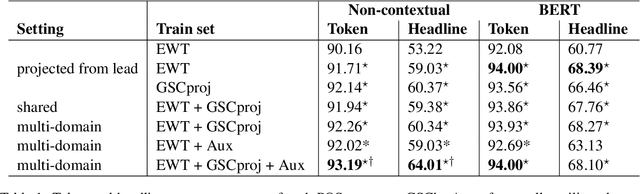
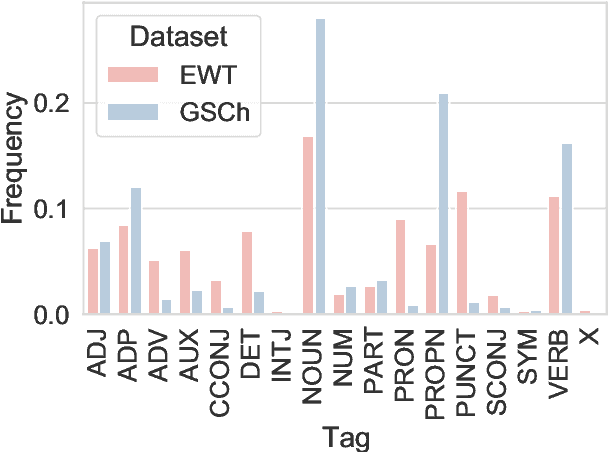
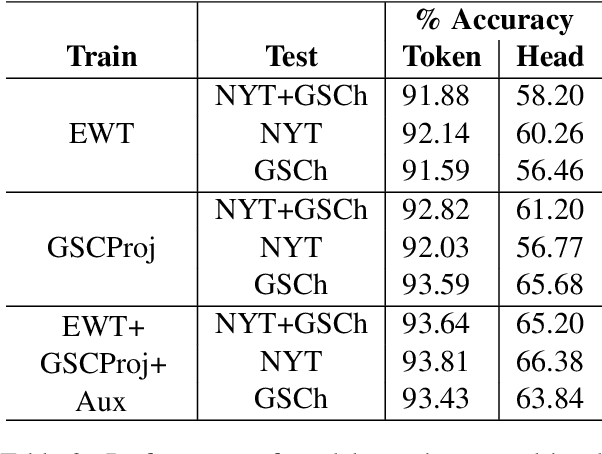
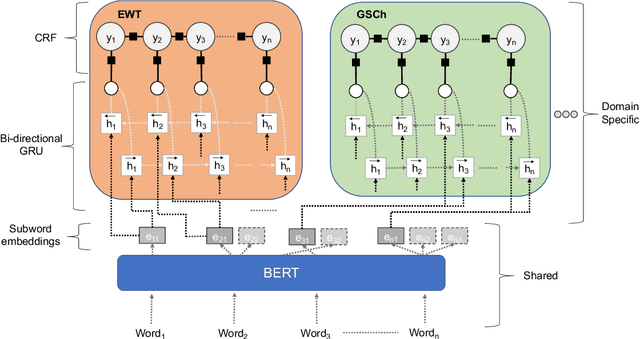
Part of speech (POS) tagging is a familiar NLP task. State of the art taggers routinely achieve token-level accuracies of over 97% on news body text, evidence that the problem is well understood. However, the register of English news headlines, "headlinese", is very different from the register of long-form text, causing POS tagging models to underperform on headlines. In this work, we automatically annotate news headlines with POS tags by projecting predicted tags from corresponding sentences in news bodies. We train a multi-domain POS tagger on both long-form and headline text and show that joint training on both registers improves over training on just one or naively concatenating training sets. We evaluate on a newly-annotated corpus of over 5,248 English news headlines from the Google sentence compression corpus, and show that our model yields a 23% relative error reduction per token and 19% per headline. In addition, we demonstrate that better headline POS tags can improve the performance of a syntax-based open information extraction system. We make POSH, the POS-tagged Headline corpus, available to encourage research in improved NLP models for news headlines.