 Add to Chrome
 Add to Firefox
 Add to Edge
Quantum Tensor Network Learning with DMRG
Aug 19, 2026
Tensor Networks are a relatively new machine learning approach. The architectures proposed initially are inspired by approaches from quantum many-body physics simulations. One common layout is the matrix product state (MPS) also known as a tensor train optimized with gradient descent techniques. We introduce a global normalization condition, so that the MPS represents a quantum state. We investigate two optimization methods that find the locally optimal tensors and compare them regarding their effectiveness. One is based on gradient descent and the other on an adaptation of DMRG.
* 6 pages, 2 figures, 1 table, ESANN conference

Entanglement is Half the Story: Post-Selection vs. Partial Traces
May 04, 2026While tensor networks have their traditional application in simulating quantum systems, in the recent decade they have gathered interest as machine learning models. We combine the experience from both fields and derive how quantum constraints placed on a tensor network manifest a change in capabilities. To this end, we employ a method of inference of classical tensor networks on a quantum computer to define a hybrid architecture. This hybrid tensor network is a practical unified framework for it's classical and quantum tensor network edge cases. We identify post-selection as the important property on which this interpolation hinges. The amount of post-selection corresponds to the level to which quantum constraints are enforced on the tensor network. On this basis, we propose a new hyperparameter which controls the transition between the hybrid and the quantum tensor network. In the comparison of classical and quantum tensor networks it complements the bond dimension. Quantum machine learning is improved by using the hyperparameter to allocate the practically limited post-selection to the quantum model in a trainable manner.
Kernel-based optimization of measurement operators for quantum reservoir computers
Feb 16, 2026Finding optimal measurement operators is crucial for the performance of quantum reservoir computers (QRCs), since they employ a fixed quantum feature map. We formulate the training of both stateless (quantum extreme learning machines, QELMs) and stateful (memory dependent) QRCs in the framework of kernel ridge regression. This approach renders an optimal measurement operator that minimizes prediction error for a given reservoir and training dataset. For large qubit numbers, this method is more efficient than the conventional training of QRCs. We discuss efficiency and practical implementation strategies, including Pauli basis decomposition and operator diagonalization, to adapt the optimal observable to hardware constraints. Numerical experiments on image classification and time series prediction tasks demonstrate the effectiveness of this approach, which can also be applied to other quantum ML models.
Hybrid quantum tensor networks for aeroelastic applications
Aug 07, 2025We investigate the application of hybrid quantum tensor networks to aeroelastic problems, harnessing the power of Quantum Machine Learning (QML). By combining tensor networks with variational quantum circuits, we demonstrate the potential of QML to tackle complex time series classification and regression tasks. Our results showcase the ability of hybrid quantum tensor networks to achieve high accuracy in binary classification. Furthermore, we observe promising performance in regressing discrete variables. While hyperparameter selection remains a challenge, requiring careful optimisation to unlock the full potential of these models, this work contributes significantly to the development of QML for solving intricate problems in aeroelasticity. We present an end-to-end trainable hybrid algorithm. We first encode time series into tensor networks to then utilise trainable tensor networks for dimensionality reduction, and convert the resulting tensor to a quantum circuit in the encoding step. Then, a tensor network inspired trainable variational quantum circuit is applied to solve either a classification or a multivariate or univariate regression task in the aeroelasticity domain.
Tensor networks for quantum machine learning
Mar 21, 2023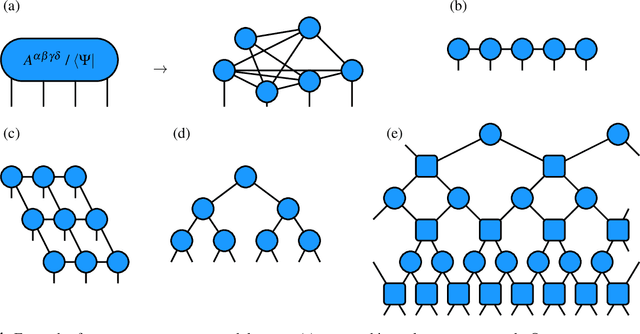
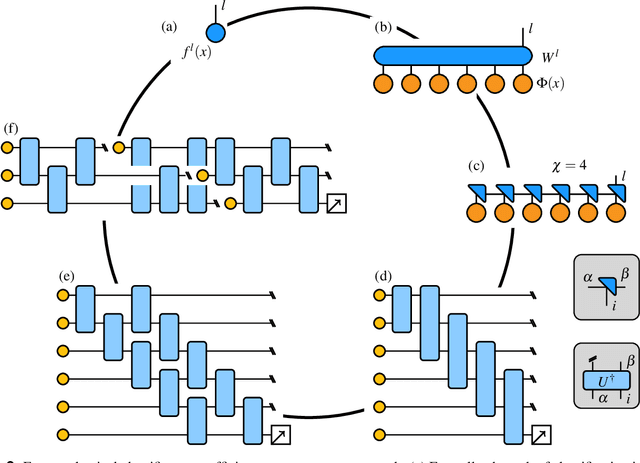
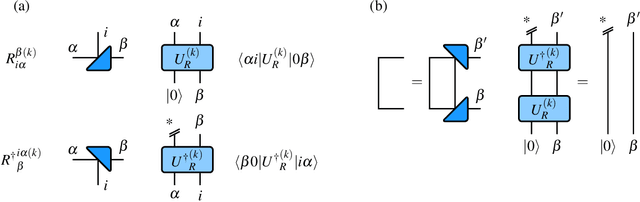
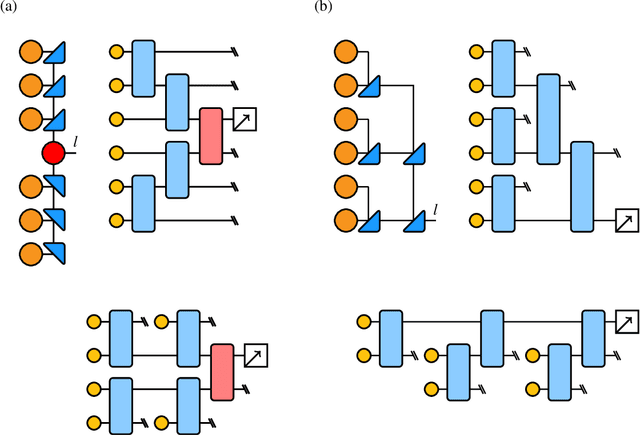
Once developed for quantum theory, tensor networks have been established as a successful machine learning paradigm. Now, they have been ported back to the quantum realm in the emerging field of quantum machine learning to assess problems that classical computers are unable to solve efficiently. Their nature at the interface between physics and machine learning makes tensor networks easily deployable on quantum computers. In this review article, we shed light on one of the major architectures considered to be predestined for variational quantum machine learning. In particular, we discuss how layouts like MPS, PEPS, TTNs and MERA can be mapped to a quantum computer, how they can be used for machine learning and data encoding and which implementation techniques improve their performance.