 Add to Chrome
 Add to Firefox
 Add to Edge
When Readability and Source Retention Diverge: An Evaluability Gap in AI Translation
Aug 19, 2026
Readable AI output can leave an evaluability gap: even when the source is shown, an overall-quality judgment may not reflect what an output preserves. We investigated how source-text condition and output rendering relate to perceived translation quality, and how output and system appraisals relate to trust and stated disclosure willingness in a plain-text interface. A focal 2 * 2 comparison (N=306) using TransLingo examined simple generated narratives and complex literary-philosophical prose alongside LLM-generated readability-oriented outputs and researcher-revised fidelity-oriented outputs. A descriptive stimulus audit indicated greater source retention in fidelity-oriented outputs in both source-text conditions. Factorial analyses showed a significant rendering-by-source-text-condition interaction in perceived quality. Participants rated fidelity-oriented outputs higher than readability-oriented outputs for the simple narratives, whereas no reliable rendering difference emerged for the complex prose. A corresponding source-condition-dependent pattern was observed for perceived intelligence, agency-oriented anthropomorphic attribution, and task-performance trust. A separate theory-ordered appraisal-structure SEM characterized concurrent associations among perceived quality, perceived intelligence, agency-oriented anthropomorphic attribution, task-performance trust, and stated disclosure willingness across six domains, with task-performance trust as the proximal correlate of stated willingness. The observed rating pattern distinguishes source access from source evaluability: for the complex stimuli, displaying the source did not ensure that one overall-quality rating reflected differences in retained content. It also separates support for evaluating translation output from data-handling support for decisions about what personal text to entrust to a system.

Leveraging Schema Labels to Enhance Dataset Search
Jan 27, 2020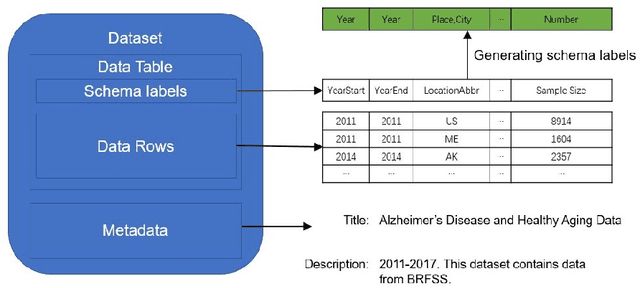
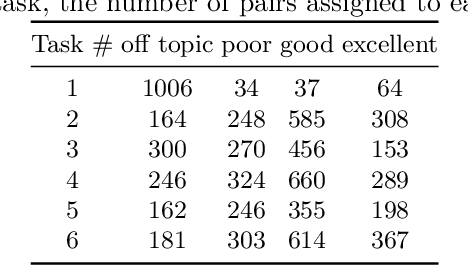
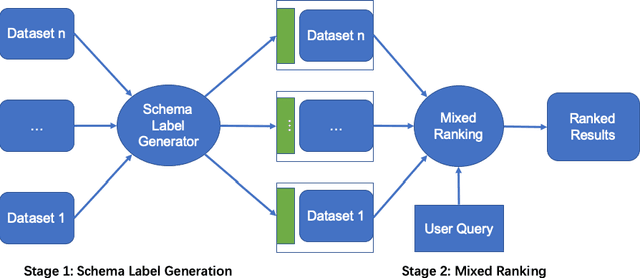
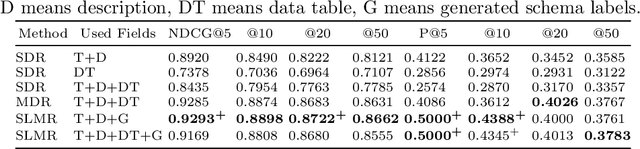
A search engine's ability to retrieve desirable datasets is important for data sharing and reuse. Existing dataset search engines typically rely on matching queries to dataset descriptions. However, a user may not have enough prior knowledge to write a query using terms that match with description text.We propose a novel schema label generation model which generates possible schema labels based on dataset table content. We incorporate the generated schema labels into a mixed ranking model which not only considers the relevance between the query and dataset metadata but also the similarity between the query and generated schema labels. To evaluate our method on real-world datasets, we create a new benchmark specifically for the dataset retrieval task. Experiments show that our approach can effectively improve the precision and NDCG scores of the dataset retrieval task compared with baseline methods. We also test on a collection of Wikipedia tables to show that the features generated from schema labels can improve the unsupervised and supervised web table retrieval task as well.