 Add to Chrome
 Add to Firefox
 Add to Edge
Physics-informed Diffusion Generative Model for Time-Series Data Synthesis in Dynamic Systems
Aug 11, 2026
Industrial time-series signals, such as turbine temperature and rotational speed in aero-engines, are essential for monitoring the health and operational status of complex dynamical systems. However, collecting such data is often limited by harsh environments (e.g., high temperature and high pressure) and the high cost of experimental testing. To address this challenge, we introduce PhysDGM, a stepwise physics-embedded diffusion generative model for synthesizing time-series data that are consistent with the underlying physical laws of dynamical systems. PhysDGM embeds physical laws directly into each reverse diffusion step of the generative process, ensuring trajectory-level physical consistency, rather than enforcing constraints only at the final output. A large-scale AI-synthetic dataset (4.4 million samples, 20x scale-up) constructed by PhysDGM demonstrates strong fidelity across 34 datasets spanning turbofan engines, aero-engines, batteries, and chemical processes. After incorporating the synthetic data, the downstream task performance substantially surpassed that using real data alone by 48% for remaining useful life prediction, 15% for health indicator estimation, 22% for state-of-health assessment, and 20% for fault diagnosis. Moreover, it requires 10-20x less training data than existing approaches, substantially reducing the high cost of data collection in dynamical systems. We further demonstrate PhysDGM's potential in identifying early-stage faults in aero-engines by incorporating AI-synthesized data. In summary, PhysDGM provides a solid foundation for generating physically consistent industrial time-series, paving the way for expanding physics-guided AI into diverse data-scarce environments, including both industrial machinery and complex chemical reaction dynamics.

VLT: A Vision-Language-Time Series Multimodal Foundation Model for Industrial Intelligence
Jul 16, 2026Industrial time series serve as the foundation for Prognostics and Health Management (PHM) to ensure the reliability and safety of industrial equipment such as aero-engines. However, existing approaches are typically limited to single-modality modeling, which restricts their generalization in complex scenarios. Although recent advances in large language models (LLMs) provide new opportunities for multimodal learning, bridging continuous time-series signals and discrete textual semantics remains an open challenge. To this end, we propose VLT, a multimodal foundation model that jointly models time-series, frequency-spectrum visual representations, and textual knowledge. A key insight is to utilize the frequency spectrum as a visual bridge to connect continuous temporal signals with discrete semantics. Specifically, a Time-aware Mixture-of-Experts (Time-MoE) is designed to capture heterogeneous temporal dynamics, while a Frequency-Text Augmented Learner enables joint modeling of spectral and semantic features within a shared representation space. Furthermore, a time-centric gradient alignment mechanism is introduced to mitigate cross-modal optimization conflicts via gradient normalization and reliability-aware dynamic reweighting. Extensive experiments on multiple industrial datasets demonstrate that VLT outperforms state-of-the-art methods, achieving superior robustness and generalization under few-shot, noisy, and incomplete-modality settings.
TS-MLLM: A Multi-Modal Large Language Model-based Framework for Industrial Time-Series Big Data Analysis
Mar 08, 2026Accurate analysis of industrial time-series big data is critical for the Prognostics and Health Management (PHM) of industrial equipment. While recent advancements in Large Language Models (LLMs) have shown promise in time-series analysis, existing methods typically focus on single-modality adaptations, failing to exploit the complementary nature of temporal signals, frequency-domain visual representations, and textual knowledge information. In this paper, we propose TS-MLLM, a unified multi-modal large language model framework designed to jointly model temporal signals, frequency-domain images, and textual domain knowledge. Specifically, we first develop an Industrial time-series Patch Modeling branch to capture long-range temporal dynamics. To integrate cross-modal priors, we introduce a Spectrum-aware Vision-Language Model Adaptation (SVLMA) mechanism that enables the model to internalize frequency-domain patterns and semantic context. Furthermore, a Temporal-centric Multi-modal Attention Fusion (TMAF) mechanism is designed to actively retrieve relevant visual and textual cues using temporal features as queries, ensuring deep cross-modal alignment. Extensive experiments on multiple industrial benchmarks demonstrate that TS-MLLM significantly outperforms state-of-the-art methods, particularly in few-shot and complex scenarios. The results validate our framework's superior robustness, efficiency, and generalization capabilities for industrial time-series prediction.
A Brain-Inspired Gating Mechanism Unlocks Robust Computation in Spiking Neural Networks
Sep 03, 2025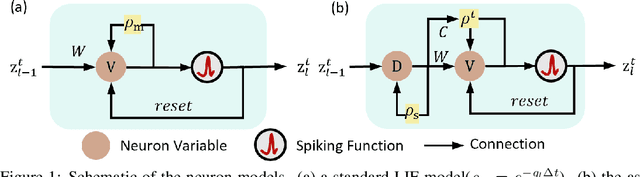
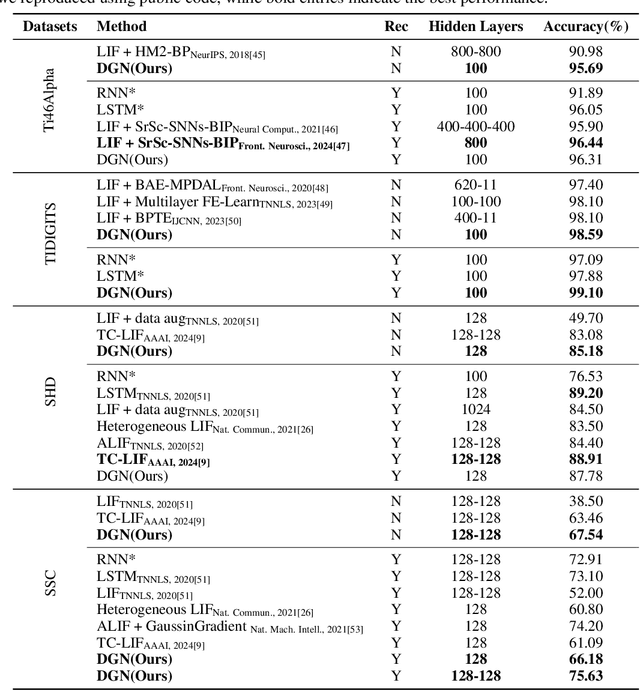
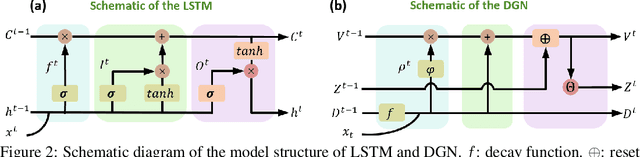
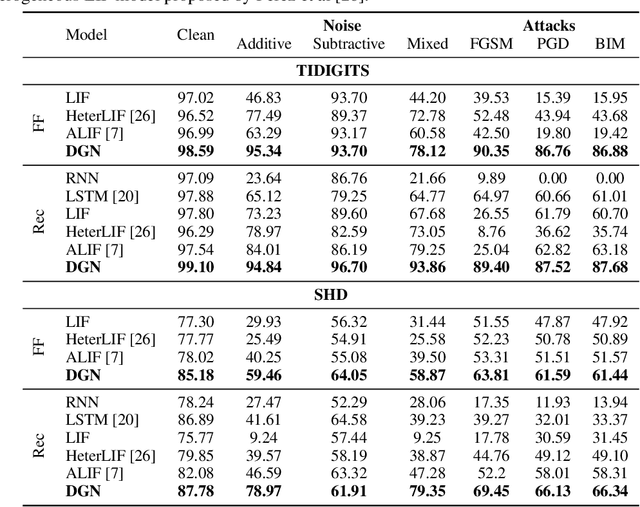
While spiking neural networks (SNNs) provide a biologically inspired and energy-efficient computational framework, their robustness and the dynamic advantages inherent to biological neurons remain significantly underutilized owing to oversimplified neuron models. In particular, conventional leaky integrate-and-fire (LIF) neurons often omit the dynamic conductance mechanisms inherent in biological neurons, thereby limiting their capacity to cope with noise and temporal variability. In this work, we revisit dynamic conductance from a functional perspective and uncover its intrinsic role as a biologically plausible gating mechanism that modulates information flow. Building on this insight, we introduce the Dynamic Gated Neuron~(DGN), a novel spiking unit in which membrane conductance evolves in response to neuronal activity, enabling selective input filtering and adaptive noise suppression. We provide a theoretical analysis showing that DGN possess enhanced stochastic stability compared to standard LIF models, with dynamic conductance intriguingly acting as a disturbance rejection mechanism. DGN-based SNNs demonstrate superior performance across extensive evaluations on anti-noise tasks and temporal-related benchmarks such as TIDIGITS and SHD, consistently exhibiting excellent robustness. Our results highlight, for the first time, a biologically plausible dynamic gating as a key mechanism for robust spike-based computation, providing not only theoretical guarantees but also strong empirical validations. This work thus paves the way for more resilient, efficient, and biologically inspired spiking neural networks.
AIGC for Industrial Time Series: From Deep Generative Models to Large Generative Models
Jul 16, 2024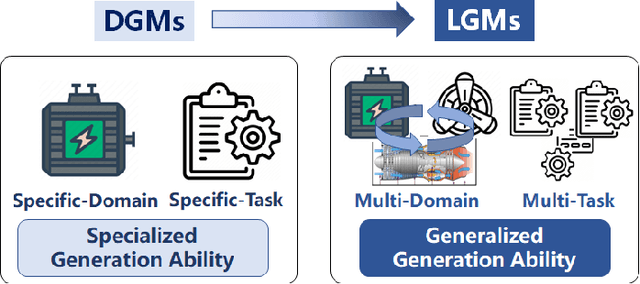
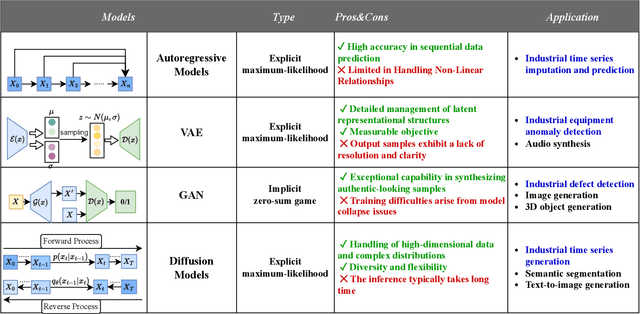
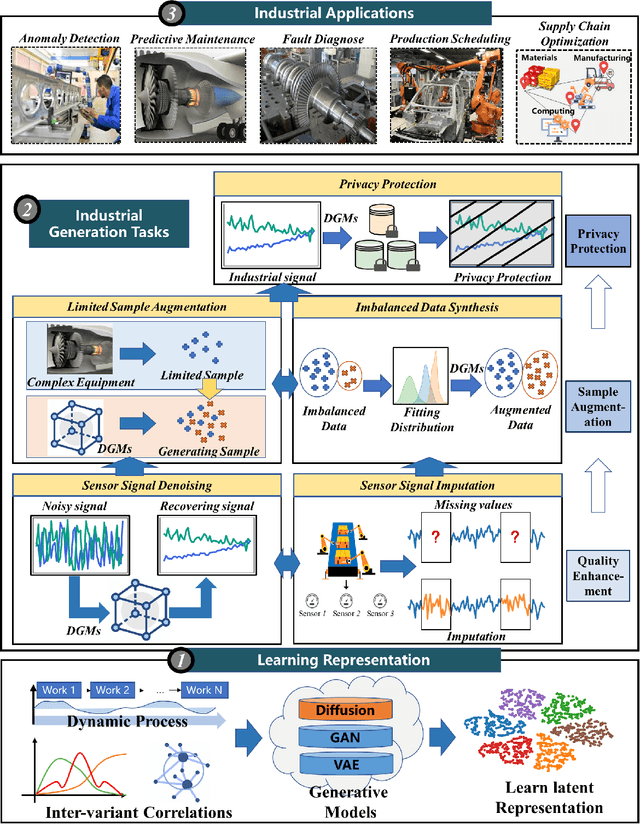
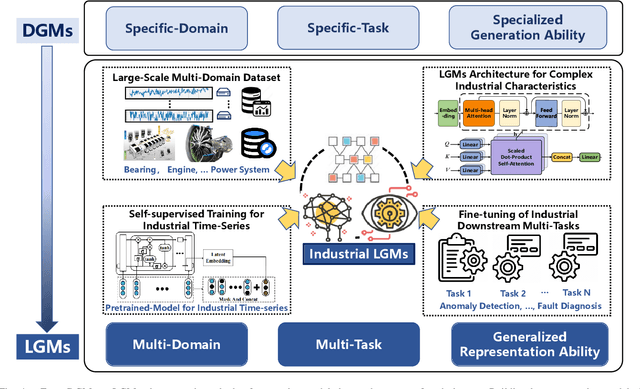
With the remarkable success of generative models like ChatGPT, Artificial Intelligence Generated Content (AIGC) is undergoing explosive development. Not limited to text and images, generative models can generate industrial time series data, addressing challenges such as the difficulty of data collection and data annotation. Due to their outstanding generation ability, they have been widely used in Internet of Things, metaverse, and cyber-physical-social systems to enhance the efficiency of industrial production. In this paper, we present a comprehensive overview of generative models for industrial time series from deep generative models (DGMs) to large generative models (LGMs). First, a DGM-based AIGC framework is proposed for industrial time series generation. Within this framework, we survey advanced industrial DGMs and present a multi-perspective categorization. Furthermore, we systematically analyze the critical technologies required to construct industrial LGMs from four aspects: large-scale industrial dataset, LGMs architecture for complex industrial characteristics, self-supervised training for industrial time series, and fine-tuning of industrial downstream tasks. Finally, we conclude the challenges and future directions to enable the development of generative models in industry.
Diff-MTS: Temporal-Augmented Conditional Diffusion-based AIGC for Industrial Time Series Towards the Large Model Era
Jul 16, 2024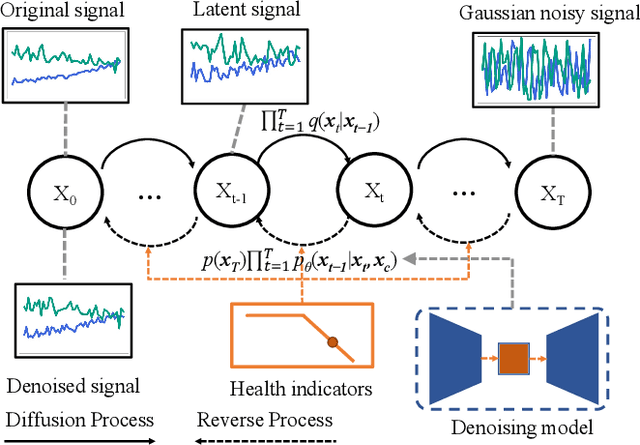
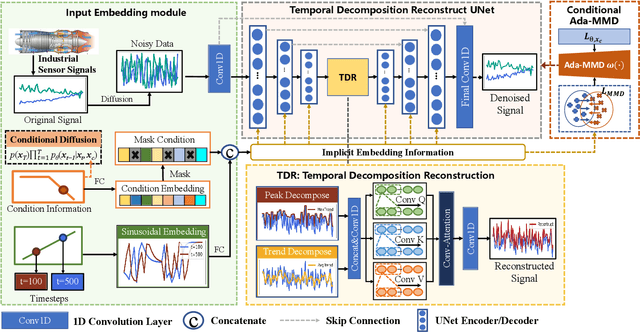
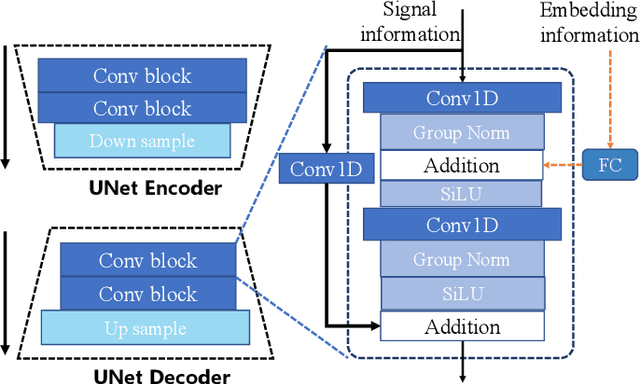
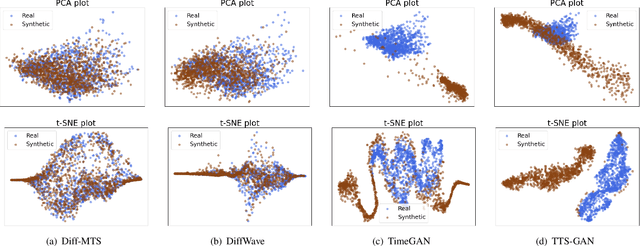
Industrial Multivariate Time Series (MTS) is a critical view of the industrial field for people to understand the state of machines. However, due to data collection difficulty and privacy concerns, available data for building industrial intelligence and industrial large models is far from sufficient. Therefore, industrial time series data generation is of great importance. Existing research usually applies Generative Adversarial Networks (GANs) to generate MTS. However, GANs suffer from unstable training process due to the joint training of the generator and discriminator. This paper proposes a temporal-augmented conditional adaptive diffusion model, termed Diff-MTS, for MTS generation. It aims to better handle the complex temporal dependencies and dynamics of MTS data. Specifically, a conditional Adaptive Maximum-Mean Discrepancy (Ada-MMD) method has been proposed for the controlled generation of MTS, which does not require a classifier to control the generation. It improves the condition consistency of the diffusion model. Moreover, a Temporal Decomposition Reconstruction UNet (TDR-UNet) is established to capture complex temporal patterns and further improve the quality of the synthetic time series. Comprehensive experiments on the C-MAPSS and FEMTO datasets demonstrate that the proposed Diff-MTS performs substantially better in terms of diversity, fidelity, and utility compared with GAN-based methods. These results show that Diff-MTS facilitates the generation of industrial data, contributing to intelligent maintenance and the construction of industrial large models.
Universal Sleep Decoder: Aligning awake and sleep neural representation across subjects
Sep 28, 2023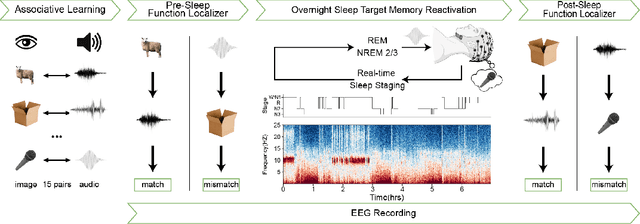
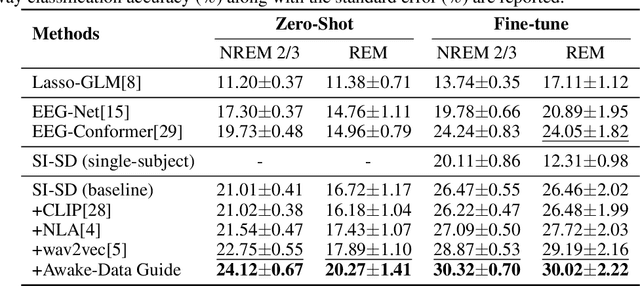
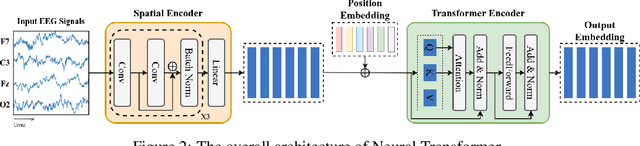

Decoding memory content from brain activity during sleep has long been a goal in neuroscience. While spontaneous reactivation of memories during sleep in rodents is known to support memory consolidation and offline learning, capturing memory replay in humans is challenging due to the absence of well-annotated sleep datasets and the substantial differences in neural patterns between wakefulness and sleep. To address these challenges, we designed a novel cognitive neuroscience experiment and collected a comprehensive, well-annotated electroencephalography (EEG) dataset from 52 subjects during both wakefulness and sleep. Leveraging this benchmark dataset, we developed the Universal Sleep Decoder (USD) to align neural representations between wakefulness and sleep across subjects. Our model achieves up to 16.6% top-1 zero-shot accuracy on unseen subjects, comparable to decoding performances using individual sleep data. Furthermore, fine-tuning USD on test subjects enhances decoding accuracy to 25.9% top-1 accuracy, a substantial improvement over the baseline chance of 6.7%. Model comparison and ablation analyses reveal that our design choices, including the use of (i) an additional contrastive objective to integrate awake and sleep neural signals and (ii) the pretrain-finetune paradigm to incorporate different subjects, significantly contribute to these performances. Collectively, our findings and methodologies represent a significant advancement in the field of sleep decoding.