 Add to Chrome
 Add to Firefox
 Add to Edge
Code Review Agent Benchmark
Mar 24, 2026
Software engineering agents have shown significant promise in writing code. As AI agents permeate code writing, and generate huge volumes of code automatically -- the matter of code quality comes front and centre. As the automatically generated code gets integrated into huge code-bases -- the issue of code review and broadly quality assurance becomes important. In this paper, we take a fresh look at the problem and curate a code review dataset for AI agents to work with. Our dataset called c-CRAB (pronounced see-crab) can evaluate agents for code review tasks. Specifically given a pull-request (which could be coming from code generation agents or humans), if a code review agent produces a review, our evaluation framework can asses the reviewing capability of the code review agents. Our evaluation framework is used to evaluate the state of the art today -- the open-source PR-agent, as well as commercial code review agents from Devin, Claude Code, and Codex. Our c-CRAB dataset is systematically constructed from human reviews -- given a human review of a pull request instance we generate corresponding tests to evaluate the code review agent generated reviews. Such a benchmark construction gives us several insights. Firstly, the existing review agents taken together can solve only around 40% of the c-CRAB tasks, indicating the potential to close this gap by future research. Secondly, we observe that the agent reviews often consider different aspects from the human reviews -- indicating the potential for human-agent collaboration for code review that could be deployed in future software teams. Last but not the least, the agent generated tests from our data-set act as a held out test-suite and hence quality gate for agent generated reviews. What this will mean for future collaboration of code generation agents, test generation agents and code review agents -- remains to be investigated.

SpecRover: Code Intent Extraction via LLMs
Aug 07, 2024

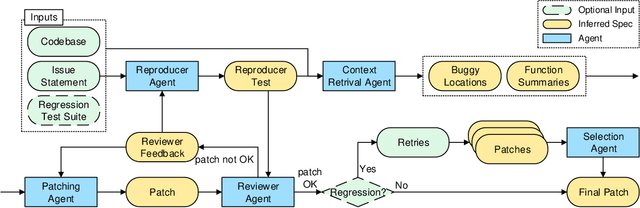

Autonomous program improvement typically involves automatically producing bug fixes and feature additions. Such program improvement can be accomplished by a combination of large language model (LLM) and program analysis capabilities, in the form of an LLM agent. Since program repair or program improvement typically requires a specification of intended behavior - specification inference can be useful for producing high quality program patches. In this work, we examine efficient and low-cost workflows for iterative specification inference within an LLM agent. Given a GitHub issue to be resolved in a software project, our goal is to conduct iterative code search accompanied by specification inference - thereby inferring intent from both the project structure and behavior. The intent thus captured is examined by a reviewer agent with the goal of vetting the patches as well as providing a measure of confidence in the vetted patches. Our approach SpecRover (AutoCodeRover-v2) is built on the open-source LLM agent AutoCodeRover. In an evaluation on the full SWE-Bench consisting of 2294 GitHub issues, it shows more than 50% improvement in efficacy over AutoCodeRover. Compared to the open-source agents available, our work shows modest cost ($0.65 per issue) in resolving an average GitHub issue in SWE-Bench lite. The production of explanation by SpecRover allows for a better "signal" to be given to the developer, on when the suggested patches can be accepted with confidence. SpecRover also seeks to demonstrate the continued importance of specification inference in automated program repair, even as program repair technologies enter the LLM era.
AutoCodeRover: Autonomous Program Improvement
Apr 15, 2024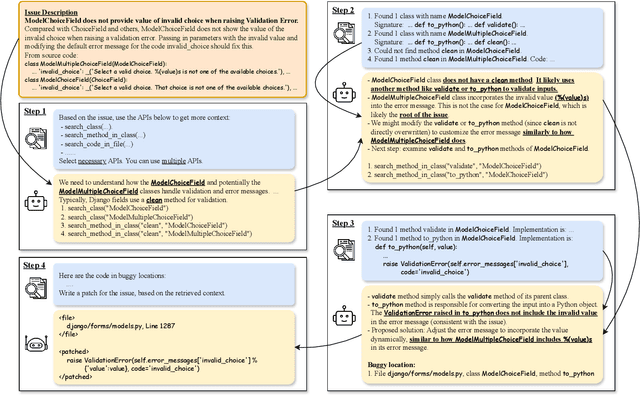


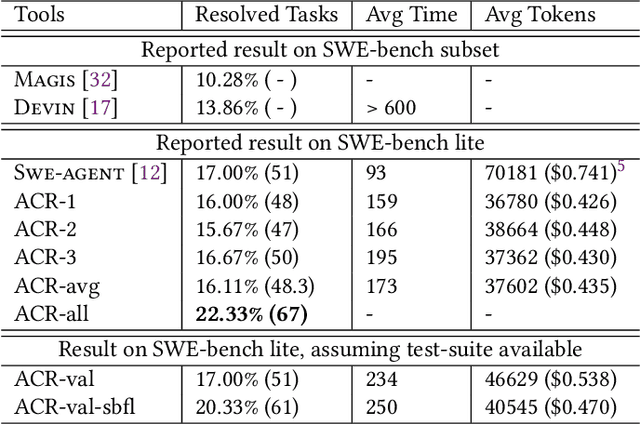
Researchers have made significant progress in automating the software development process in the past decades. Recent progress in Large Language Models (LLMs) has significantly impacted the development process, where developers can use LLM-based programming assistants to achieve automated coding. Nevertheless software engineering involves the process of program improvement apart from coding, specifically to enable software maintenance (e.g. bug fixing) and software evolution (e.g. feature additions). In this paper, we propose an automated approach for solving GitHub issues to autonomously achieve program improvement. In our approach called AutoCodeRover, LLMs are combined with sophisticated code search capabilities, ultimately leading to a program modification or patch. In contrast to recent LLM agent approaches from AI researchers and practitioners, our outlook is more software engineering oriented. We work on a program representation (abstract syntax tree) as opposed to viewing a software project as a mere collection of files. Our code search exploits the program structure in the form of classes/methods to enhance LLM's understanding of the issue's root cause, and effectively retrieve a context via iterative search. The use of spectrum based fault localization using tests, further sharpens the context, as long as a test-suite is available. Experiments on SWE-bench-lite which consists of 300 real-life GitHub issues show increased efficacy in solving GitHub issues (22-23% on SWE-bench-lite). On the full SWE-bench consisting of 2294 GitHub issues, AutoCodeRover solved around 16% of issues, which is higher than the efficacy of the recently reported AI software engineer Devin from Cognition Labs, while taking time comparable to Devin. We posit that our workflow enables autonomous software engineering, where, in future, auto-generated code from LLMs can be autonomously improved.