 Add to Chrome
 Add to Firefox
 Add to Edge
Phase Uniformity Detector for GRSMReceivers in mmWave and Sub-THz Bands
Jun 22, 2026
This paper introduces a phase-domain statistical detector, the Phase Uniformity Detector (PUD), for binary hypothesis testing in Generalized Receive Spatial Modulation (GRSM) systems. The PUD uses direct RF sampling to obtain received signal samples, their phases are modeled via Directional Statistics (DS). A Generalized Likelihood Ratio Test (GLRT) is derived and reduced to a Rayleigh uniformity test with a closed-form, noise-variance-independent threshold. Unlike conventional Energy Detection (ED), the PUD offers robust spatial detection under Independent Local Oscillator Phase Noise (ILO-PN), remaining insensitive to energy fluctuations and noise uncertainty. Additionally, a phase-coherence-aware combining scheme mitigates ILO-PN without requiring estimation.

Exploiting Spatial Modulation for Strong PhaseNoise Mitigation in mmWave Massive MIMO
Mar 11, 2026This letter investigates phase noise (PN) mitigation in generalized receiver spatial modulation (GRSM) massive MIMO systems at mmWave under a common local oscillator (CLO). Under CLO, the received energy remains invariant relative to the no-PN scenario, enabling reliable energy-based spatial detection using the no-PN threshold. PN-sensitivity and geometry-based metrics are introduced to design compact, PN-resilient MQAM symbol pools with low detection complexity. PN robustness is further improved through an enhanced PN-aware GRSM-MQAM system that exploits spatial modulation (SM) to recover part of the MQAM bits and strategically maps spatial-pattern Hamming weights to reduce the effective PN impact. In addition, a practical single-stage PN estimation/compensation architecture is proposed, while a benchmark double-stage compensation is adopted to quantify the upper bound achievable via separate Tx/Rx PN mitigation. Results show that under PN, the overall BER is mainly dominated by MQAM symbol detection errors, especially for denser constellations, whereas spatial detection remains robust. The proposed single-stage compensation improves PN resilience, while the benchmark double-stage compensation approaches near PN-free performance.
Lightweight Learning for Grant-Free Activity Detection in Cell-Free Massive MIMO Networks
Mar 14, 2025Grant-free random access (GF-RA) is a promising access technique for massive machine-type communications (mMTC) in future wireless networks, particularly in the context of 5G and beyond (6G) systems. Within the context of GF-RA, this study investigates the efficiency of employing supervised machine learning techniques to tackle the challenges on the device activity detection (AD). GF-RA addresses scalability by employing non-orthogonal pilot sequences, which provides an efficient alternative comparing to conventional grant-based random access (GB-RA) technique that are constrained by the scarcity of orthogonal preamble resources. In this paper, we propose a novel lightweight data-driven algorithmic framework specifically designed for activity detection in GF-RA for mMTC in cell-free massive multiple-input multiple-output (CF-mMIMO) networks. We propose two distinct framework deployment strategies, centralized and decentralized, both tailored to streamline the proposed approach implementation across network infrastructures. Moreover, we introduce optimized post-detection methodologies complemented by a clustering stage to enhance overall detection performances. Our 3GPP-compliant simulations have validated that the proposed algorithm achieves state-of-the-art model-based activity detection accuracy while significantly reducing complexity. Achieving 99% accuracy, it demonstrates real-world viability and effectiveness.
Robust Learning-Based Sparse Recovery for Device Activity Detection in Grant-Free Random Access Cell-Free Massive MIMO: Enhancing Resilience to Impairments
Mar 13, 2025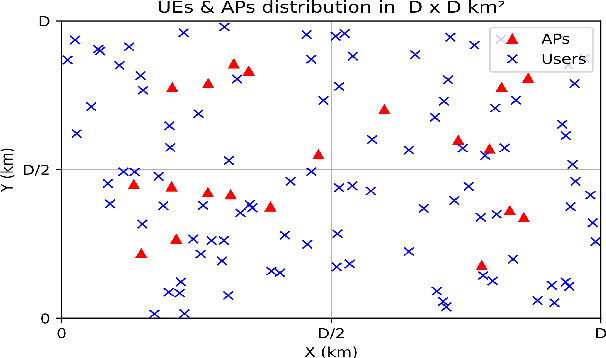
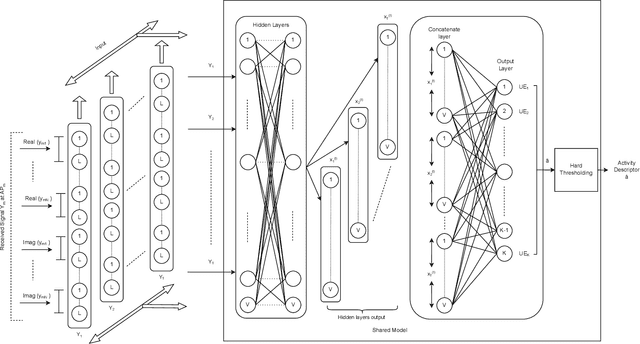
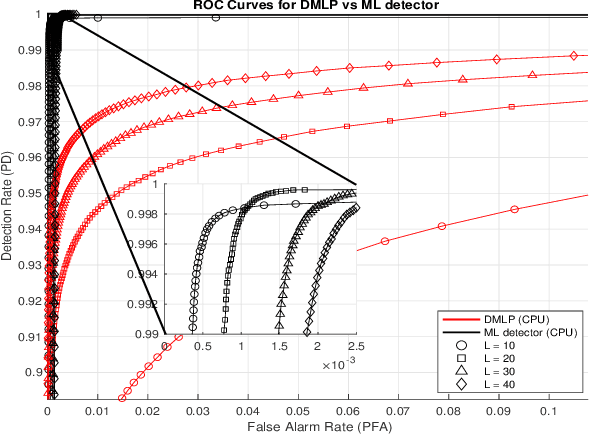
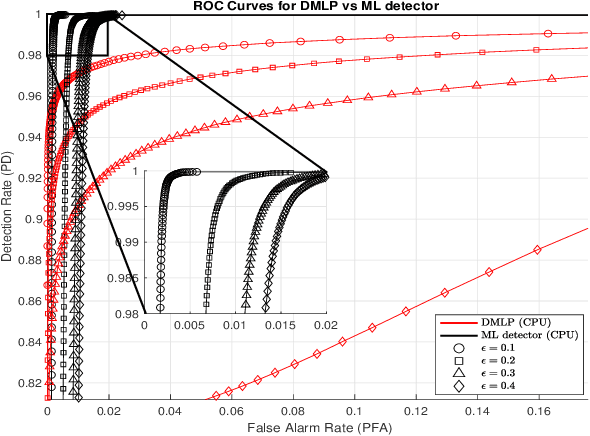
Massive MIMO is considered a key enabler to support massive machine-type communication (mMTC). While massive access schemes have been extensively analyzed for co-located massive MIMO arrays, this paper explores activity detection in grant-free random access for mMTC within the context of cell-free massive MIMO systems, employing distributed antenna arrays. This sparse support recovery of device activity status is performed by a finite cluster of access points (APs) from a large number of geographically distributed APs collaborating to serve a larger number of devices. Active devices transmit non-orthogonal pilot sequences to APs, which forward the received signals to a central processing unit (CPU) for collaborative activity detection. This paper proposes a simple and efficient data-driven algorithm tailored for device activity detection, implemented centrally at the CPU. Furthermore, the study assesses the algorithm's robustness to input perturbations and examines the effects of adopting fixed-point representation on its performance.