 Add to Chrome
 Add to Firefox
 Add to Edge
RSLoRA: Training-free Rank Allocation for LoRA via Representational Sensitivity Probing
Jul 05, 2026
Low-Rank Adaptation (LoRA) has become a cornerstone of parameter-efficient fine-tuning (PEFT); however, the conventional practice of uniform rank assignment ignores the functional heterogeneity of neural layers. Existing rank allocation methods typically struggle with a trade-off between computational intensity and heuristic simplicity: training-based methods suffer from prohibitive overhead, while pre-allocation methods fail to capture the dynamic task-specific representation manifold. In this paper, we propose RSLoRA (Representational Sensitivity LoRA), a training-free and gradient-free rank allocator driven by activation-space geometry. We identify a "sensitivity regime shift" across layers, observing that static weight analysis and local gradients are insufficient to reflect how updates reshape a model's internal representations. To address this, RSLoRA introduces a virtual representational probing mechanism. By simulating adaptation through structured low-rank noise and measuring the resulting manifold displacement by using Effective Rank and Frechet Distance, we identify high-sensitivity modules that require higher rank capacity. Our framework effectively bridges the gap between expert-crafted heuristics and actual representational impact. Extensive evaluations demonstrate that RSLoRA consistently outperforms state-of-the-art allocators (e.g., AdaLoRA, GoRA) across mainstream benchmarks. By eliminating the need for iterative training-time adjustments and backward gradients, RSLoRA provides a highly efficient, robust, and representation-aware solution for large-scale model adaptation.

Unlocking the Potential of Continual Model Merging: An ODE Perspective
May 20, 2026Continual Model Merging (CMM) enables rapid customization of foundation models across sequentially arriving tasks, offering a scalable alternative to repeated retraining. However, existing merging rules lack explicit controllability over the allocation of learning capacity between previously learned capabilities and newly merged models. Consequently, as tasks are merged sequentially, this deficiency accumulates into severe forgetting, particularly in scenarios with heterogeneous task importance, where performance allocation becomes highly inconsistent. The key reason can be attributed to the fact that previous methods treat each task model as an isolated parameter point and apply fixed algebraic combinations, rather than explicitly constructing a transition that respects how independently trained models can be connected in parameter space. Motivated by mode connectivity, we assume that desirable merged models lie on low loss connecting paths, and that continual merging should follow such paths without crossing loss barriers that induce forgetting. Grounded in these insights, we propose a novel ODE-driven Merging (ODE-M) tailored for CMM that traces such a path by integrating a time-dependent velocity field and enforcing barrier constraints to prevent loss-increasing steps. Extensive experiments demonstrate that ODE-M achieves state-of-the-art performance compared to its competitors across mainstream CMM benchmarks.
Revolutionizing Mixed Precision Quantization: Towards Training-free Automatic Proxy Discovery via Large Language Models
Dec 08, 2025Mixed-Precision Quantization (MPQ) liberates the Deep Neural Networks (DNNs) from the Out-Of-Memory (OOM) bottleneck, which garnered increasing research attention. However, conventional methods either searched from costly differentiable optimization, which is neither efficient nor flexible, or learned a quantized DNN from the proxy (i.e., HAWQ) manually designed by human experts, which is labor-intensive and requires huge expert knowledge. Can we design a proxy without involving any human experts and training? In this paper, we provide an affirmative answer by proposing a novel Large Language Models (LLMs)-driven Training-free Automatic Proxy (dubbed TAP) discovery framework, which reforms the design paradigm of MPQ by utilizing LLMs to find superior TAP tailored for MPQ, automatically. In addition, to bridge the gap between black-box LLMs and the tough MPQ task, we ingeniously propose simple Direct Policy Optimization (DPO) based reinforcement learning to enhance LLMs' reasoning by optimizing prompts, which can construct a positive feedback loop between the LLM and the MPQ task, enabling LLMs to generate better TAP in the next evolution. Extensive experiments on mainstream benchmarks demonstrate that TAP achieves state-of-the-art performance. Finally, we truly believe that our TAP will significantly contribute to the MPQ community by providing a new perspective on LLM-driven design algorithms.
Breaking Expert Knowledge Limits: Self-Pruning for Large Language Models
Nov 19, 2025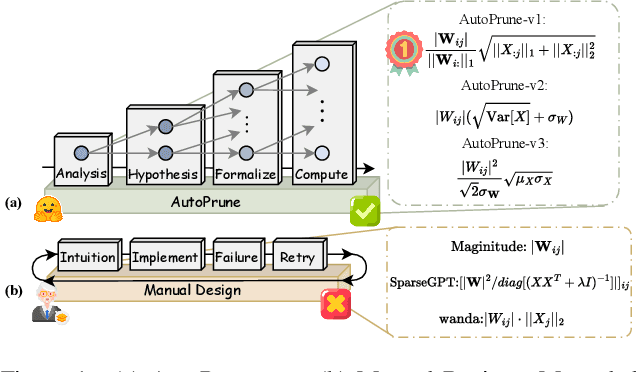
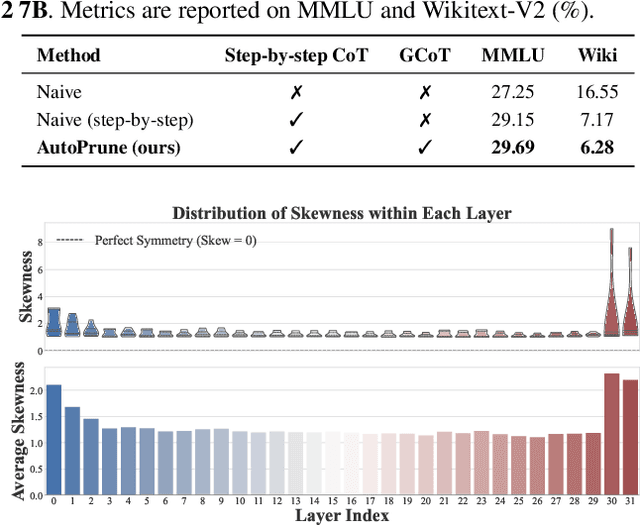
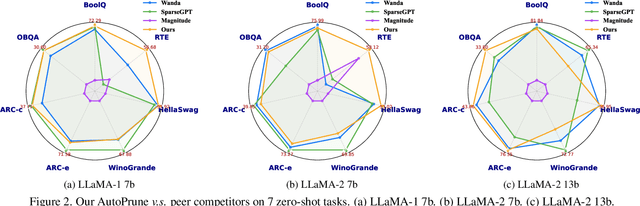

Large language models (LLMs) have achieved remarkable performance on a wide range of tasks, hindering real-world deployment due to their massive size. Existing pruning methods (e.g., Wanda) tailored for LLMs rely heavily on manual design pruning algorithms, thereby leading to \textit{huge labor costs} and \textit{requires expert knowledge}. Furthermore, we are the first to identify the serious \textit{outlier value issue} behind dramatic performance degradation under high pruning ratios that are caused by uniform sparsity, raising an additional concern about how to design adaptive pruning sparsity ideal for LLMs. Can LLMs prune by themselves? In this work, we introduce an affirmative answer by proposing a novel pruning method called \textbf{AutoPrune}, which first overcomes expert knowledge limits by leveraging LLMs to design optimal pruning algorithms for themselves automatically without any expert knowledge. Specifically, to mitigate the black-box nature of LLMs, we propose a Graph-driven Chain-of-Thought (GCoT) to optimize prompts, significantly enhancing the reasoning process in learning the pruning algorithm and enabling us to generate pruning algorithms with superior performance and interpretability in the next generation. Finally, grounded in insights of outlier value issue, we introduce Skew-aware Dynamic Sparsity Allocation (SDSA) to overcome the outlier value issue, mitigating performance degradation under high pruning ratios. We conduct extensive experiments on mainstream LLMs benchmarks, demonstrating the superiority of AutoPrune, which consistently excels state-of-the-art competitors. The code is available at: https://anonymous.4open.science/r/AutoPrune.