 Add to Chrome
 Add to Firefox
 Add to Edge
UniRef-UAV: A Multimodal Benchmark for Universal Referring in UAV Imagery
Jul 09, 2026
Unmanned aerial vehicles (UAVs) increasingly rely on visual grounding capabilities to localize task-relevant targets from diverse instructions in complex aerial scenes. Existing referring expression comprehension (REC) benchmarks and methods, however, are largely built around text-only queries and single-object outputs, which limits their applicability to practical UAV scenarios involving reference images, multimodal instructions, absent targets, and multiple valid target instances. To address this gap, we introduce \emph{Universal Referring}, a generalized UAV referring task that jointly expands the query modality and the output cardinality. We construct \emph{UniRef-UAV}, a multimodal benchmark that supports text-only, image-only, and text+image queries with modality-dependent target cardinality, where text-only and text+image queries admit no-target, single-target, and multi-target grounding while image-only queries focus on existence-aware single-instance grounding. It also provides in-domain and cross-domain evaluation protocols for visual-query generalization. We further present \emph{UAV-URNet}, a detection-style baseline that maps heterogeneous queries into a shared query space and predicts variable-size target sets through set prediction. Extensive experiments show that UAV-URNet provides a stable and reproducible baseline with more consistent no-target discrimination and a more lightweight, reproducible implementation than large general-purpose MLLMs. Additional domain analysis, query-representation analysis, and ablation studies demonstrate that multimodal queries help reduce visual-query ambiguity and promote a more unified query--target alignment space. The annotations, visual query crops/images, train/validation/test splits, evaluation scripts, and baseline code will be made publicly available to facilitate reproducible research.

Few-Cost Salient Object Detection with Adversarial-Paced Learning
Apr 05, 2021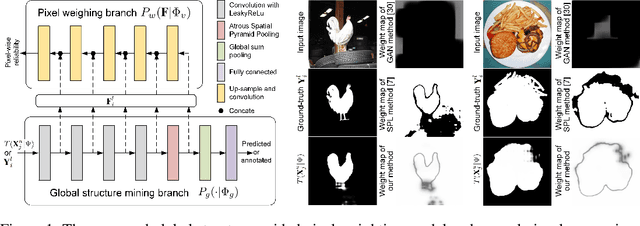
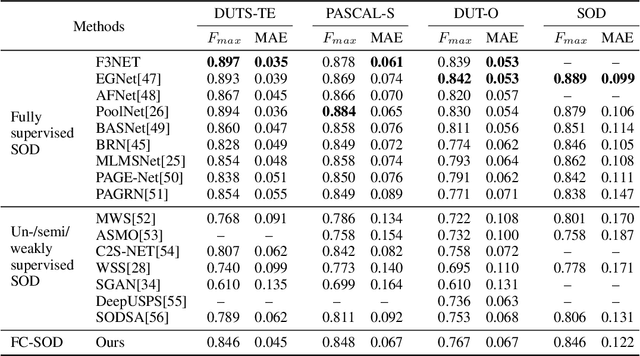
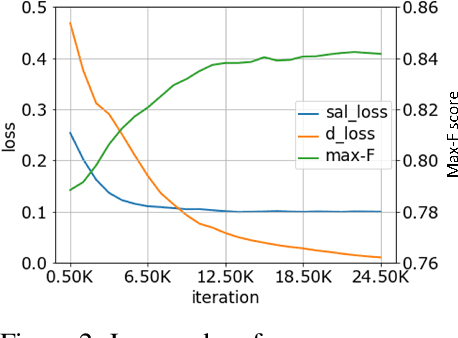
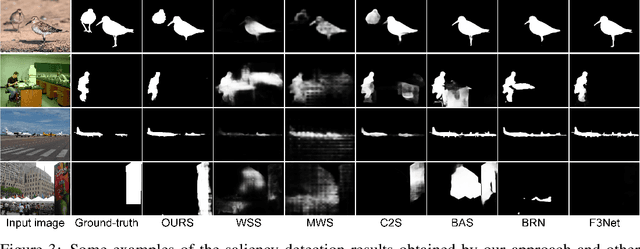
Detecting and segmenting salient objects from given image scenes has received great attention in recent years. A fundamental challenge in training the existing deep saliency detection models is the requirement of large amounts of annotated data. While gathering large quantities of training data becomes cheap and easy, annotating the data is an expensive process in terms of time, labor and human expertise. To address this problem, this paper proposes to learn the effective salient object detection model based on the manual annotation on a few training images only, thus dramatically alleviating human labor in training models. To this end, we name this task as the few-cost salient object detection and propose an adversarial-paced learning (APL)-based framework to facilitate the few-cost learning scenario. Essentially, APL is derived from the self-paced learning (SPL) regime but it infers the robust learning pace through the data-driven adversarial learning mechanism rather than the heuristic design of the learning regularizer. Comprehensive experiments on four widely-used benchmark datasets demonstrate that the proposed method can effectively approach to the existing supervised deep salient object detection models with only 1k human-annotated training images. The project page is available at https://github.com/hb-stone/FC-SOD.
Densely Nested Top-Down Flows for Salient Object Detection
Feb 18, 2021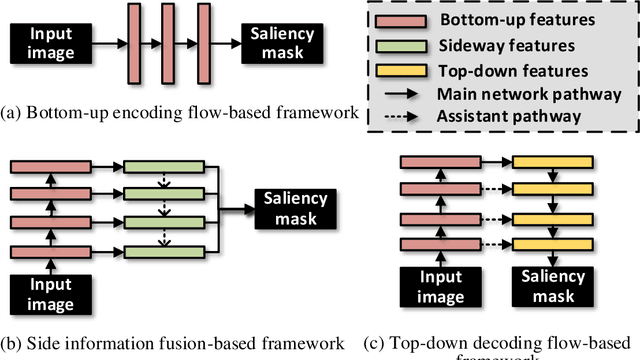
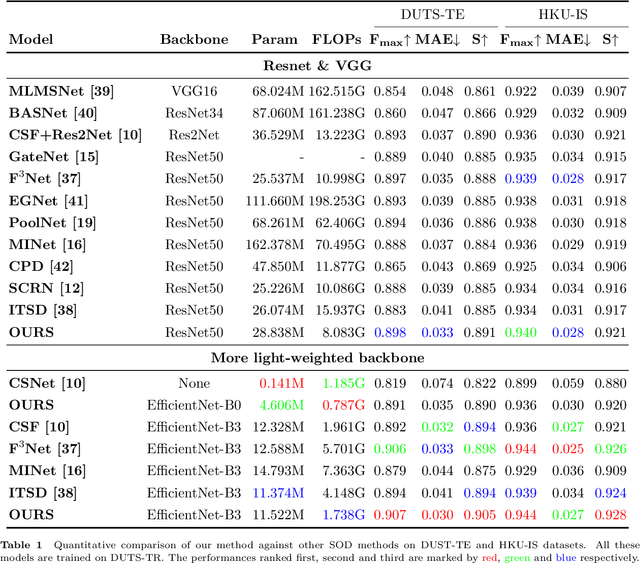
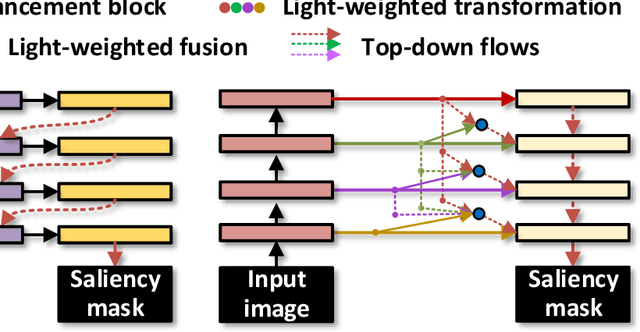
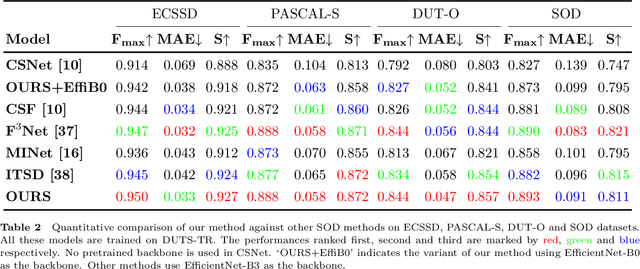
With the goal of identifying pixel-wise salient object regions from each input image, salient object detection (SOD) has been receiving great attention in recent years. One kind of mainstream SOD methods is formed by a bottom-up feature encoding procedure and a top-down information decoding procedure. While numerous approaches have explored the bottom-up feature extraction for this task, the design on top-down flows still remains under-studied. To this end, this paper revisits the role of top-down modeling in salient object detection and designs a novel densely nested top-down flows (DNTDF)-based framework. In every stage of DNTDF, features from higher levels are read in via the progressive compression shortcut paths (PCSP). The notable characteristics of our proposed method are as follows. 1) The propagation of high-level features which usually have relatively strong semantic information is enhanced in the decoding procedure; 2) With the help of PCSP, the gradient vanishing issues caused by non-linear operations in top-down information flows can be alleviated; 3) Thanks to the full exploration of high-level features, the decoding process of our method is relatively memory efficient compared against those of existing methods. Integrating DNTDF with EfficientNet, we construct a highly light-weighted SOD model, with very low computational complexity. To demonstrate the effectiveness of the proposed model, comprehensive experiments are conducted on six widely-used benchmark datasets. The comparisons to the most state-of-the-art methods as well as the carefully-designed baseline models verify our insights on the top-down flow modeling for SOD. The code of this paper is available at https://github.com/new-stone-object/DNTD.