 Add to Chrome
 Add to Firefox
 Add to Edge
Detecting Brick Kiln Infrastructure at Scale: Graph, Foundation, and Remote Sensing Models for Satellite Imagery Data
Feb 12, 2026
Brick kilns are a major source of air pollution and forced labor in South Asia, yet large-scale monitoring remains limited by sparse and outdated ground data. We study brick kiln detection at scale using high-resolution satellite imagery and curate a multi city zoom-20 (0.149 meters per pixel) resolution dataset comprising over 1.3 million image tiles across five regions in South and Central Asia. We propose ClimateGraph, a region-adaptive graph-based model that captures spatial and directional structure in kiln layouts, and evaluate it against established graph learning baselines. In parallel, we assess a remote sensing based detection pipeline and benchmark it against recent foundation models for satellite imagery. Our results highlight complementary strengths across graph, foundation, and remote sensing approaches, providing practical guidance for scalable brick kiln monitoring from satellite imagery.

Data-Driven Approach to assess and identify gaps in healthcare set up in South Asia
Sep 21, 2024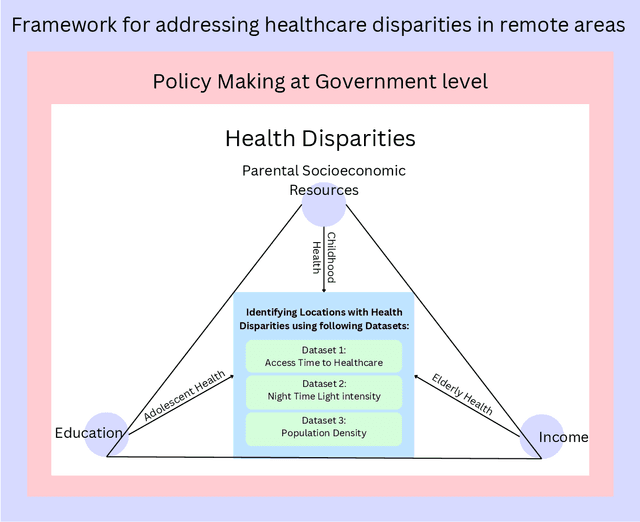
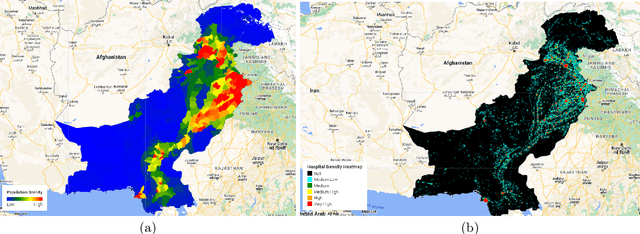
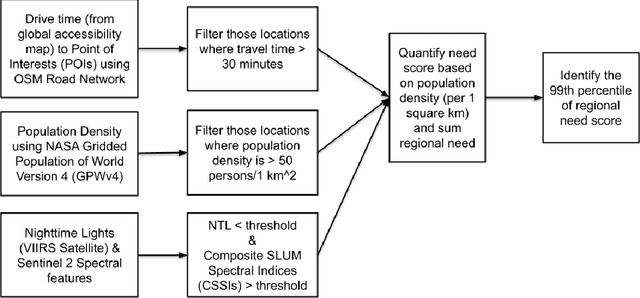
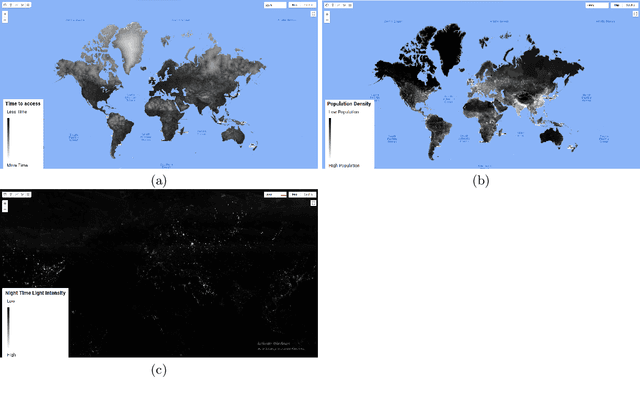
Primary healthcare is a crucial strategy for achieving universal health coverage. South Asian countries are working to improve their primary healthcare system through their country specific policies designed in line with WHO health system framework using the six thematic pillars: Health Financing, Health Service delivery, Human Resource for Health, Health Information Systems, Governance, Essential Medicines and Technology, and an addition area of Cross-Sectoral Linkages. Measuring the current accessibility of healthcare facilities and workforce availability is essential for improving healthcare standards and achieving universal health coverage in developing countries. Data-driven surveillance approaches are required that can provide rapid, reliable, and geographically scalable solutions to understand a) which communities and areas are most at risk of inequitable access and when, b) what barriers to health access exist, and c) how they can be overcome in ways tailored to the specific challenges faced by individual communities. We propose to harness current breakthroughs in Earth-observation (EO) technology, which provide the ability to generate accurate, up-to-date, publicly accessible, and reliable data, which is necessary for equitable access planning and resource allocation to ensure that vaccines, and other interventions reach everyone, particularly those in greatest need, during normal and crisis times. This requires collaboration among countries to identify evidence based solutions to shape health policy and interventions, and drive innovations and research in the region.