 Add to Chrome
 Add to Firefox
 Add to Edge
Heterogeneity-Aware Belief Synchronization for Semantic Communication in AI-Native 6G Networks
Aug 13, 2026
6G networks will not be serving as communication infrastructures only; rather, they are expected to evolve into intelligent systems, where thousands of autonomous artificial intelligence (AI) agents are interconnected. The agents are deployed across a wide range of platforms including low Earth orbit (LEO) satellites, high-altitude platforms (HAPs), unmanned aerial vehicles (UAVs), edge servers, and terrestrial devices. These agents continuously observe their environment and exchange information. Semantic communication provides an efficient mechanism for exchanging meaningful information instead of raw data. However, its effectiveness depends on the communicating agents having sufficiently aligned beliefs to correctly interpret and decode the transmitted messages. This assumption becomes difficult to satisfy in the 6G network where heterogeneous AI models operate under diverse computational constraints and continuously acquire different knowledge from their local environments. This article presents a heterogeneity-aware belief synchronization framework for 6G AI-native networks. It uses latent translation models deployed on multi-access edge computing (MEC) servers. These models translate belief updates from one agent to agent-specific knowledge without requiring joint training and a homogeneous architecture of models. By exchanging compact belief updates through a latent translation model only when necessary, the framework preserves privacy, reduces synchronization cost, and minimizes local knowledge drift. We validate the framework through a case study on a multi-layered terrestrial/non-terrestrial network. Results demonstrate that it maintains low synchronization cost, measured by the number of parameters transmitted, and low belief alignment error across the heterogeneous agents in the case study.

Multiconnectivity for SAGIN: Current Trends, Challenges, AI-driven Solutions, and Opportunities
Dec 25, 2025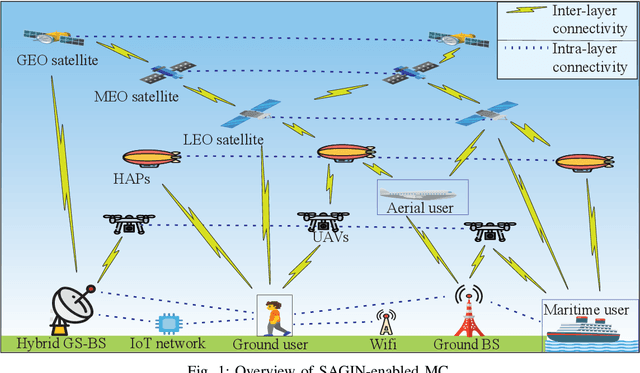
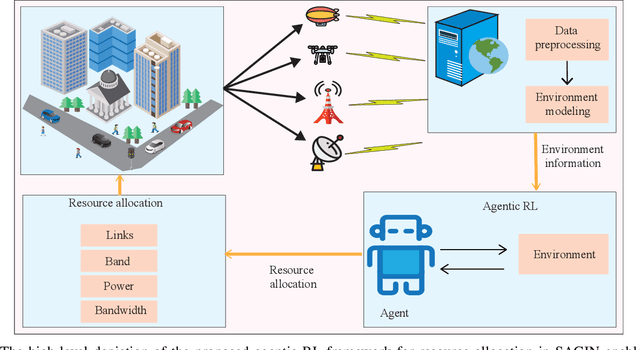
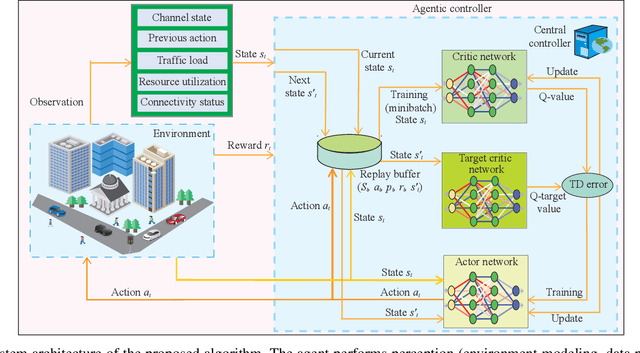
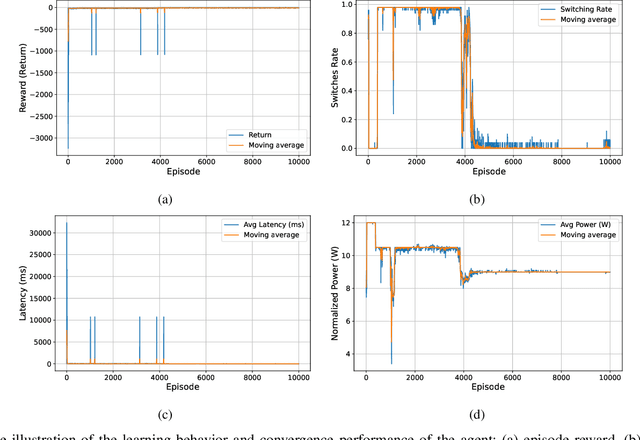
Space-air-ground-integrated network (SAGIN)-enabled multiconnectivity (MC) is emerging as a key enabler for next-generation networks, enabling users to simultaneously utilize multiple links across multi-layer non-terrestrial networks (NTN) and multi-radio access technology (multi-RAT) terrestrial networks (TN). However, the heterogeneity of TN and NTN introduces complex architectural challenges that complicate MC implementation. Specifically, the diversity of link types, spanning air-to-air, air-to-space, space-to-space, space-to-ground, and ground-to-ground communications, renders optimal resource allocation highly complex. Recent advancements in reinforcement learning (RL) and agentic artificial intelligence (AI) have shown remarkable effectiveness in optimal decision-making in complex and dynamic environments. In this paper, we review the current developments in SAGIN-enabled MC and outline the key challenges associated with its implementation. We further highlight the transformative potential of AI-driven approaches for resource optimization in a heterogeneous SAGIN environment. To this end, we present a case study on resource allocation optimization enabled by agentic RL for SAGIN-enabled MC involving diverse radio access technologies (RATs). Results show that learning-based methods can effectively handle complex scenarios and substantially enhance network performance in terms of latency and capacity while incurring a moderate increase in power consumption as an acceptable tradeoff. Finally, open research problems and future directions are presented to realize efficient SAGIN-enabled MC.
STAR-RIS-Assisted Hybrid NOMA mmWave Communication: Optimization and Performance Analysis
May 13, 2022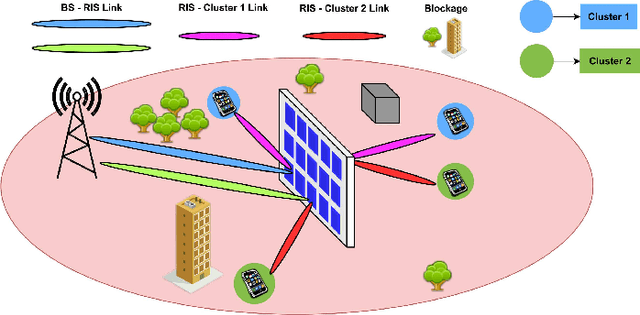
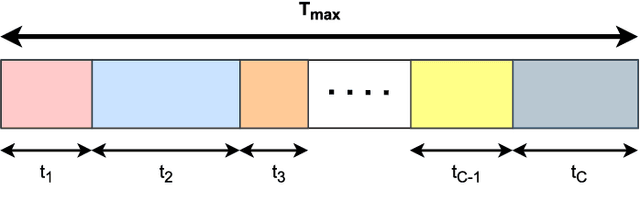
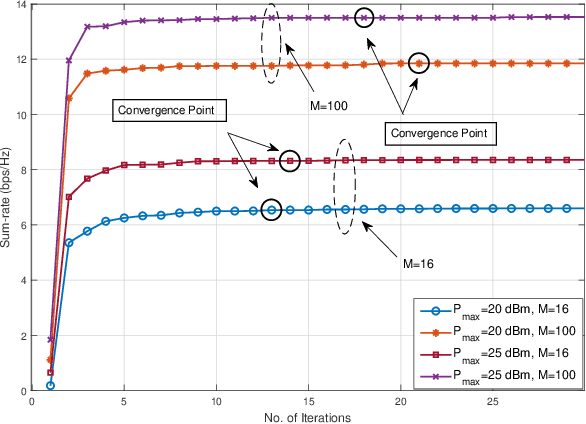
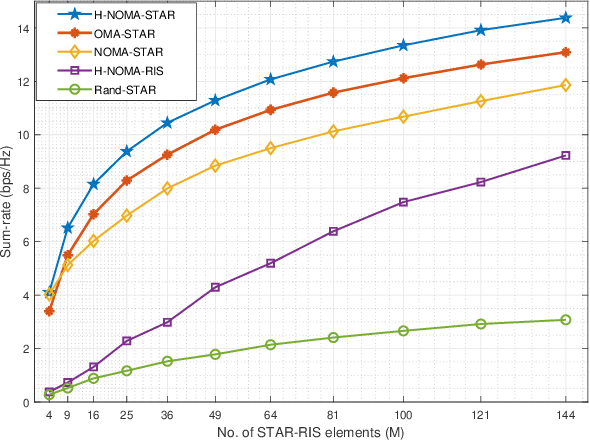
Simultaneously reflecting and transmitting reconfigurable intelligent surfaces (STAR-RIS) has recently emerged as prominent technology that exploits the transmissive property of RIS to mitigate the half-space coverage limitation of conventional RIS operating on millimeter-wave (mmWave). In this paper, we study a downlink STAR-RIS-based multi-user multiple-input single-output (MU-MISO) mmWave hybrid non-orthogonal multiple access (H-NOMA) wireless network, where a sum-rate maximization problem has been formulated. The design of active and passive beamforming vectors, time and power allocation for H-NOMA is a highly coupled non-convex problem. To handle the problem, we propose an optimization framework based on alternating optimization (AO) that iteratively solves active and passive beamforming sub-problems. Channel correlations and channel strength-based techniques have been proposed for a specific case of two-user optimal clustering and decoding order assignment, respectively, for which analytical solutions to joint power and time allocation for H-NOMA have also been derived. Simulation results show that: 1) the proposed framework leveraging H-NOMA outperforms conventional OMA and NOMA to maximize the achievable sum-rate; 2) using the proposed framework, the supported number of clusters for the given design constraints can be increased considerably; 3) through STAR-RIS, the number of elements can be significantly reduced as compared to conventional RIS to ensure a similar quality-of-service (QoS).
Backhaul-Aware Intelligent Positioning of UAVs and Association of Terrestrial Base Stations for Fronthaul Connectivity
May 01, 2021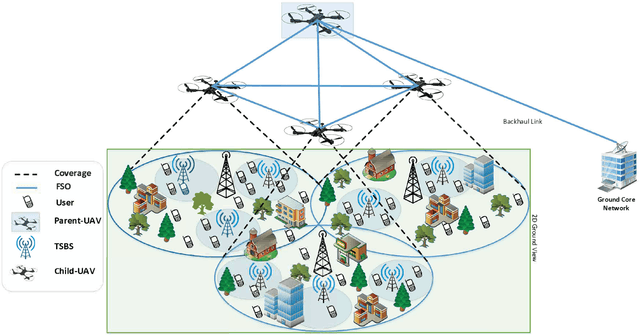
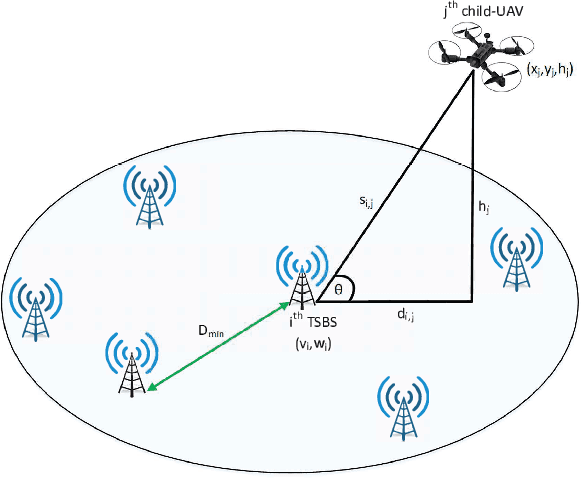
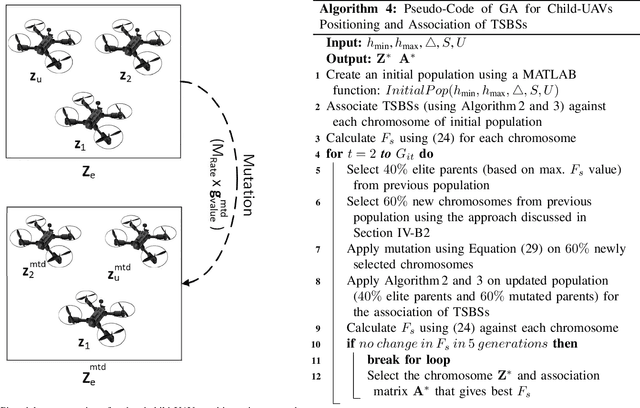
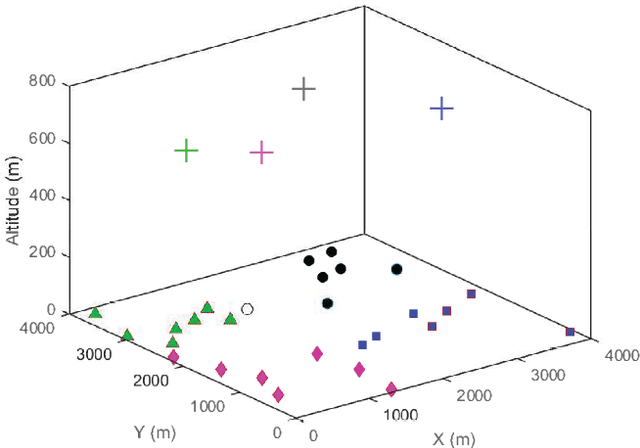
The mushroom growth of cellular users requires novel advancements in the existing cellular infrastructure. One way to handle such a tremendous increase is to densely deploy terrestrial small-cell base stations (TSBSs) with careful management of smart backhaul/fronthaul networks. Nevertheless, terrestrial backhaul hubs significantly suffer from the dense fading environment and are difficult to install in a typical urban environment. Therefore, this paper considers the idea of replacing terrestrial backhaul network with an aerial network consisting of unmanned aerial vehicles (UAVs) to provide the fronthaul connectivity between the TSBSs and the ground core-network (GCN). To this end, we focus on the joint positioning of UAVs and the association of TSBSs such that the sum-rate of the overall system is maximized. In particular, the association problem of TSBSs with UAVs is formulated under communication-related constraints, i.e., bandwidth, number of connections to a UAV, power limit, interference threshold, UAV heights, and backhaul data rate. To meet this joint objective, we take advantage of the genetic algorithm (GA) due to the offline nature of our optimization problem. The performance of the proposed approach is evaluated using the unsupervised learning-based k-means clustering algorithm. We observe that the proposed approach is highly effective to satisfy the requirements of smart fronthaul networks.