 Add to Chrome
 Add to Firefox
 Add to Edge
Chunk-Guided Q-Learning
Mar 14, 2026
In offline reinforcement learning (RL), single-step temporal-difference (TD) learning can suffer from bootstrapping error accumulation over long horizons. Action-chunked TD methods mitigate this by backing up over multiple steps, but can introduce suboptimality by restricting the policy class to open-loop action sequences. To resolve this trade-off, we present Chunk-Guided Q-Learning (CGQ), a single-step TD algorithm that guides a fine-grained single-step critic by regularizing it toward a chunk-based critic trained using temporally extended backups. This reduces compounding error while preserving fine-grained value propagation. We theoretically show that CGQ attains tighter critic optimality bounds than either single-step or action-chunked TD learning alone. Empirically, CGQ achieves strong performance on challenging long-horizon OGBench tasks, often outperforming both single-step and action-chunked methods.

Web Agents with World Models: Learning and Leveraging Environment Dynamics in Web Navigation
Oct 17, 2024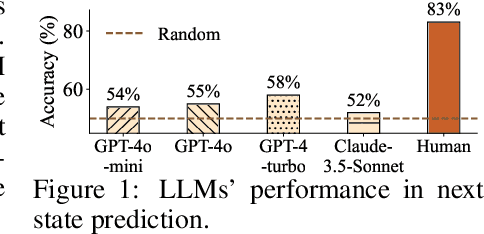
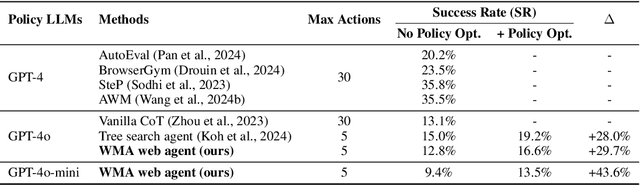
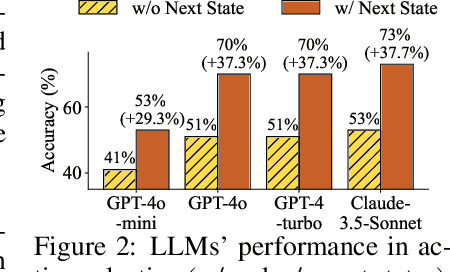

Large language models (LLMs) have recently gained much attention in building autonomous agents. However, the performance of current LLM-based web agents in long-horizon tasks is far from optimal, often yielding errors such as repeatedly buying a non-refundable flight ticket. By contrast, humans can avoid such an irreversible mistake, as we have an awareness of the potential outcomes (e.g., losing money) of our actions, also known as the "world model". Motivated by this, our study first starts with preliminary analyses, confirming the absence of world models in current LLMs (e.g., GPT-4o, Claude-3.5-Sonnet, etc.). Then, we present a World-model-augmented (WMA) web agent, which simulates the outcomes of its actions for better decision-making. To overcome the challenges in training LLMs as world models predicting next observations, such as repeated elements across observations and long HTML inputs, we propose a transition-focused observation abstraction, where the prediction objectives are free-form natural language descriptions exclusively highlighting important state differences between time steps. Experiments on WebArena and Mind2Web show that our world models improve agents' policy selection without training and demonstrate our agents' cost- and time-efficiency compared to recent tree-search-based agents.