 Add to Chrome
 Add to Firefox
 Add to Edge
HotelQuEST: Balancing Quality and Efficiency in Agentic Search
Feb 27, 2026
Agentic search has emerged as a promising paradigm for adaptive retrieval systems powered by large language models (LLMs). However, existing benchmarks primarily focus on quality, overlooking efficiency factors that are critical for real-world deployment. Moreover, real-world user queries often contain underspecified preferences, a challenge that remains largely underexplored in current agentic search evaluation. As a result, many agentic search systems remain impractical despite their impressive performance. In this work, we introduce HotelQuEST, a benchmark comprising 214 hotel search queries that range from simple factual requests to complex queries, enabling evaluation across the full spectrum of query difficulty. We further address the challenge of evaluating underspecified user preferences by collecting clarifications that make annotators' implicit preferences explicit for evaluation. We find that LLM-based agents achieve higher accuracy than traditional retrievers, but at substantially higher costs due to redundant tool calls and suboptimal routing that fails to match query complexity to model capability. Our analysis exposes inefficiencies in current agentic search systems and demonstrates substantial potential for cost-aware optimization.

EncodeRec: An Embedding Backbone for Recommendation Systems
Jan 15, 2026Recent recommender systems increasingly leverage embeddings from large pre-trained language models (PLMs). However, such embeddings exhibit two key limitations: (1) PLMs are not explicitly optimized to produce structured and discriminative embedding spaces, and (2) their representations remain overly generic, often failing to capture the domain-specific semantics crucial for recommendation tasks. We present EncodeRec, an approach designed to align textual representations with recommendation objectives while learning compact, informative embeddings directly from item descriptions. EncodeRec keeps the language model parameters frozen during recommender system training, making it computationally efficient without sacrificing semantic fidelity. Experiments across core recommendation benchmarks demonstrate its effectiveness both as a backbone for sequential recommendation models and for semantic ID tokenization, showing substantial gains over PLM-based and embedding model baselines. These results underscore the pivotal role of embedding adaptation in bridging the gap between general-purpose language models and practical recommender systems.
X-Cross: Dynamic Integration of Language Models for Cross-Domain Sequential Recommendation
Apr 29, 2025
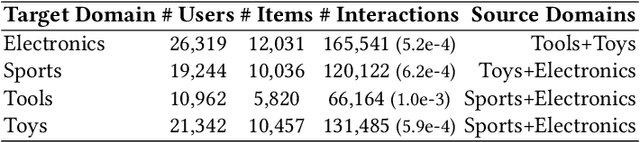
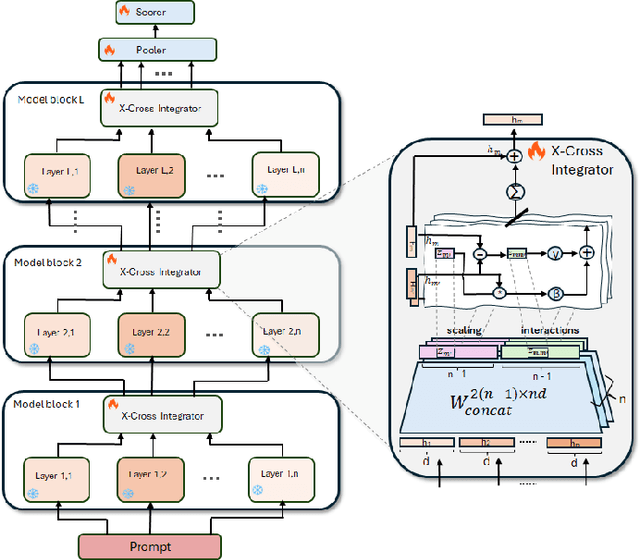
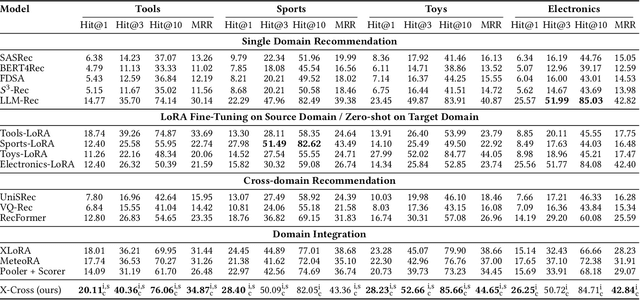
As new products are emerging daily, recommendation systems are required to quickly adapt to possible new domains without needing extensive retraining. This work presents ``X-Cross'' -- a novel cross-domain sequential-recommendation model that recommends products in new domains by integrating several domain-specific language models; each model is fine-tuned with low-rank adapters (LoRA). Given a recommendation prompt, operating layer by layer, X-Cross dynamically refines the representation of each source language model by integrating knowledge from all other models. These refined representations are propagated from one layer to the next, leveraging the activations from each domain adapter to ensure domain-specific nuances are preserved while enabling adaptability across domains. Using Amazon datasets for sequential recommendation, X-Cross achieves performance comparable to a model that is fine-tuned with LoRA, while using only 25% of the additional parameters. In cross-domain tasks, such as adapting from Toys domain to Tools, Electronics or Sports, X-Cross demonstrates robust performance, while requiring about 50%-75% less fine-tuning data than LoRA to make fine-tuning effective. Furthermore, X-Cross achieves significant improvement in accuracy over alternative cross-domain baselines. Overall, X-Cross enables scalable and adaptive cross-domain recommendations, reducing computational overhead and providing an efficient solution for data-constrained environments.