 Add to Chrome
 Add to Firefox
 Add to Edge
Co-Evolutionary Multi-Modal Alignment via Structured Adversarial Evolution
Mar 02, 2026
Adversarial behavior plays a central role in aligning large language models with human values. However, existing alignment methods largely rely on static adversarial settings, which fundamentally limit robustness, particularly in multimodal settings with a larger attack surface. In this work, we move beyond static adversarial supervision and introduce co-evolutionary alignment with evolving attacks, instantiated by CEMMA (Co-Evolutionary Multi-Modal Alignment), an automated and adaptive framework for multimodal safety alignment. We introduce an Evolutionary Attacker that decomposes adversarial prompts into method templates and harmful intents. By employing genetic operators, including mutation, crossover, and differential evolution, it enables simple seed attacks to inherit the structural efficacy of sophisticated jailbreaks. The Adaptive Defender is iteratively updated on the synthesized hard negatives, forming a closed-loop process that adapts alignment to evolving attacks. Experiments show that the Evolutionary Attacker substantially increases red-teaming jailbreak attack success rate (ASR), while the Adaptive Defender improves robustness and generalization across benchmarks with higher data efficiency, without inducing excessive benign refusal, and remains compatible with inference-time defenses such as AdaShield.

Multi-graph Fusion for Multi-view Spectral Clustering
Sep 16, 2019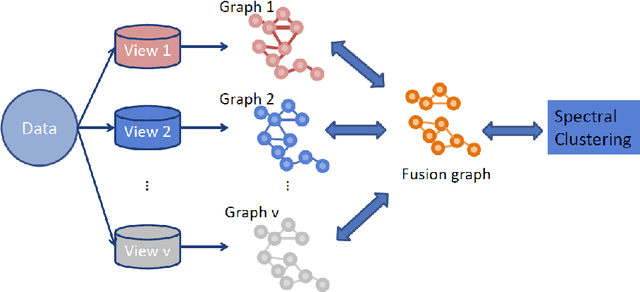
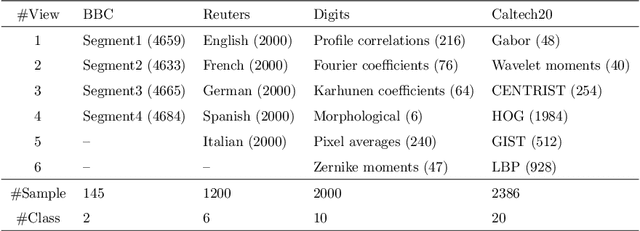
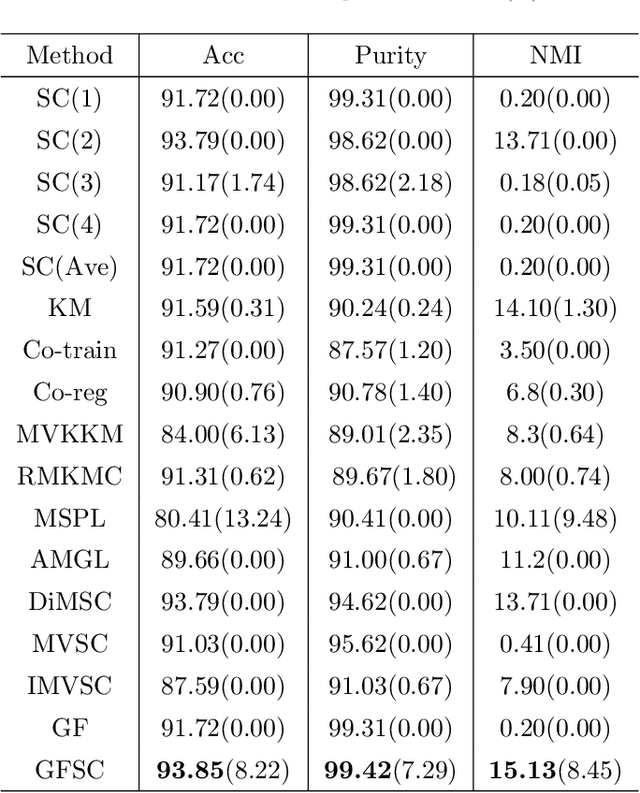
A panoply of multi-view clustering algorithms has been developed to deal with prevalent multi-view data. Among them, spectral clustering-based methods have drawn much attention and demonstrated promising results recently. Despite progress, there are still two fundamental questions that stay unanswered to date. First, how to fuse different views into one graph. More often than not, the similarities between samples may be manifested differently by different views. Many existing algorithms either simply take the average of multiple views or just learn a common graph. These simple approaches fail to consider the flexible local manifold structures of all views. Hence, the rich heterogeneous information is not fully exploited. Second, how to learn the explicit cluster structure. Most existing methods don't pay attention to the quality of the graphs and perform graph learning and spectral clustering separately. Those unreliable graphs might lead to suboptimal clustering results. To fill these gaps, in this paper, we propose a novel multi-view spectral clustering model which performs graph fusion and spectral clustering simultaneously. The fusion graph approximates the original graph of each individual view but maintains an explicit cluster structure. Experiments on four widely used data sets confirm the superiority of the proposed method.