 Add to Chrome
 Add to Firefox
 Add to Edge
MCR-Bionic Hand: Anatomical Structural Priors for Dexterous Manipulation
Jun 11, 2026
Dexterous robotic hands are usually formulated as high dimensional active control systems governed by degrees of freedom, actuation, and algorithms. Human hand dexterity, however, is partly encoded in the physical architecture of bones, ligaments, tendons, aponeuroses, and intrinsic muscles. This work describes that contribution as two linked forms of structural intelligence: structural prior generation, in which wrist to finger tenodesis, FDS/FDP routing, and the dorsal extensor hood transform low dimensional posture inputs into default grasp configurations and PIP to DIP coordination; and muscle mediated modulation, in which extrinsic muscles, lumbricals, and interossei regulate MCP posture, distal stability, fingertip force paths, and contact states around that default state. Based on this framework, MCR-Bionic Hand is developed as a 1:1 musculoskeletal biomimetic hand integrating a two row eight bone wrist, cross wrist tendons, anatomical flexor routing, volar plate and collateral ligament constraints, the dorsal extensor hood, and intrinsic muscle pathways within one body. Functional demonstrations and geometric mechanical models show that wrist posture induces multi joint pre shaping, the extensor hood maps PIP posture to a coupled DIP response, and intrinsic plus pathways modulate distal stability and fingertip action direction after grasp formation. Contact rich tasks, including coin rotation, pen transfer, dorsal coin flipping, and cube manipulation, show that MCR-Bionic links low dimensional state generation with fine post contact modulation. These results suggest that anatomical biomimetics is valuable not for visual similarity, but for identifying human hand structures that perform part of control.

Compliant actuators that mimic biological muscle performance with applications in a highly biomimetic robotic arm
Oct 31, 2023This paper endeavours to bridge the existing gap in muscular actuator design for ligament-skeletal-inspired robots, thereby fostering the evolution of these robotic systems. We introduce two novel compliant actuators, namely the Internal Torsion Spring Compliant Actuator (ICA) and the External Spring Compliant Actuator (ECA), and present a comparative analysis against the previously conceived Magnet Integrated Soft Actuator (MISA) through computational and experimental results. These actuators, employing a motor-tendon system, emulate biological muscle-like forms, enhancing artificial muscle technology. A robotic arm application inspired by the skeletal ligament system is presented. Experiments demonstrate satisfactory power in tasks like lifting dumbbells (peak power: 36W), playing table tennis (end-effector speed: 3.2 m/s), and door opening, without compromising biomimetic aesthetics. Compared to other linear stiffness serial elastic actuators (SEAs), ECA and ICA exhibit high power-to-volume (361 x 10^3 W/m) and power-to-mass (111.6 W/kg) ratios respectively, endorsing the biomimetic design's promise in robotic development.
Enhancing the Performance of a Biomimetic Robotic Elbow-and-Forearm System Through Bionics-Inspired Optimization
Oct 27, 2023This paper delineates the formulation and verification of an innovative robotic forearm and elbow design, mirroring the intricate biomechanics of human skeletal and ligament systems. Conventional robotic models often undervalue the substantial function of soft tissues, leading to a compromise between compactness, safety, stability, and range of motion. In contrast, this study proposes a holistic replication of biological joints, encompassing bones, cartilage, ligaments, and tendons, culminating in a biomimetic robot. The research underscores the compact and stable structure of the human forearm, attributable to a tri-bone framework and diverse soft tissues. The methodology involves exhaustive examinations of human anatomy, succeeded by a theoretical exploration of the contribution of soft tissues to the stability of the prototype. The evaluation results unveil remarkable parallels between the range of motion of the robotic joints and their human counterparts. The robotic elbow emulates 98.8% of the biological elbow's range of motion, with high torque capacities of 11.25 Nm (extension) and 24 Nm (flexion). Similarly, the robotic forearm achieves 58.6% of the human forearm's rotational range, generating substantial output torques of 14 Nm (pronation) and 7.8 Nm (supination). Moreover, the prototype exhibits significant load-bearing abilities, resisting a 5kg dumbbell load without substantial displacement. It demonstrates a payload capacity exceeding 4kg and rapid action capabilities, such as lifting a 2kg dumbbell at a speed of 0.74Hz and striking a ping-pong ball at an end-effector speed of 3.2 m/s. This research underscores that a detailed anatomical study can address existing robotic design obstacles, optimize performance and anthropomorphic resemblance, and reaffirm traditional anatomical principles.
Development and Characteristics of a Highly Biomimetic Robotic Shoulder Through Bionics-Inspired Optimization
Oct 27, 2023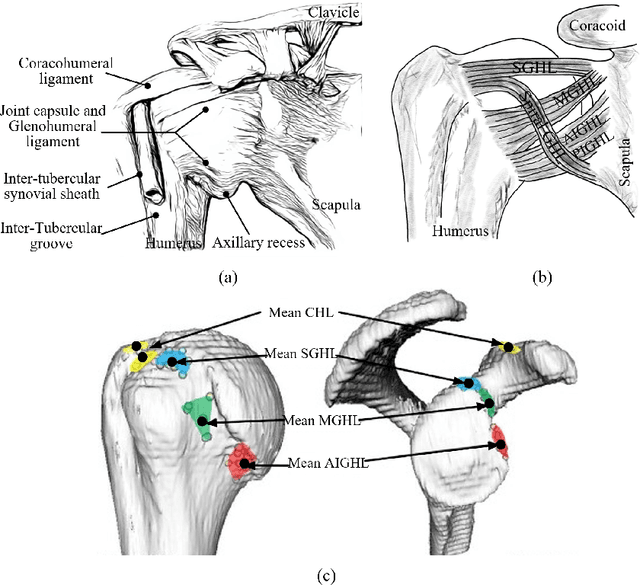
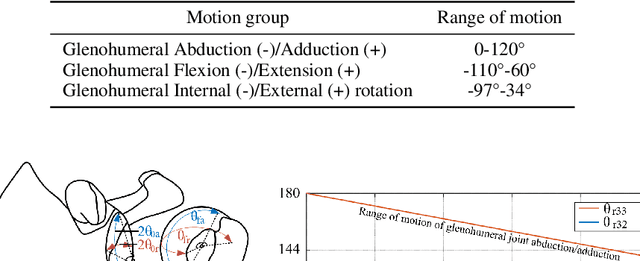
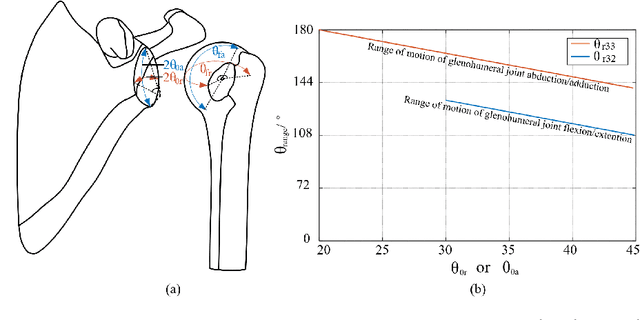
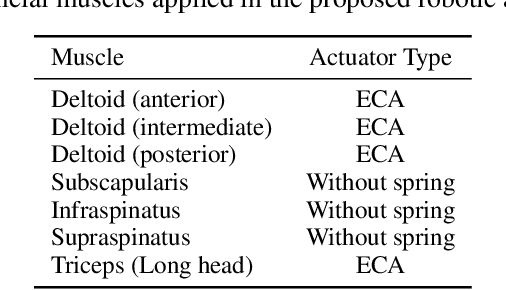
This paper critically analyzes conventional and biomimetic robotic arms, underscoring the trade-offs between size, motion range, and load capacity in current biomimetic models. By delving into the human shoulder's mechanical intelligence, particularly the glenohumeral joint's intricate features such as its unique ball-and-socket structure and self-locking mechanism, we pinpoint innovations that bolster both stability and mobility while maintaining compactness. To substantiate these insights, we present a groundbreaking biomimetic robotic glenohumeral joint that authentically mirrors human musculoskeletal elements, from ligaments to tendons, integrating the biological joint's mechanical intelligence. Our exhaustive simulations and tests reveal enhanced flexibility and load capacity for the robotic joint. The advanced robotic arm demonstrates notable capabilities, including a significant range of motions and a 4 kg payload capacity, even exerting over 1.5 Nm torque. This study not only confirms the human shoulder joint's mechanical innovations but also introduces a pioneering design for a next-generation biomimetic robotic arm, setting a new benchmark in robotic technology.
Sarrus-inspired Deployable Polyhedral Mechanisms
Aug 30, 2023Deployable polyhedral mechanisms (DPMs) have witnessed flourishing growth in recent years because of their potential applications in robotics, space exploration, structure engineering, etc. This paper firstly presents the construction, mobility and kinematics of a family of Sarrus-inspired deployable polyhedral mechanisms. By carrying out expansion operation and implanting Sarrus linkages along the straight-line motion paths, deployable tetrahedral, cubic and dodecahedral mechanisms are identified and constructed following tetrahedral, octahedral and icosahedral symmetry, respectively. Three paired transformations with synchronized radial motion between Platonic and Archimedean polyhedrons are revealed, and their significant symmetric properties are perfectly remained in each work configuration. Subsequently, with assistant of equivalent prismatic joints, the equivalent analysis strategy for mobility of multiloop polyhedral mechanisms is proposed to significantly simplify the calculation process. This paper hence presents the construction method and equivalent analysis of the Sarrus-inspired DPMs that are not only valuable in theoretical investigation, but also have great potential in practical applications such as mechanical metamaterials, deployable architectures and space exploration.