 Add to Chrome
 Add to Firefox
 Add to Edge
ReGraph: Learning to Generate Recipe Graphs from Food Images
Aug 07, 2026
Recent Large Multimodal Models (LMMs) have achieved impressive performance in recipe generation from food images.However, cooking is a structured transformation process in which ingredients undergo state changes through ordered actions,while free-form recipe language leaves the corresponding entities, intermediate states, and dependencies largely implicit and entangled.A graph representation makes this procedural knowledge explicit and compositional, providing a structured basis for assessing whether model outputs encode process-level knowledge rather than merely presenting plausible textual descriptions. To address this limitation, we present ReGraph, a large-scale recipe graph dataset that represents ingredients, cooking actions, and tools as entities, uses entity attributes to describe ingredient state changes, and employs typed relations to encode manipulation targets, destinations, and procedural ordering. ReGraph further incorporates explicit Recipe Reasoning Chain-of-Thought (RR-CoT) traces, providing auxiliary supervision for procedural decomposition and structured graph generation. Building on ReGraph, we propose Recipe Graph Learning (RGL), a two-stage framework that enables LMMs to generate a plausible fine-grained cooking workflow from a food image in the form of a structured recipe graph. Under a deterministic, schema-aware matching protocol, our experiments reveal a substantial gap between text-generation quality and recoverable procedural structure: recipes produced by existing approaches achieve competitive text-generation scores yet yield limited reference-aligned entity and relation structure under the ReGraph schema. In contrast, across two representative LMM backbones, RGL consistently improves the generation of cooking entities and procedural relations, while our analysis further shows that fine-grained ingredient-state capture remains the most challenging dimension.

Retrieval Augmented Recipe Generation
Nov 13, 2024Given the potential applications of generating recipes from food images, this area has garnered significant attention from researchers in recent years. Existing works for recipe generation primarily utilize a two-stage training method, first generating ingredients and then obtaining instructions from both the image and ingredients. Large Multi-modal Models (LMMs), which have achieved notable success across a variety of vision and language tasks, shed light to generating both ingredients and instructions directly from images. Nevertheless, LMMs still face the common issue of hallucinations during recipe generation, leading to suboptimal performance. To tackle this, we propose a retrieval augmented large multimodal model for recipe generation. We first introduce Stochastic Diversified Retrieval Augmentation (SDRA) to retrieve recipes semantically related to the image from an existing datastore as a supplement, integrating them into the prompt to add diverse and rich context to the input image. Additionally, Self-Consistency Ensemble Voting mechanism is proposed to determine the most confident prediction recipes as the final output. It calculates the consistency among generated recipe candidates, which use different retrieval recipes as context for generation. Extensive experiments validate the effectiveness of our proposed method, which demonstrates state-of-the-art (SOTA) performance in recipe generation tasks on the Recipe1M dataset.
From Canteen Food to Daily Meals: Generalizing Food Recognition to More Practical Scenarios
Mar 12, 2024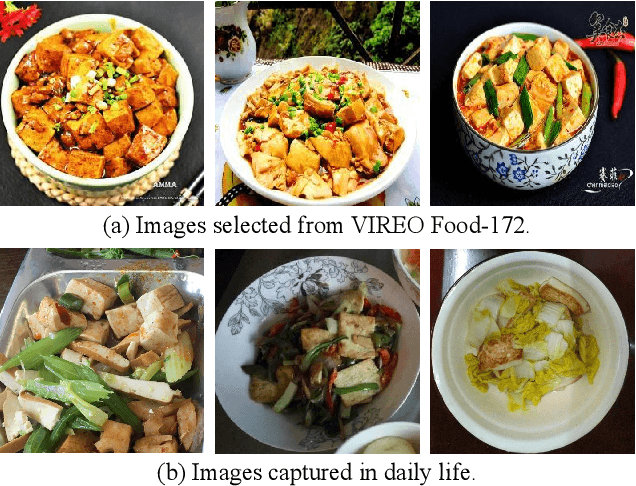
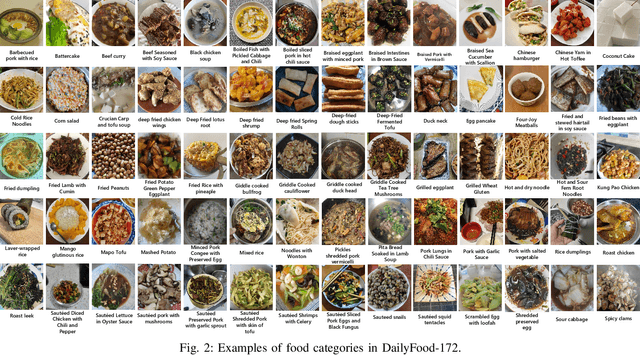
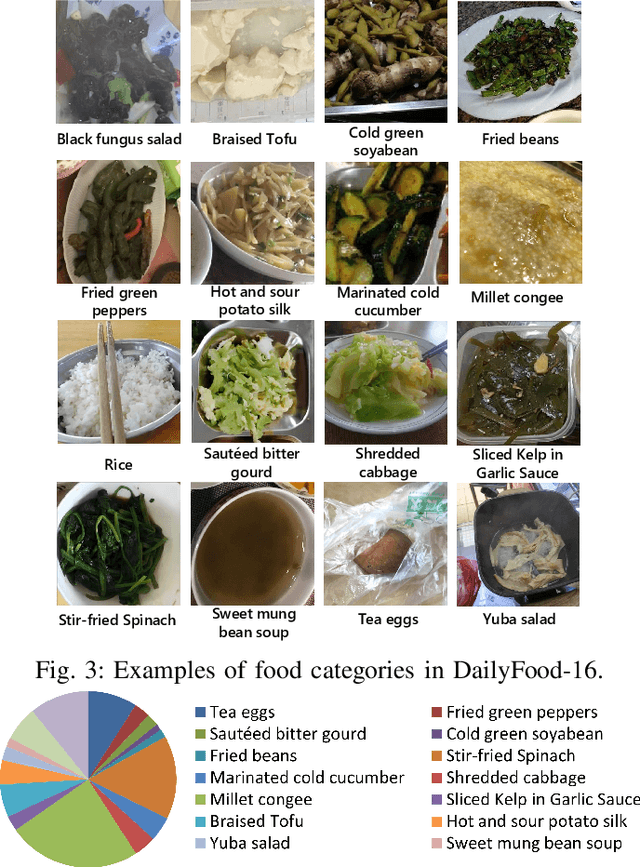
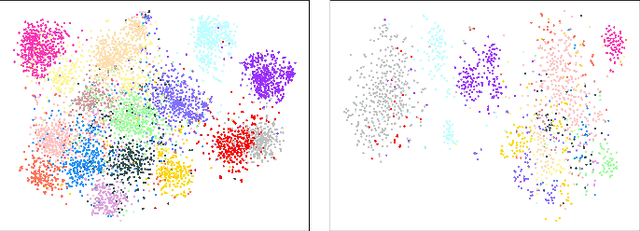
The precise recognition of food categories plays a pivotal role for intelligent health management, attracting significant research attention in recent years. Prominent benchmarks, such as Food-101 and VIREO Food-172, provide abundant food image resources that catalyze the prosperity of research in this field. Nevertheless, these datasets are well-curated from canteen scenarios and thus deviate from food appearances in daily life. This discrepancy poses great challenges in effectively transferring classifiers trained on these canteen datasets to broader daily-life scenarios encountered by humans. Toward this end, we present two new benchmarks, namely DailyFood-172 and DailyFood-16, specifically designed to curate food images from everyday meals. These two datasets are used to evaluate the transferability of approaches from the well-curated food image domain to the everyday-life food image domain. In addition, we also propose a simple yet effective baseline method named Multi-Cluster Reference Learning (MCRL) to tackle the aforementioned domain gap. MCRL is motivated by the observation that food images in daily-life scenarios exhibit greater intra-class appearance variance compared with those in well-curated benchmarks. Notably, MCRL can be seamlessly coupled with existing approaches, yielding non-trivial performance enhancements. We hope our new benchmarks can inspire the community to explore the transferability of food recognition models trained on well-curated datasets toward practical real-life applications.