 Add to Chrome
 Add to Firefox
 Add to Edge
When Recommendation Denoising Meets Popularity Bias: Understanding and Mitigating Their Interaction
Jun 12, 2026
Implicit feedback is the dominant data source for recommender systems, but behavioral logs are often contaminated by false-positive interactions caused by mis-clicks, biased exposure, and interface effects. Denoising recommendation methods improve robustness by down-weighting or filtering interactions suspected to be noisy, often relying on the small-loss heuristic. We revisit this heuristic through the lens of popularity bias. Tail-item positives can be harder to fit because they are sparsely observed, and thus may receive larger losses even when they reflect genuine user preference. Under such popularity-dependent loss patterns, monotone loss-based reweighting can suppress clean-but-hard tail signals and increase the head-tail imbalance in effective supervision. We formalize this interaction through the effective head-tail signal ratio induced by denoising weights and derive a conditional reallocation result: when the loss distribution of tail positives is right-shifted relative to that of head positives, small-loss reweighting increases the effective head-tail signal ratio compared with ERM. Motivated by this analysis, we propose Popularity-Aware Denoising (PAD), a lightweight plug-in framework that modulates denoising strength by item popularity. PAD applies stronger denoising to highly exposed items while being more conservative on tail items, preserving more clean-but-hard long-tail signals. Experiments on three datasets and three backbones show that PAD generally improves over representative denoising baselines and provides favorable accuracy-diversity tradeoffs, especially on MF-style recommenders.

Sharpness-Aware Cross-Domain Recommendation to Cold-Start Users
Aug 06, 2024
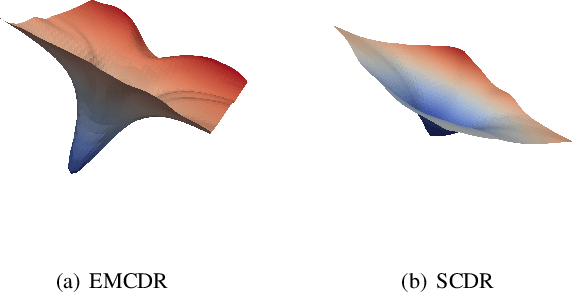

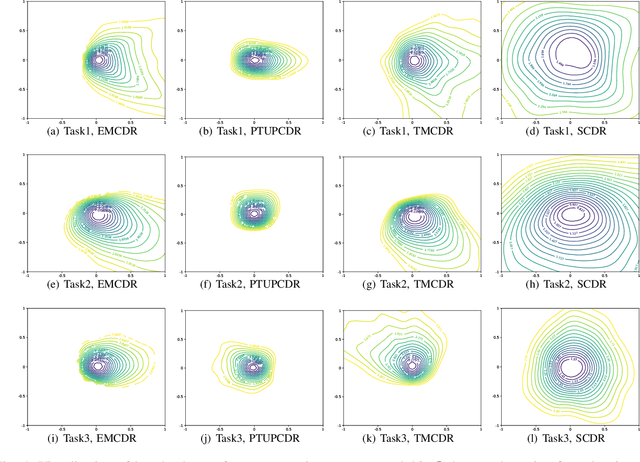
Cross-Domain Recommendation (CDR) is a promising paradigm inspired by transfer learning to solve the cold-start problem in recommender systems. Existing state-of-the-art CDR methods train an explicit mapping function to transfer the cold-start users from a data-rich source domain to a target domain. However, a limitation of these methods is that the mapping function is trained on overlapping users across domains, while only a small number of overlapping users are available for training. By visualizing the loss landscape of the existing CDR model, we find that training on a small number of overlapping users causes the model to converge to sharp minima, leading to poor generalization. Based on this observation, we leverage loss-geometry-based machine learning approach and propose a novel CDR method called Sharpness-Aware CDR (SCDR). Our proposed method simultaneously optimizes recommendation loss and loss sharpness, leading to better generalization with theoretical guarantees. Empirical studies on real-world datasets demonstrate that SCDR significantly outperforms the other CDR models for cold-start recommendation tasks, while concurrently enhancing the model's robustness to adversarial attacks.