 Add to Chrome
 Add to Firefox
 Add to Edge
Learning Molecular Chirality via Chiral Determinant Kernels
Feb 07, 2026
Chirality is a fundamental molecular property that governs stereospecific behavior in chemistry and biology. Capturing chirality in machine learning models remains challenging due to the geometric complexity of stereochemical relationships and the limitations of traditional molecular representations that often lack explicit stereochemical encoding. Existing approaches to chiral molecular representation primarily focus on central chirality, relying on handcrafted stereochemical tags or limited 3D encodings, and thus fail to generalize to more complex forms such as axial chirality. In this work, we introduce ChiDeK (Chiral Determinant Kernels), a framework that systematically integrates stereogenic information into molecular representation learning. We propose the chiral determinant kernel to encode the SE(3)-invariant chirality matrix and employ cross-attention to integrate stereochemical information from local chiral centers into the global molecular representation. This design enables explicit modeling of chiral-related features within a unified architecture, capable of jointly encoding central and axial chirality. To support the evaluation of axial chirality, we construct a new benchmark for electronic circular dichroism (ECD) and optical rotation (OR) prediction. Across four tasks, including R/S configuration classification, enantiomer ranking, ECD spectrum prediction, and OR prediction, ChiDeK achieves substantial improvements over state-of-the-art baselines, most notably yielding over 7% higher accuracy on axially chiral tasks on average.

Reaction Prediction via Interaction Modeling of Symmetric Difference Shingle Sets
Nov 16, 2025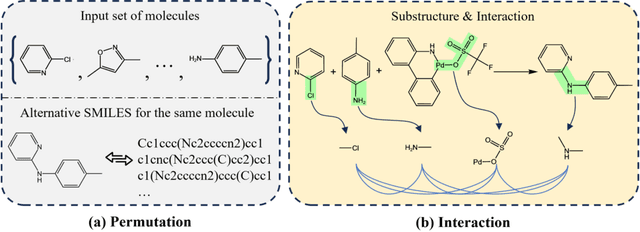
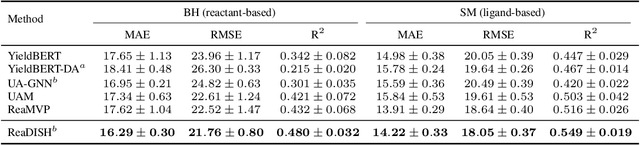
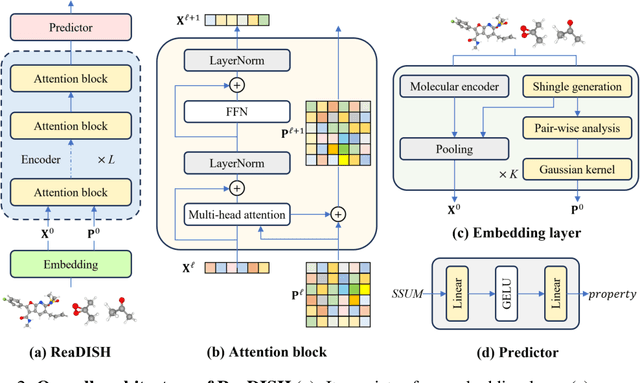
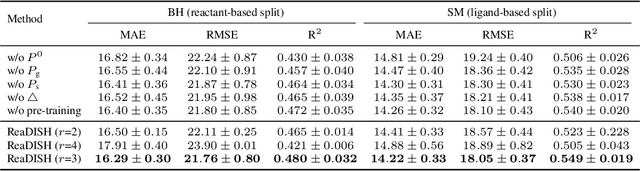
Chemical reaction prediction remains a fundamental challenge in organic chemistry, where existing machine learning models face two critical limitations: sensitivity to input permutations (molecule/atom orderings) and inadequate modeling of substructural interactions governing reactivity. These shortcomings lead to inconsistent predictions and poor generalization to real-world scenarios. To address these challenges, we propose ReaDISH, a novel reaction prediction model that learns permutation-invariant representations while incorporating interaction-aware features. It introduces two innovations: (1) symmetric difference shingle encoding, which extends the differential reaction fingerprint (DRFP) by representing shingles as continuous high-dimensional embeddings, capturing structural changes while eliminating order sensitivity; and (2) geometry-structure interaction attention, a mechanism that models intra- and inter-molecular interactions at the shingle level. Extensive experiments demonstrate that ReaDISH improves reaction prediction performance across diverse benchmarks. It shows enhanced robustness with an average improvement of 8.76% on R$^2$ under permutation perturbations.
RTMol: Rethinking Molecule-text Alignment in a Round-trip View
Nov 15, 2025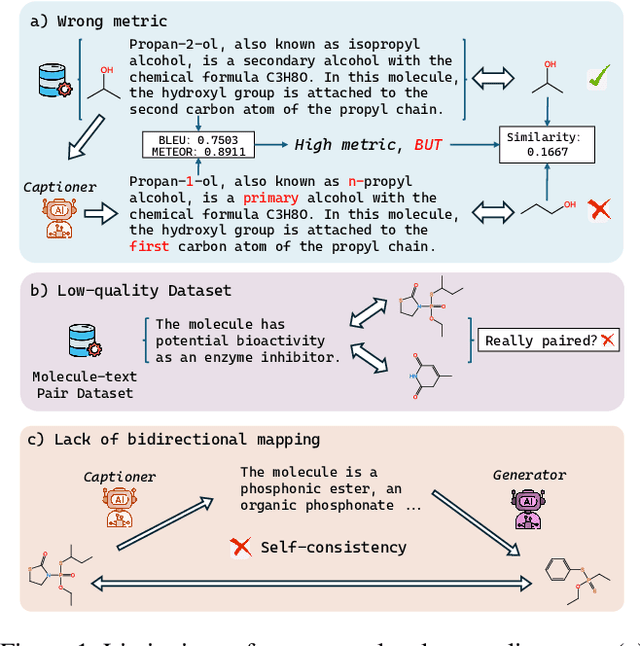
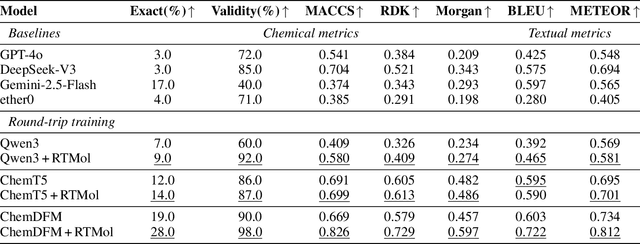
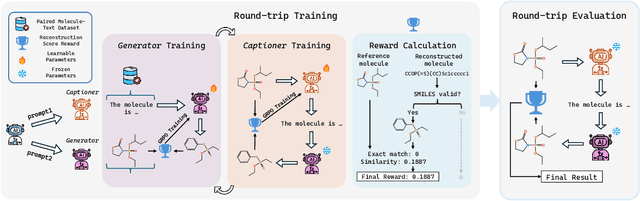
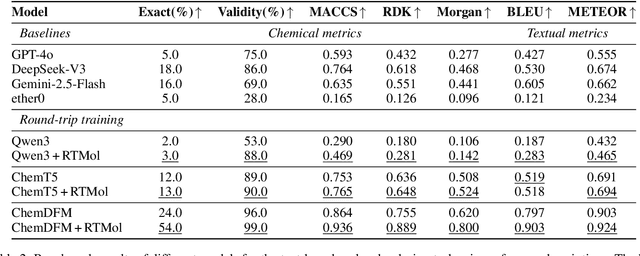
Aligning molecular sequence representations (e.g., SMILES notations) with textual descriptions is critical for applications spanning drug discovery, materials design, and automated chemical literature analysis. Existing methodologies typically treat molecular captioning (molecule-to-text) and text-based molecular design (text-to-molecule) as separate tasks, relying on supervised fine-tuning or contrastive learning pipelines. These approaches face three key limitations: (i) conventional metrics like BLEU prioritize linguistic fluency over chemical accuracy, (ii) training datasets frequently contain chemically ambiguous narratives with incomplete specifications, and (iii) independent optimization of generation directions leads to bidirectional inconsistency. To address these issues, we propose RTMol, a bidirectional alignment framework that unifies molecular captioning and text-to-SMILES generation through self-supervised round-trip learning. The framework introduces novel round-trip evaluation metrics and enables unsupervised training for molecular captioning without requiring paired molecule-text corpora. Experiments demonstrate that RTMol enhances bidirectional alignment performance by up to 47% across various LLMs, establishing an effective paradigm for joint molecule-text understanding and generation.