 Add to Chrome
 Add to Firefox
 Add to Edge
DualSpectralCF: Training-Free Sign-Aware Spectral Collaborative Filtering
Aug 10, 2026
Real-world recommendation platforms routinely collect explicit negative feedback such as 1-star reviews, hate-button clicks, distrust between users, and very-low watch-ratio videos. Learned sign-aware recommenders exploit this signal for clear accuracy gains, but only at the cost of gradient-based training. In parallel, a line of training-free spectral collaborative filtering methods matches or beats learned graph recommenders at a fraction of the cost, yet operates on positive interactions alone. We bridge these two lines with DualSpectralCF, a training-free framework of two components that attach to any spectral backbone of the form $\hat{\mathbf{r}}_u = F(\mathbf{M}) \mathbf{r}_u$: a signed input signal $\mathbf{r}_u^{\pm}$ that encodes the user's explicit dislikes, and a signed item-item operator $\mathbf{M}^{\pm}$ that blends like-together and dislike-together similarity. The framework is backbone-agnostic and adds just two scalar hyperparameters. We instantiate DualSpectralCF on ChebyCF, GF-CF, and Turbo-CF, and evaluate on five sign-aware benchmarks: every instance matches or beats its unsigned backbone on all 5 datasets, with Recall@20 lifts up to +32.6% with backbone-specific $(γ, κ)$ tuning and +1.9% to +16.0% for DualSpectralCF-Cheby at the fixed default $(γ= -0.5, κ= 0.1)$, and the family runs 7.7 to 155.3$\times$ faster than SIGformer while reaching 70.7% to 90.7% of its accuracy. Sign-awareness helps most for cold-start users, with up to +29.2% Recall@20 on Epinions users with 1 to 5 training items.

Sequential Modality Dropout for Robust Multi-Modal Sequential Recommendation
Aug 10, 2026Multi-modal sequential recommenders assume every item carries every modality, but real product catalogs often miss images or text, and a model trained on complete data loses much of its recommendation accuracy when a modality is unavailable at serving time. We propose Sequential Modality Dropout (SMD): during training, each modality stream (image and text) is independently erased with probability p for an entire user interaction history, so the model learns to predict the next item without relying on any single modality. We measure robustness by retention, the fraction of a model's full-modality accuracy (HR@10) that survives when a modality is removed at test time. Across four backbones (MM-SASRec, IISAN, MISSRec, and fMRLRec) on four Amazon domains, SMD raises text retention by 1.0 to 3.2x at essentially no cost to full-modality accuracy; under an extreme 95% per-item missing rate, it retains 61% of HR@10 versus 22% without (a 2.8x improvement). An optional cross-modal reconstruction loss further lifts retention from 90% to 98% on a simple additive backbone under severe text missingness. SMD is a four-line, architecture-agnostic change that makes multi-modal sequential recommenders robust to the missing modalities they actually encounter in deployment.
TestAug: A Framework for Augmenting Capability-based NLP Tests
Oct 14, 2022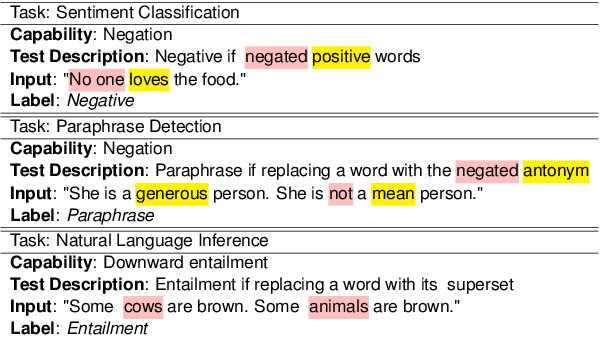
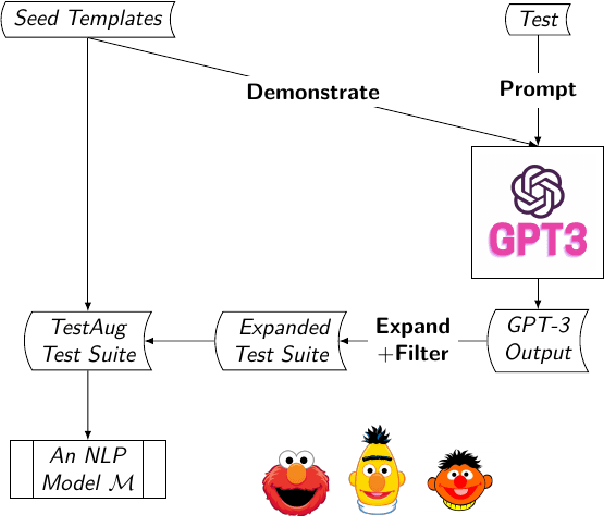
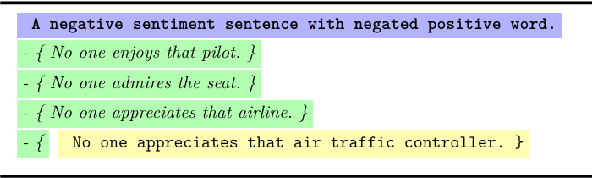
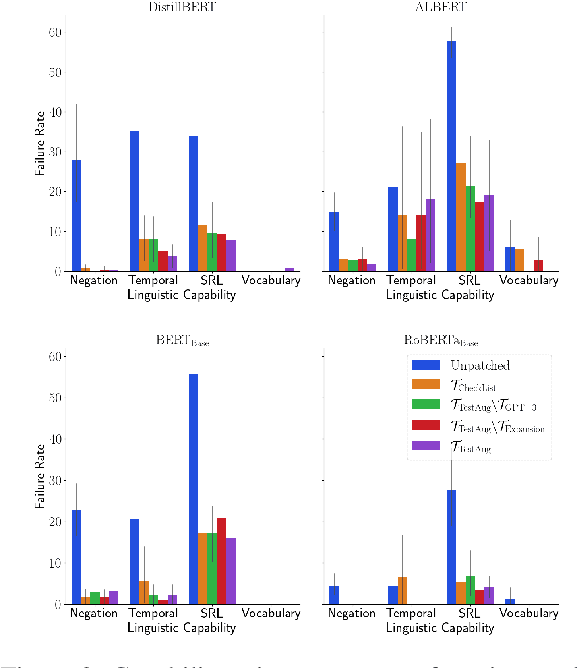
The recently proposed capability-based NLP testing allows model developers to test the functional capabilities of NLP models, revealing functional failures that cannot be detected by the traditional heldout mechanism. However, existing work on capability-based testing requires extensive manual efforts and domain expertise in creating the test cases. In this paper, we investigate a low-cost approach for the test case generation by leveraging the GPT-3 engine. We further propose to use a classifier to remove the invalid outputs from GPT-3 and expand the outputs into templates to generate more test cases. Our experiments show that TestAug has three advantages over the existing work on behavioral testing: (1) TestAug can find more bugs than existing work; (2) The test cases in TestAug are more diverse; and (3) TestAug largely saves the manual efforts in creating the test suites. The code and data for TestAug can be found at our project website (https://guanqun-yang.github.io/testaug/) and GitHub (https://github.com/guanqun-yang/testaug).
Few-Sample Named Entity Recognition for Security Vulnerability Reports by Fine-Tuning Pre-Trained Language Models
Aug 14, 2021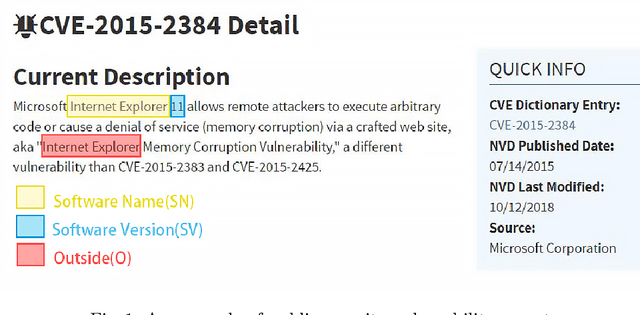

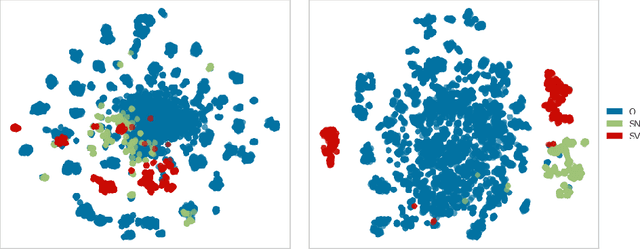
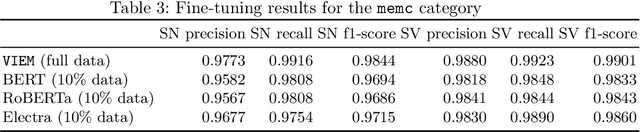
Public security vulnerability reports (e.g., CVE reports) play an important role in the maintenance of computer and network systems. Security companies and administrators rely on information from these reports to prioritize tasks on developing and deploying patches to their customers. Since these reports are unstructured texts, automatic information extraction (IE) can help scale up the processing by converting the unstructured reports to structured forms, e.g., software names and versions and vulnerability types. Existing works on automated IE for security vulnerability reports often rely on a large number of labeled training samples. However, creating massive labeled training set is both expensive and time consuming. In this work, for the first time, we propose to investigate this problem where only a small number of labeled training samples are available. In particular, we investigate the performance of fine-tuning several state-of-the-art pre-trained language models on our small training dataset. The results show that with pre-trained language models and carefully tuned hyperparameters, we have reached or slightly outperformed the state-of-the-art system on this task. Consistent with previous two-step process of first fine-tuning on main category and then transfer learning to others as in [7], if otherwise following our proposed approach, the number of required labeled samples substantially decrease in both stages: 90% reduction in fine-tuning from 5758 to 576,and 88.8% reduction in transfer learning with 64 labeled samples per category. Our experiments thus demonstrate the effectiveness of few-sample learning on NER for security vulnerability report. This result opens up multiple research opportunities for few-sample learning for security vulnerability reports, which is discussed in the paper. Code: https://github.com/guanqun-yang/FewVulnerability.