 Add to Chrome
 Add to Firefox
 Add to Edge
Uncertainty-Aware Concept and Motion Segmentation for Semi-Supervised Angiography Videos
Mar 01, 2026
Segmentation of the main coronary artery from X-ray coronary angiography (XCA) sequences is crucial for the diagnosis of coronary artery diseases. However, this task is challenging due to issues such as blurred boundaries, inconsistent radiation contrast, complex motion patterns, and a lack of annotated images for training. Although Semi-Supervised Learning (SSL) can alleviate the annotation burden, conventional methods struggle with complicated temporal dynamics and unreliable uncertainty quantification. To address these challenges, we propose SAM3-based Teacher-student framework with Motion-Aware consistency and Progressive Confidence Regularization (SMART), a semi-supervised vessel segmentation approach for X-ray angiography videos. First, our method utilizes SAM3's unique promptable concept segmentation design and innovates a SAM3-based teacher-student framework to maximize the performance potential of both the teacher and the student. Second, we enhance segmentation by integrating the vessel mask warping technique and motion consistency loss to model complex vessel dynamics. To address the issue of unreliable teacher predictions caused by blurred boundaries and minimal contrast, we further propose a progressive confidence-aware consistency regularization to mitigate the risk of unreliable outputs. Extensive experiments on three datasets of XCA sequences from different institutions demonstrate that SMART achieves state-of-the-art performance while requiring significantly fewer annotations, making it particularly valuable for real-world clinical applications where labeled data is scarce. Our code is available at: https://github.com/qimingfan10/SMART.

Bi-Grid Reconstruction for Image Anomaly Detection
Apr 01, 2025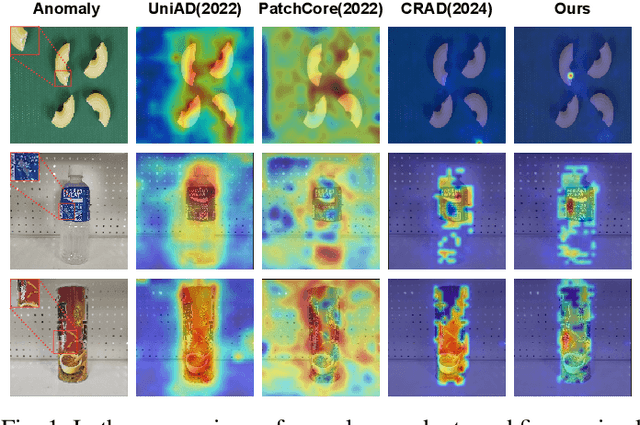
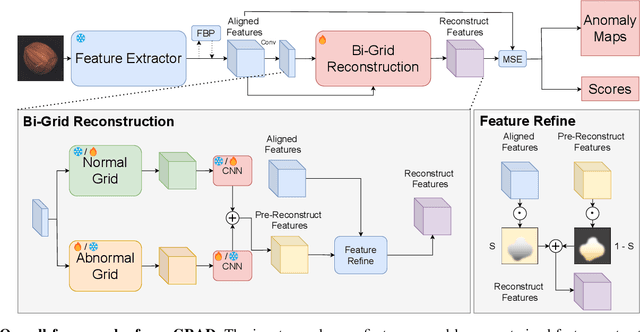
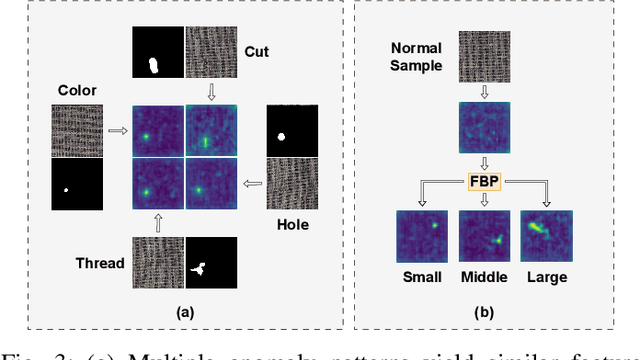
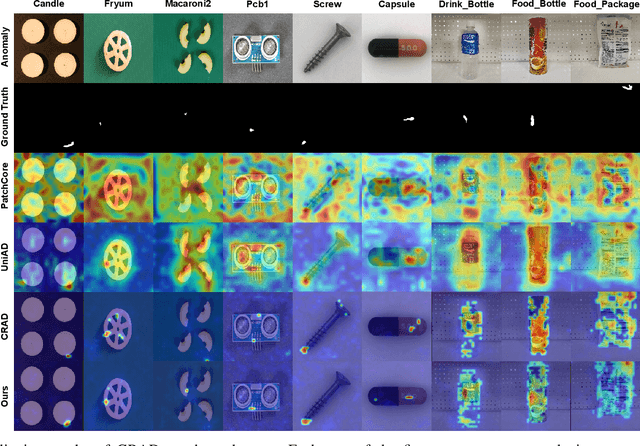
In image anomaly detection, significant advancements have been made using un- and self-supervised methods with datasets containing only normal samples. However, these approaches often struggle with fine-grained anomalies. This paper introduces \textbf{GRAD}: Bi-\textbf{G}rid \textbf{R}econstruction for Image \textbf{A}nomaly \textbf{D}etection, which employs two continuous grids to enhance anomaly detection from both normal and abnormal perspectives. In this work: 1) Grids as feature repositories that improve generalization and mitigate the Identical Shortcut (IS) issue; 2) An abnormal feature grid that refines normal feature boundaries, boosting detection of fine-grained defects; 3) The Feature Block Paste (FBP) module, which synthesizes various anomalies at the feature level for quick abnormal grid deployment. GRAD's robust representation capabilities also allow it to handle multiple classes with a single model. Evaluations on datasets like MVTecAD, VisA, and GoodsAD show significant performance improvements in fine-grained anomaly detection. GRAD excels in overall accuracy and in discerning subtle differences, demonstrating its superiority over existing methods.
SAM-VMNet: Deep Neural Networks For Coronary Angiography Vessel Segmentation
Jun 01, 2024Coronary artery disease (CAD) is one of the most prevalent diseases in the cardiovascular field and one of the major contributors to death worldwide. Computed Tomography Angiography (CTA) images are regarded as the authoritative standard for the diagnosis of coronary artery disease, and by performing vessel segmentation and stenosis detection on CTA images, physicians are able to diagnose coronary artery disease more accurately. In order to combine the advantages of both the base model and the domain-specific model, and to achieve high-precision and fully-automatic segmentation and detection with a limited number of training samples, we propose a novel architecture, SAM-VMNet, which combines the powerful feature extraction capability of MedSAM with the advantage of the linear complexity of the visual state-space model of VM-UNet, giving it faster inferences than Vision Transformer with faster inference speed and stronger data processing capability, achieving higher segmentation accuracy and stability for CTA images. Experimental results show that the SAM-VMNet architecture performs excellently in the CTA image segmentation task, with a segmentation accuracy of up to 98.32% and a sensitivity of up to 99.33%, which is significantly better than other existing models and has stronger domain adaptability. Comprehensive evaluation of the CTA image segmentation task shows that SAM-VMNet accurately extracts the vascular trunks and capillaries, demonstrating its great potential and wide range of application scenarios for the vascular segmentation task, and also laying a solid foundation for further stenosis detection.