 Add to Chrome
 Add to Firefox
 Add to Edge
Invisible Safety Threat: Malicious Finetuning for LLM via Steganography
Mar 09, 2026
Understanding and addressing potential safety alignment risks in large language models (LLMs) is critical for ensuring their safe and trustworthy deployment. In this paper, we highlight an insidious safety threat: a compromised LLM can maintain a facade of proper safety alignment while covertly generating harmful content. To achieve this, we finetune the model to understand and apply a steganographic technique. At inference time, we input a prompt that contains a steganographically embedded malicious target question along with a plaintext cover question. The model, in turn, produces a target response similarly embedded within a benign-looking cover response. In this process, human observers only see the model being prompted with a cover question and generating a corresponding cover response, while the malicious content is hidden from view. We demonstrate this invisible safety threat on GPT-4.1 despite the OpenAI finetuning API's safeguards. The finetuned model produces steganographic malicious outputs in response to hidden malicious prompts, while the user interface displays only a fully benign cover interaction. We also replicate the attack on three open-source models, Llama-3.3-70B-Instruct, Phi-4, and Mistral-Small-24B-Base-2501, confirming the generality of our method. We quantitatively evaluate our method on the AdvBench dataset, using Llama-Guard-3-8B for content safety classification. Across all four models, all stegotexts containing malicious content are incorrectly classified as safe.

Self-Purification Mitigates Backdoors in Multimodal Diffusion Language Models
Feb 24, 2026Multimodal Diffusion Language Models (MDLMs) have recently emerged as a competitive alternative to their autoregressive counterparts. Yet their vulnerability to backdoor attacks remains largely unexplored. In this work, we show that well-established data-poisoning pipelines can successfully implant backdoors into MDLMs, enabling attackers to manipulate model behavior via specific triggers while maintaining normal performance on clean inputs. However, defense strategies effective to these models are yet to emerge. To bridge this gap, we introduce a backdoor defense framework for MDLMs named DiSP (Diffusion Self-Purification). DiSP is driven by a key observation: selectively masking certain vision tokens at inference time can neutralize a backdoored model's trigger-induced behaviors and restore normal functionality. Building on this, we purify the poisoned dataset using the compromised model itself, then fine-tune the model on the purified data to recover it to a clean one. Given such a specific design, DiSP can remove backdoors without requiring any auxiliary models or clean reference data. Extensive experiments demonstrate that our approach effectively mitigates backdoor effects, reducing the attack success rate (ASR) from over 90% to typically under 5%, while maintaining model performance on benign tasks.
CoT-Valve: Length-Compressible Chain-of-Thought Tuning
Feb 13, 2025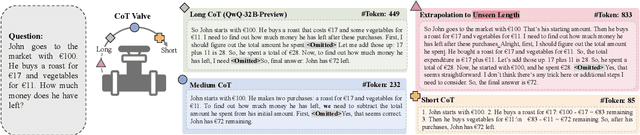
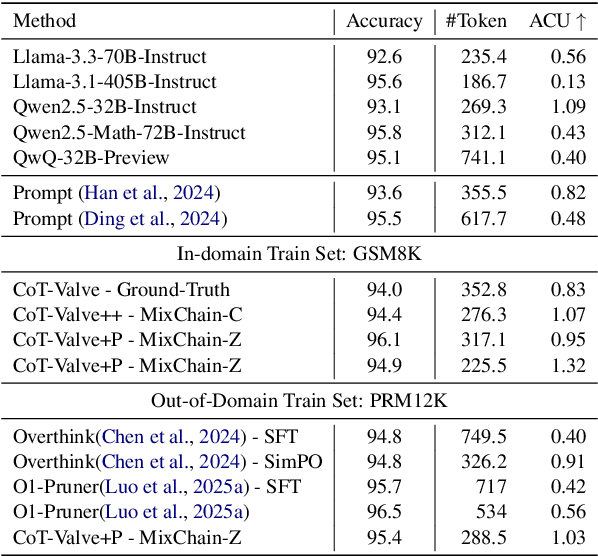
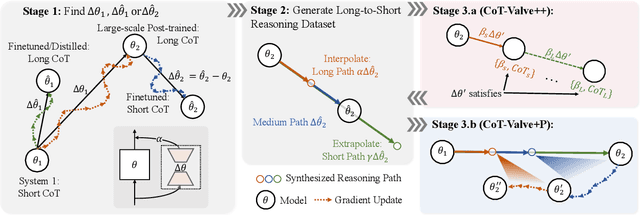
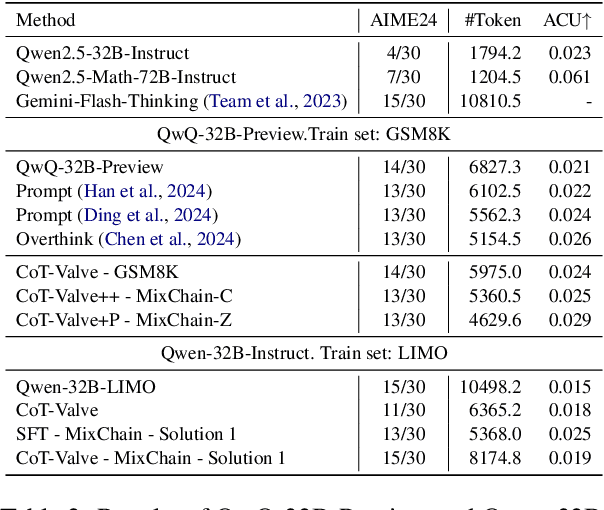
Chain-of-Thought significantly enhances a model's reasoning capability, but it also comes with a considerable increase in inference costs due to long chains. With the observation that the reasoning path can be easily compressed under easy tasks but struggle on hard tasks, we explore the feasibility of elastically controlling the length of reasoning paths with only one model, thereby reducing the inference overhead of reasoning models dynamically based on task difficulty. We introduce a new tuning and inference strategy named CoT-Valve, designed to allow models to generate reasoning chains of varying lengths. To achieve this, we propose to identify a direction in the parameter space that, when manipulated, can effectively control the length of generated CoT. Moreover, we show that this property is valuable for compressing the reasoning chain. We construct datasets with chains from long to short for the same questions and explore two enhanced strategies for CoT-Valve: (1) a precise length-compressible CoT tuning method, and (2) a progressive chain length compression approach. Our experiments show that CoT-Valve successfully enables controllability and compressibility of the chain and shows better performance than the prompt-based control. We applied this method to QwQ-32B-Preview, reducing reasoning chains on GSM8K from 741 to 225 tokens with a minor performance drop (95.07% to 94.92%) and on AIME from 6827 to 4629 tokens, with only one additional incorrect answer.