 Add to Chrome
 Add to Firefox
 Add to Edge
Reasoning4Sciences: Bridging Reasoning Language Models to All Scientific Branches
May 31, 2026
While Reasoning Language Models (RLMs) are rapidly emerging as powerful tools for scientific research, their impact is primarily concentrated in "hard science" fields. The slow -- or lack of -- adoption of RLMs in other branches of science is causing a widening gap in research productivity. In this survey, we provide the first comprehensive analysis of RLM adoption across 28 scientific disciplines following the classification used by the European Research Council (ERC), spanning the Social Sciences and Humanities, Physical Sciences and Engineering, and Life Sciences. We examine how RLMs are developed, evaluated, and applied across disciplines. Furthermore, we introduce a maturity-oriented assessment framework based on available domain-specific development and evaluation resources, revealing substantial disparities in RLM maturity that become even more pronounced when only publicly available resources are considered. Finally, we highlight current implementation paradigms that are gaining popularity across disciplines, current challenges, and future directions in enabling RLM adoption across science.

How Annotation Trains Annotators: Competence Development in Social Influence Recognition
Apr 03, 2026Human data annotation, especially when involving experts, is often treated as an objective reference. However, many annotation tasks are inherently subjective, and annotators' judgments may evolve over time. This study investigates changes in the quality of annotators' work from a competence perspective during a process of social influence recognition. The study involved 25 annotators from five different groups, including both experts and non-experts, who annotated a dataset of 1,021 dialogues with 20 social influence techniques, along with intentions, reactions, and consequences. An initial subset of 150 texts was annotated twice - before and after the main annotation process - to enable comparison. To measure competence shifts, we combined qualitative and quantitative analyses of the annotated data, semi-structured interviews with annotators, self-assessment surveys, and Large Language Model training and evaluation on the comparison dataset. The results indicate a significant increase in annotators' self-perceived competence and confidence. Moreover, observed changes in data quality suggest that the annotation process may enhance annotator competence and that this effect is more pronounced in expert groups. The observed shifts in annotator competence have a visible impact on the performance of LLMs trained on their annotated data.
PLLuM: A Family of Polish Large Language Models
Nov 05, 2025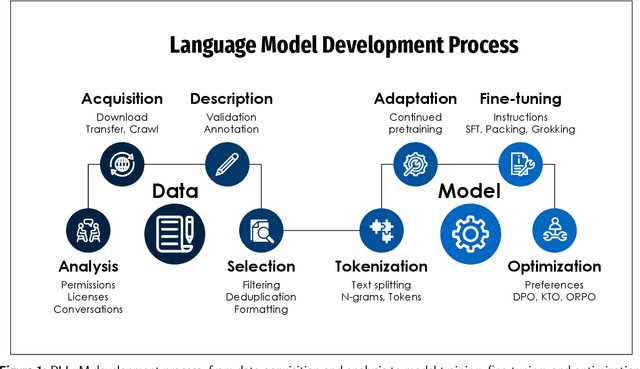
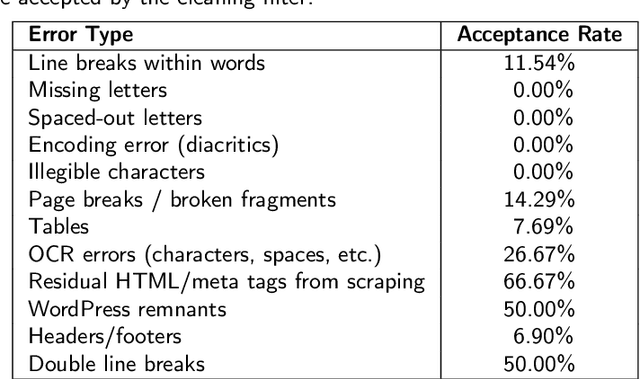
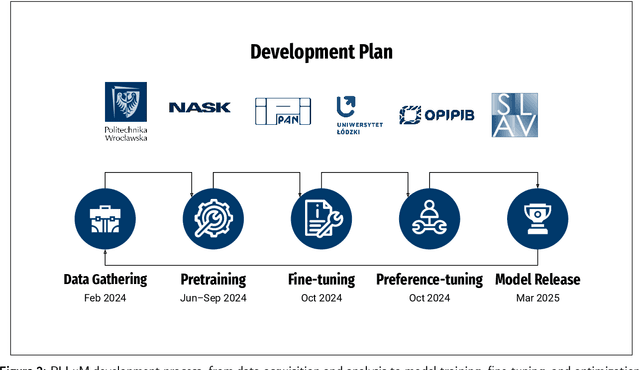

Large Language Models (LLMs) play a central role in modern artificial intelligence, yet their development has been primarily focused on English, resulting in limited support for other languages. We present PLLuM (Polish Large Language Model), the largest open-source family of foundation models tailored specifically for the Polish language. Developed by a consortium of major Polish research institutions, PLLuM addresses the need for high-quality, transparent, and culturally relevant language models beyond the English-centric commercial landscape. We describe the development process, including the construction of a new 140-billion-token Polish text corpus for pre-training, a 77k custom instructions dataset, and a 100k preference optimization dataset. A key component is a Responsible AI framework that incorporates strict data governance and a hybrid module for output correction and safety filtering. We detail the models' architecture, training procedures, and alignment techniques for both base and instruction-tuned variants, and demonstrate their utility in a downstream task within public administration. By releasing these models publicly, PLLuM aims to foster open research and strengthen sovereign AI technologies in Poland.
Enhancing AI Face Realism: Cost-Efficient Quality Improvement in Distilled Diffusion Models with a Fully Synthetic Dataset
May 04, 2025
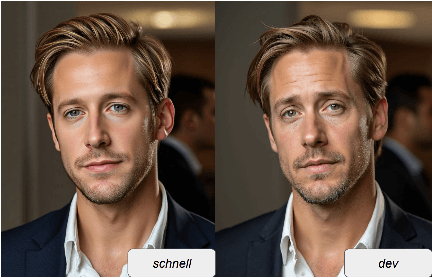
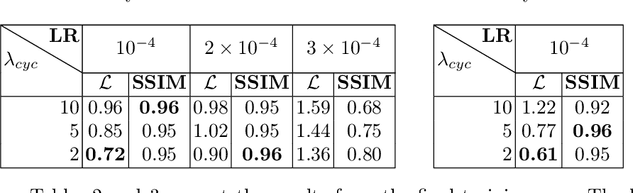
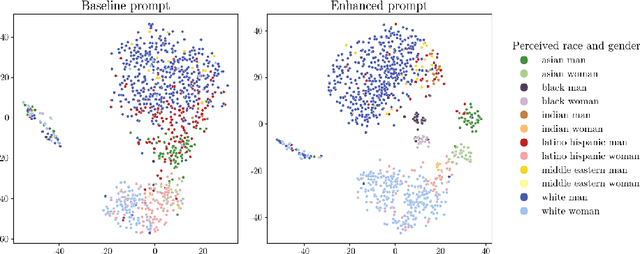
This study presents a novel approach to enhance the cost-to-quality ratio of image generation with diffusion models. We hypothesize that differences between distilled (e.g. FLUX.1-schnell) and baseline (e.g. FLUX.1-dev) models are consistent and, therefore, learnable within a specialized domain, like portrait generation. We generate a synthetic paired dataset and train a fast image-to-image translation head. Using two sets of low- and high-quality synthetic images, our model is trained to refine the output of a distilled generator (e.g., FLUX.1-schnell) to a level comparable to a baseline model like FLUX.1-dev, which is more computationally intensive. Our results show that the pipeline, which combines a distilled version of a large generative model with our enhancement layer, delivers similar photorealistic portraits to the baseline version with up to an 82% decrease in computational cost compared to FLUX.1-dev. This study demonstrates the potential for improving the efficiency of AI solutions involving large-scale image generation.