 Add to Chrome
 Add to Firefox
 Add to Edge
Reasoning4Sciences: Bridging Reasoning Language Models to All Scientific Branches
May 31, 2026
While Reasoning Language Models (RLMs) are rapidly emerging as powerful tools for scientific research, their impact is primarily concentrated in "hard science" fields. The slow -- or lack of -- adoption of RLMs in other branches of science is causing a widening gap in research productivity. In this survey, we provide the first comprehensive analysis of RLM adoption across 28 scientific disciplines following the classification used by the European Research Council (ERC), spanning the Social Sciences and Humanities, Physical Sciences and Engineering, and Life Sciences. We examine how RLMs are developed, evaluated, and applied across disciplines. Furthermore, we introduce a maturity-oriented assessment framework based on available domain-specific development and evaluation resources, revealing substantial disparities in RLM maturity that become even more pronounced when only publicly available resources are considered. Finally, we highlight current implementation paradigms that are gaining popularity across disciplines, current challenges, and future directions in enabling RLM adoption across science.

How Annotation Trains Annotators: Competence Development in Social Influence Recognition
Apr 03, 2026Human data annotation, especially when involving experts, is often treated as an objective reference. However, many annotation tasks are inherently subjective, and annotators' judgments may evolve over time. This study investigates changes in the quality of annotators' work from a competence perspective during a process of social influence recognition. The study involved 25 annotators from five different groups, including both experts and non-experts, who annotated a dataset of 1,021 dialogues with 20 social influence techniques, along with intentions, reactions, and consequences. An initial subset of 150 texts was annotated twice - before and after the main annotation process - to enable comparison. To measure competence shifts, we combined qualitative and quantitative analyses of the annotated data, semi-structured interviews with annotators, self-assessment surveys, and Large Language Model training and evaluation on the comparison dataset. The results indicate a significant increase in annotators' self-perceived competence and confidence. Moreover, observed changes in data quality suggest that the annotation process may enhance annotator competence and that this effect is more pronounced in expert groups. The observed shifts in annotator competence have a visible impact on the performance of LLMs trained on their annotated data.
The Dark Patterns of Personalized Persuasion in Large Language Models: Exposing Persuasive Linguistic Features for Big Five Personality Traits in LLMs Responses
Nov 12, 2024
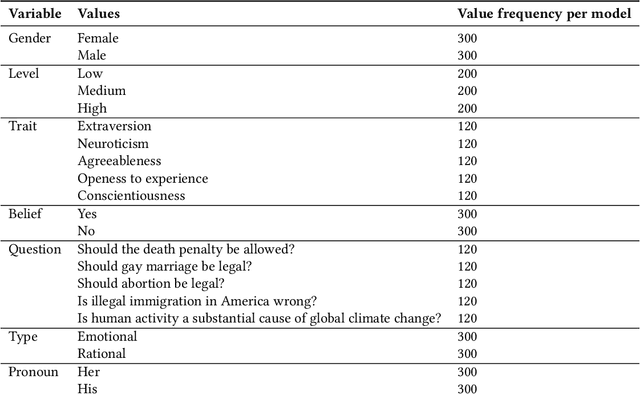
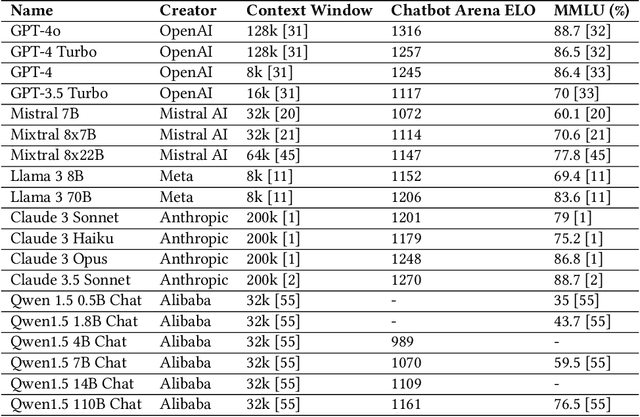
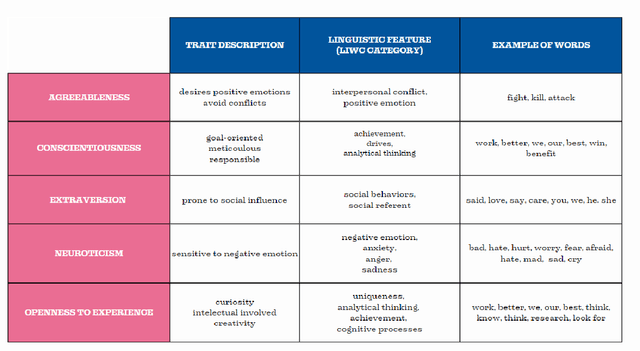
This study explores how the Large Language Models (LLMs) adjust linguistic features to create personalized persuasive outputs. While research showed that LLMs personalize outputs, a gap remains in understanding the linguistic features of their persuasive capabilities. We identified 13 linguistic features crucial for influencing personalities across different levels of the Big Five model of personality. We analyzed how prompts with personality trait information influenced the output of 19 LLMs across five model families. The findings show that models use more anxiety-related words for neuroticism, increase achievement-related words for conscientiousness, and employ fewer cognitive processes words for openness to experience. Some model families excel at adapting language for openness to experience, others for conscientiousness, while only one model adapts language for neuroticism. Our findings show how LLMs tailor responses based on personality cues in prompts, indicating their potential to create persuasive content affecting the mind and well-being of the recipients.
ChatGPT: Jack of all trades, master of none
Feb 21, 2023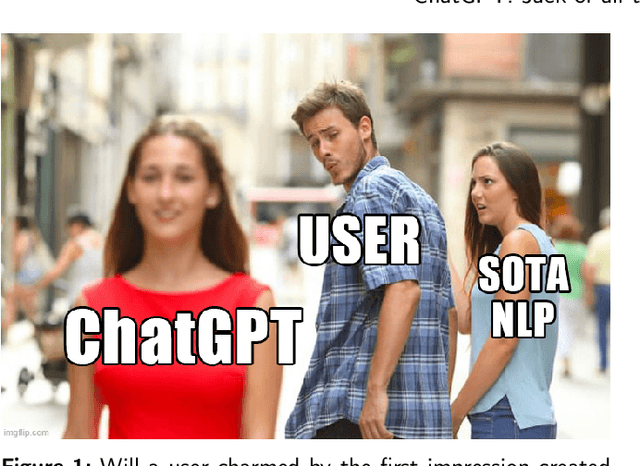
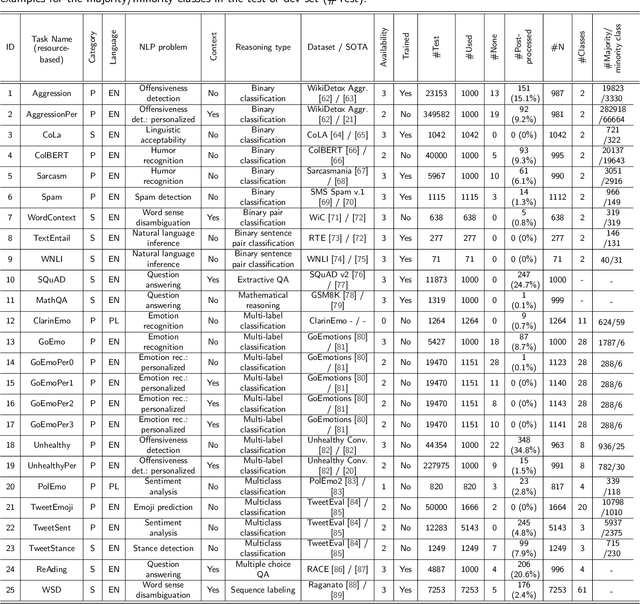
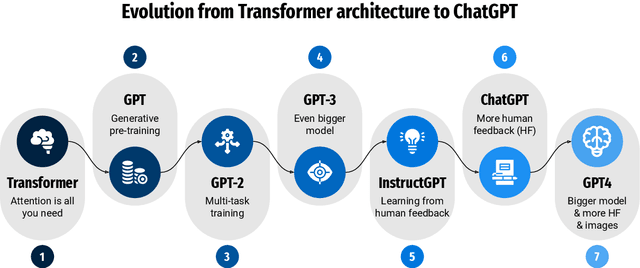

OpenAI has released the Chat Generative Pre-trained Transformer (ChatGPT) and revolutionized the approach in artificial intelligence to human-model interaction. The first contact with the chatbot reveals its ability to provide detailed and precise answers in various areas. There are several publications on ChatGPT evaluation, testing its effectiveness on well-known natural language processing (NLP) tasks. However, the existing studies are mostly non-automated and tested on a very limited scale. In this work, we examined ChatGPT's capabilities on 25 diverse analytical NLP tasks, most of them subjective even to humans, such as sentiment analysis, emotion recognition, offensiveness and stance detection, natural language inference, word sense disambiguation, linguistic acceptability and question answering. We automated ChatGPT's querying process and analyzed more than 38k responses. Our comparison of its results with available State-of-the-Art (SOTA) solutions showed that the average loss in quality of the ChatGPT model was about 25% for zero-shot and few-shot evaluation. We showed that the more difficult the task (lower SOTA performance), the higher the ChatGPT loss. It especially refers to pragmatic NLP problems like emotion recognition. We also tested the ability of personalizing ChatGPT responses for selected subjective tasks via Random Contextual Few-Shot Personalization, and we obtained significantly better user-based predictions. Additional qualitative analysis revealed a ChatGPT bias, most likely due to the rules imposed on human trainers by OpenAI. Our results provide the basis for a fundamental discussion of whether the high quality of recent predictive NLP models can indicate a tool's usefulness to society and how the learning and validation procedures for such systems should be established.