 Add to Chrome
 Add to Firefox
 Add to Edge
Understanding Wacky Weights: A Dissection of SPLADE's Learned Term Importance
May 19, 2026
Learned sparse retrieval models such as SPLADE combine the effectiveness of neural architectures with the efficiency of inverted indices. As these models assign weights to terms from a fixed vocabulary, interpretability is often touted as a major benefit of these models. However, the emergence of wacky weights, i.e., expansion terms that appear semantically unrelated to the input, limits interpretability. While prior research has anecdotally observed this phenomenon, there is a lack of systematic understanding regarding their origins, prevalence, and contribution to retrieval effectiveness. In this paper, we reproduce SPLADE-v2 to systematically investigate wacky weights across the SPLADE family of models. We present a comprehensive dissection of wacky weights, providing a formal definition of wackiness based on the lexical utility of expansion terms. Furthermore, we introduce a novel measure to compare the prevalence of these tokens across models with varying vocabularies and sparsity levels. Beyond reproducing the original SPLADE-v2, we train it with various loss functions, datasets, and backbone transformers to isolate the factors contributing to wackiness. Our results show that larger vocabularies are associated with a higher prevalence of wacky tokens, while stricter sparsity regularizers are associated with lower prevalence. Finally, we find that wacky weights are used primarily for in-domain effectiveness rather than out-of-domain generalization.

Sinkhorn Transformations for Single-Query Postprocessing in Text-Video Retrieval
Nov 14, 2023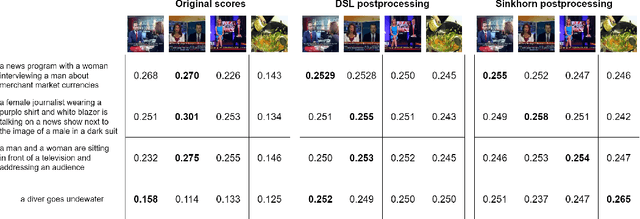
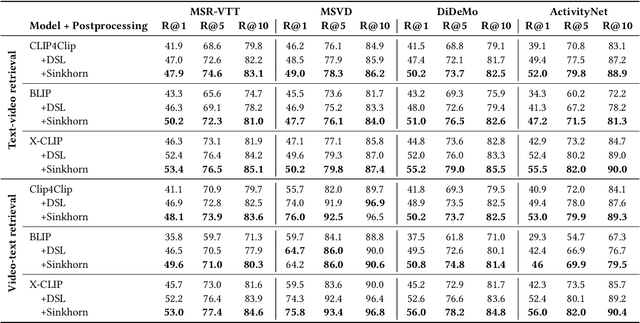
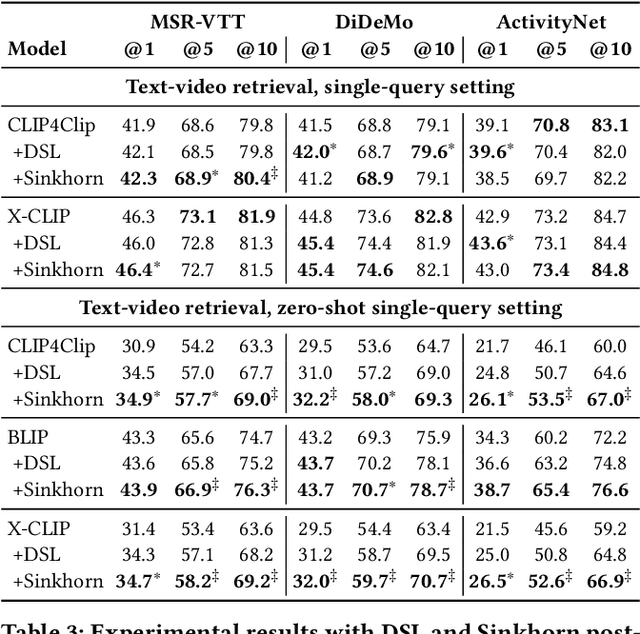
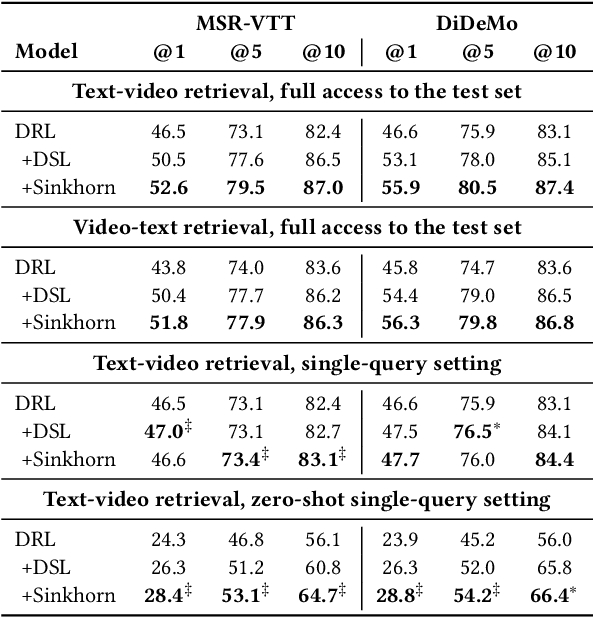
A recent trend in multimodal retrieval is related to postprocessing test set results via the dual-softmax loss (DSL). While this approach can bring significant improvements, it usually presumes that an entire matrix of test samples is available as DSL input. This work introduces a new postprocessing approach based on Sinkhorn transformations that outperforms DSL. Further, we propose a new postprocessing setting that does not require access to multiple test queries. We show that our approach can significantly improve the results of state of the art models such as CLIP4Clip, BLIP, X-CLIP, and DRL, thus achieving a new state-of-the-art on several standard text-video retrieval datasets both with access to the entire test set and in the single-query setting.