 Add to Chrome
 Add to Firefox
 Add to Edge
Explaining When PRF Fails: Participatory Auditing for Selective Query Expansion
Jul 13, 2026
Pseudo-Relevance Feedback (PRF) improves retrieval effectiveness on average, but harms a substantial fraction of queries through query drift, an asymmetry hidden by aggregate offline metrics. Existing Selective PRF (sPRF) approaches typically rely on Query Performance Prediction (QPP) methods derived from the same ranking statistics, and therefore inherit, rather than resolve, this opacity. We argue that this is a core explainability problem in IR, and propose a two-stage audit-then-automate framework. In Stage 1, a participatory audit with 108 users across 43 TREC Deep Learning 2019 queries shows that only 20.9% of queries benefit from PRF, while 25.6% suffer a degraded user experience, and that avoiding harm is nearly twice as valuable as exploiting successful expansion. In Stage 2, we repurpose LLM-based rerankers as system preference predictors that replicate these user-derived labels automatically, grounded in inspectable document evidence. Together, the two stages explain which queries PRF harms, why an sPRF decision is made, and how the decision can be inspected at scale, turning an opaque retrieval component into an auditable, user-grounded one.

Interpretable Uncertainty for Adaptive Retrieval and Reasoning in Question Answering
Jul 08, 2026Large language models (LLMs) achieve a strong performance in question answering (QA), but remain prone to hallucinations and suffer from limited transparency. Retrieval-augmented generation (RAG) can improve factuality, yet decisions about when and how to retrieve from external resources are typically based on opaque policies or computationally inefficient multi-step prompting procedures. We propose an uncertainty-aware framework for adaptive QA based on explicit signals derived from LLM internal representations. We distinguish between knowledge insufficiency and knowledge ambiguity or conflict, and efficiently estimate these from hidden states in a single forward pass. These signals guide system behaviour: RAG is triggered when knowledge is insufficient, while additional reasoning is applied when ambiguity or conflict is high. By grounding adaptive decisions in decomposed and efficiently estimable uncertainty signals, this approach provides a transparent and practical alternative to existing retrieval and reasoning strategies supporting the design of interpretable user-facing tools.
A Sensitivity-Aware Test Collection for Search Among Personal Information
Jun 25, 2026Traditional search tasks aim to satisfy user information needs by returning a subset of a collection of documents, ranked by the documents' relevance to a user query. However, some collections that contain useful information also contain sensitive personal information. Recently, there has been increasing interest in the development of Sensitivity-Aware Search (SAS) retrieval models to provide users with effective retrieval results without revealing such sensitive information. To develop such systems, test collections containing both sensitive and non-sensitive information, a set of queries, and query-document relevance assessments are required. The Enron email corpus contains real business-related emails, where some emails also contain sensitive personal information. However, the original Enron collection does not contain queries or query-relevance assessments. To this end, we crowdsource 150 query formulations for 50 different topics and 11,471 query-relevance assessments for a subset of the Enron documents that have been manually labelled for sensitivity. We follow best practices for using large language models (LLMs) in Information Retrieval evaluation to extend the collection further with additional LLM judged query-relevance assessments and sensitivity labels. We present baseline performances for relevance, sensitivity classification, and sensitivity-aware search on the collection. We make the collection available, including through the popular ir_datasets package, and provide pre-built sparse and dense indices on Huggingface to facilitate easy experimentation.
All Eyes on the Ranker: Participatory Auditing to Surface Blind Spots in Ranked Search Results
Apr 10, 2026Search engines that present users with a ranked list of search results are a fundamental technology for providing public access to information. Evaluations of such systems are typically conducted by domain experts and focus on model-centric metrics, relevance judgments, or output-based analyses, rather than on how accountability, harm, or trust are experienced by users. This paper argues that participatory auditing is essential for revealing users' causal and contextual understandings of how ranked search results produce impacts, particularly as ranking models appear increasingly convincing and sophisticated in their semantic interpretation of user queries. We report on three participatory auditing workshops (n=21) in which participants engaged with a custom search interface across four tasks, comparing a lexical ranker (BM25) and a neural semantic reranker (MonoT5), exploring varying levels of transparency and user controls, and examining an intentionally adversarially manipulated ranking. Reflexive activities prompted participants to articulate causal narratives linking search system properties to broader impacts. Synthesising the findings, we contribute a taxonomy of user-perceived impacts of ranked search results, spanning epistemic, representational, infrastructural, and downstream social impacts. However, interactions with the neural model revealed limits to participatory auditing itself: perceived system competence and accumulated trust reduced critical scrutiny during the workshop, allowing manipulations to go undetected. Participants expressed desire for visibility into the full search pipeline and recourse mechanisms. Together, these findings show how participatory auditing can surface user perceived impacts and accountability gaps that remain unseen when relying on conventional audits, while revealing where participatory auditing may encounter limitations.
Who Benefits from RAG? The Role of Exposure, Utility and Attribution Bias
Mar 25, 2026Large Language Models (LLMs) enhanced with Retrieval-Augmented Generation (RAG) have achieved substantial improvements in accuracy by grounding their responses in external documents that are relevant to the user's query. However, relatively little work has investigated the impact of RAG in terms of fairness. Particularly, it is not yet known if queries that are associated with certain groups within a fairness category systematically receive higher accuracy, or accuracy improvements in RAG systems compared to LLM-only, a phenomenon we refer to as query group fairness. In this work, we conduct extensive experiments to investigate the impact of three key factors on query group fairness in RAG, namely: Group exposure, i.e., the proportion of documents from each group appearing in the retrieved set, determined by the retriever; Group utility, i.e., the degree to which documents from each group contribute to improving answer accuracy, capturing retriever-generator interactions; and Group attribution, i.e., the extent to which the generator relies on documents from each group when producing responses. We examine group-level average accuracy and accuracy improvements disparities across four fairness categories using three datasets derived from the TREC 2022 Fair Ranking Track for two tasks: article generation and title generation. Our findings show that RAG systems suffer from the query group fairness problem and amplify disparities in terms of average accuracy across queries from different groups, compared to an LLM-only setting. Moreover, group utility, exposure, and attribution can exhibit strong positive or negative correlations with average accuracy or accuracy improvements of queries from that group, highlighting their important role in fair RAG. Our data and code are publicly available from Github.
Temporal Fact Conflicts in LLMs: Reproducibility Insights from Unifying DYNAMICQA and MULAN
Mar 16, 2026Large Language Models (LLMs) often struggle with temporal fact conflicts due to outdated or evolving information in their training data. Two recent studies with accompanying datasets report opposite conclusions on whether external context can effectively resolve such conflicts. DYNAMICQA evaluates how effective external context is in shifting the model's output distribution, finding that temporal facts are more resistant to change. In contrast, MULAN examines how often external context changes memorised facts, concluding that temporal facts are easier to update. In this reproducibility paper, we first reproduce experiments from both benchmarks. We then reproduce the experiments of each study on the dataset of the other to investigate the source of their disagreement. To enable direct comparison of findings, we standardise both datasets to align with the evaluation settings of each study. Importantly, using an LLM, we synthetically generate realistic natural language contexts to replace MULAN's programmatically constructed statements when reproducing the findings of DYNAMICQA. Our analysis reveals strong dataset dependence: MULAN's findings generalise under both methodological frameworks, whereas applying MULAN's evaluation to DYNAMICQA yields mixed outcomes. Finally, while the original studies only considered 7B LLMs, we reproduce these experiments across LLMs of varying sizes, revealing how model size influences the encoding and updating of temporal facts. Our results highlight how dataset design, evaluation metrics, and model size shape LLM behaviour in the presence of temporal knowledge conflicts.
Document Similarity Enhanced IPS Estimation for Unbiased Learning to Rank
Jul 10, 2025Learning to Rank (LTR) models learn from historical user interactions, such as user clicks. However, there is an inherent bias in the clicks of users due to position bias, i.e., users are more likely to click highly-ranked documents than low-ranked documents. To address this bias when training LTR models, many approaches from the literature re-weight the users' click data using Inverse Propensity Scoring (IPS). IPS re-weights the user's clicks proportionately to the position in the historical ranking that a document was placed when it was clicked since low-ranked documents are less likely to be seen by a user. In this paper, we argue that low-ranked documents that are similar to highly-ranked relevant documents are also likely to be relevant. Moreover, accounting for the similarity of low-ranked documents to highly ranked relevant documents when calculating IPS can more effectively mitigate the effects of position bias. Therefore, we propose an extension to IPS, called IPSsim, that takes into consideration the similarity of documents when estimating IPS. We evaluate our IPSsim estimator using two large publicly available LTR datasets under a number of simulated user click settings, and with different numbers of training clicks. Our experiments show that our IPSsim estimator is more effective than the existing IPS estimators for learning an unbiased LTR model, particularly in top-n settings when n >= 30. For example, when n = 50, our IPSsim estimator achieves a statistically significant ~3% improvement (p < 0.05) in terms of NDCG compared to the Doubly Robust estimator from the literature.
Measuring Hypothesis Testing Errors in the Evaluation of Retrieval Systems
Jul 10, 2025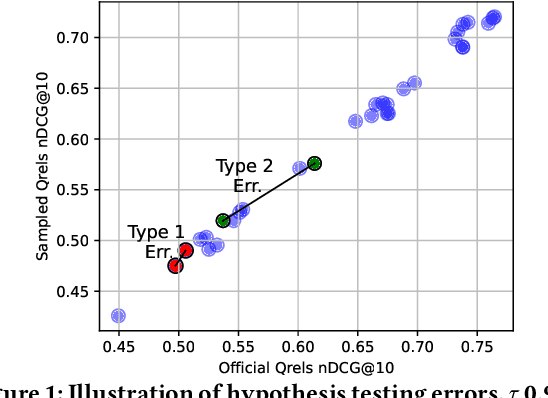

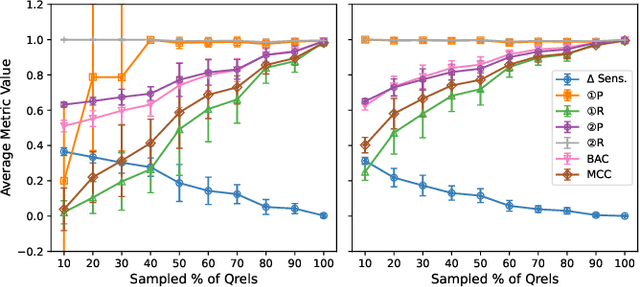

The evaluation of Information Retrieval (IR) systems typically uses query-document pairs with corresponding human-labelled relevance assessments (qrels). These qrels are used to determine if one system is better than another based on average retrieval performance. Acquiring large volumes of human relevance assessments is expensive. Therefore, more efficient relevance assessment approaches have been proposed, necessitating comparisons between qrels to ascertain their efficacy. Discriminative power, i.e. the ability to correctly identify significant differences between systems, is important for drawing accurate conclusions on the robustness of qrels. Previous work has measured the proportion of pairs of systems that are identified as significantly different and has quantified Type I statistical errors. Type I errors lead to incorrect conclusions due to false positive significance tests. We argue that also identifying Type II errors (false negatives) is important as they lead science in the wrong direction. We quantify Type II errors and propose that balanced classification metrics, such as balanced accuracy, can be used to portray the discriminative power of qrels. We perform experiments using qrels generated using alternative relevance assessment methods to investigate measuring hypothesis testing errors in IR evaluation. We find that additional insights into the discriminative power of qrels can be gained by quantifying Type II errors, and that balanced classification metrics can be used to give an overall summary of discriminative power in one, easily comparable, number.
Quantifying Query Fairness Under Unawareness
Jun 04, 2025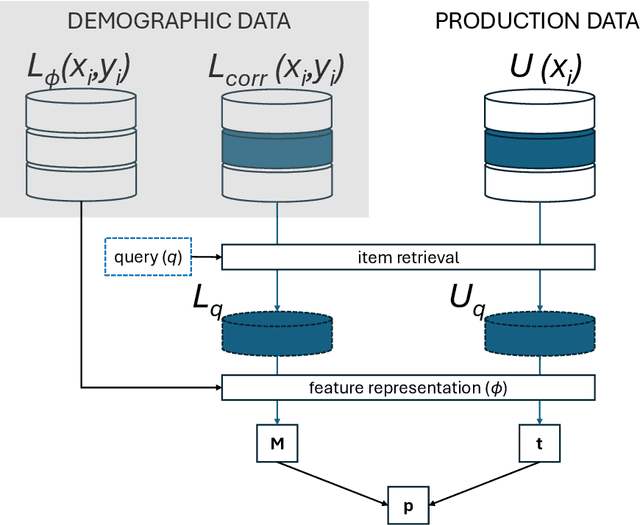

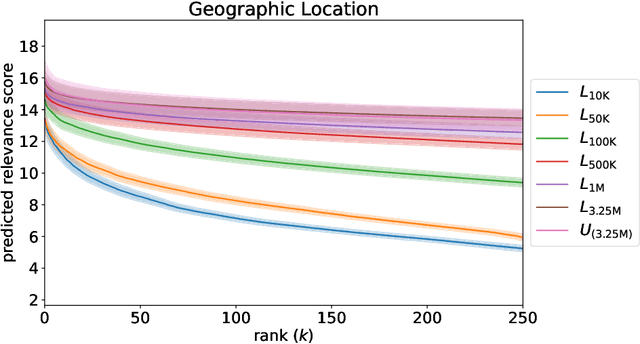

Traditional ranking algorithms are designed to retrieve the most relevant items for a user's query, but they often inherit biases from data that can unfairly disadvantage vulnerable groups. Fairness in information access systems (IAS) is typically assessed by comparing the distribution of groups in a ranking to a target distribution, such as the overall group distribution in the dataset. These fairness metrics depend on knowing the true group labels for each item. However, when groups are defined by demographic or sensitive attributes, these labels are often unknown, leading to a setting known as "fairness under unawareness". To address this, group membership can be inferred using machine-learned classifiers, and group prevalence is estimated by counting the predicted labels. Unfortunately, such an estimation is known to be unreliable under dataset shift, compromising the accuracy of fairness evaluations. In this paper, we introduce a robust fairness estimator based on quantification that effectively handles multiple sensitive attributes beyond binary classifications. Our method outperforms existing baselines across various sensitive attributes and, to the best of our knowledge, is the first to establish a reliable protocol for measuring fairness under unawareness across multiple queries and groups.
Zero-shot and Few-shot Generation Strategies for Artificial Clinical Records
Mar 14, 2024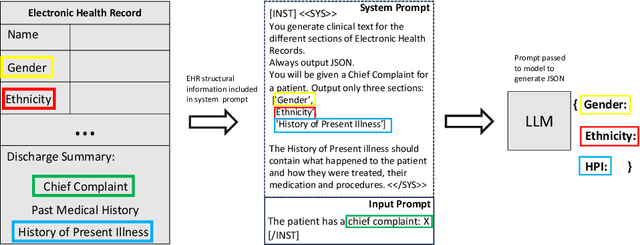

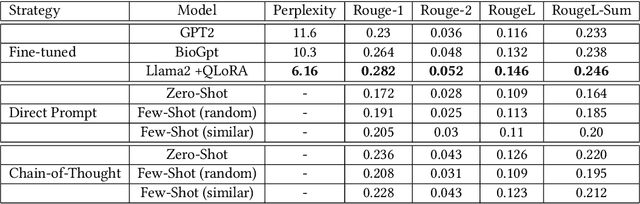
The challenge of accessing historical patient data for clinical research, while adhering to privacy regulations, is a significant obstacle in medical science. An innovative approach to circumvent this issue involves utilising synthetic medical records that mirror real patient data without compromising individual privacy. The creation of these synthetic datasets, particularly without using actual patient data to train Large Language Models (LLMs), presents a novel solution as gaining access to sensitive patient information to train models is also a challenge. This study assesses the capability of the Llama 2 LLM to create synthetic medical records that accurately reflect real patient information, employing zero-shot and few-shot prompting strategies for comparison against fine-tuned methodologies that do require sensitive patient data during training. We focus on generating synthetic narratives for the History of Present Illness section, utilising data from the MIMIC-IV dataset for comparison. In this work introduce a novel prompting technique that leverages a chain-of-thought approach, enhancing the model's ability to generate more accurate and contextually relevant medical narratives without prior fine-tuning. Our findings suggest that this chain-of-thought prompted approach allows the zero-shot model to achieve results on par with those of fine-tuned models, based on Rouge metrics evaluation.