 Add to Chrome
 Add to Firefox
 Add to Edge
Improving Network Anomaly Detection via Choquet-Integral-Based Feature Aggregation
Jul 16, 2026
This work investigates a generalized Choquet-integral-based feature aggregation framework to improve anomaly detection in high-dimensional network traffic data. The approach combines adaptive weighting with incremental feature selection to address feature redundancy. Using Random Forest and XGBoost classifiers, we evaluate models trained with both raw and Choquet-aggregated features under varying feature subset sizes. The proposed aggregation achieves up to $7\%$ higher accuracy while reducing data volume by $77.5\%$ (from $214$~MB to $48$~MB), without degrading precision and recall. Results averaged over multiple stratified repetitions indicate that Choquet-based aggregation yields statistically significant gains ($p < 0.05$) in scenarios with limited feature availability, highlighting its suitability for real-time intrusion detection under bandwidth and feature-availability constraints.

The Concept of Semantic Value in Social Network Analysis: an Application to Comparative Mythology
Sep 13, 2021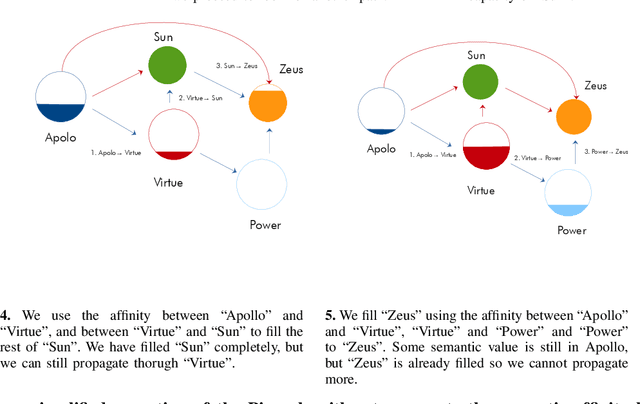
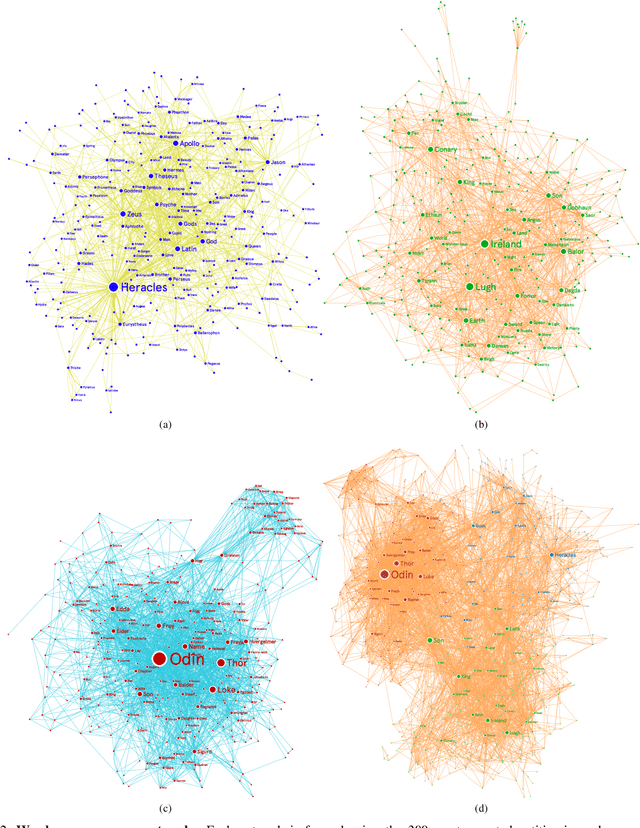
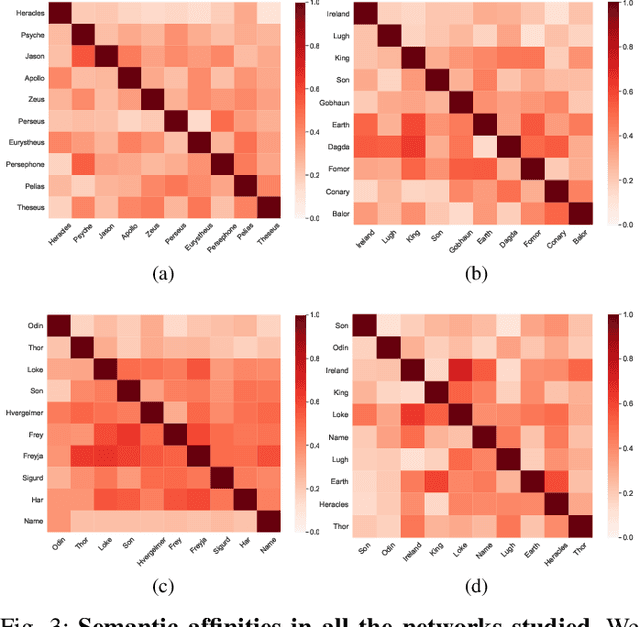
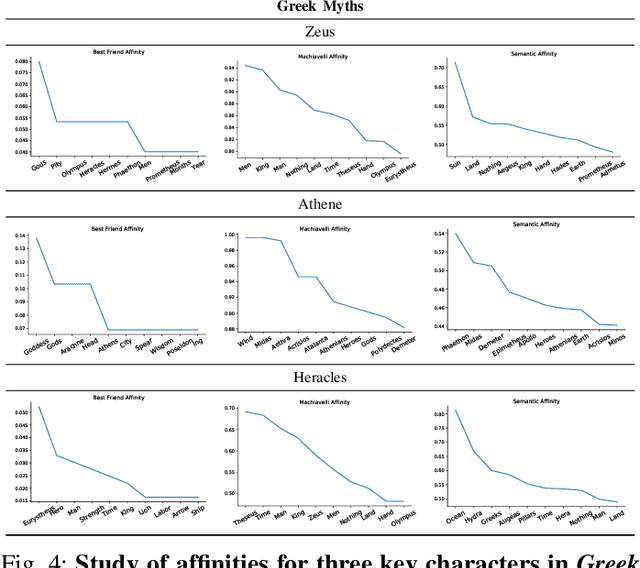
Human sciences have traditionally relied on human reasoning and intelligence to infer knowledge from a wide range of sources, such as oral and written narrations, reports, and traditions. Here we develop an extension of classical social network analysis approaches to incorporate the concept of meaning in each actor, as a mean to quantify and infer further knowledge from the original source of the network. This extension is based on a new affinity function, the semantic affinity, that establishes fuzzy-like relationships between the different actors in the network, using combinations of affinity functions. We also propose a new heuristic algorithm based on the shortest capacity problem to compute this affinity function. We use these concept of meaning and semantic affinity to analyze and compare the gods and heroes from three different classical mythologies: Greek, Celtic and Nordic. We study the relationships of each individual mythology and those of common structure that is formed when we fuse the three of them. We show a strong connection between the Celtic and Nordic gods and that Greeks put more emphasis on heroic characters rather than deities. Our approach provides a technique to highlight and quantify important relationships in the original domain of the network not deducible from its structural properties.