 Add to Chrome
 Add to Firefox
 Add to Edge
If You Want Coherence, Orchestrate a Team of Rivals: Multi-Agent Models of Organizational Intelligence
Jan 20, 2026
AI Agents can perform complex operations at great speed, but just like all the humans we have ever hired, their intelligence remains fallible. Miscommunications aren't noticed, systemic biases have no counter-action, and inner monologues are rarely written down. We did not come to fire them for their mistakes, but to hire them and provide a safe productive working environment. We posit that we can reuse a common corporate organizational structure: teams of independent AI agents with strict role boundaries can work with common goals, but opposing incentives. Multiple models serving as a team of rivals can catch and minimize errors within the final product at a small cost to the velocity of actions. In this paper we demonstrate that we can achieve reliability without acquiring perfect components, but through careful orchestration of imperfect ones. This paper describes the architecture of such a system in practice: specialized agent teams (planners, executors, critics, experts), organized into an organization with clear goals, coordinated through a remote code executor that keeps data transformations and tool invocations separate from reasoning models. Rather than agents directly calling tools and ingesting full responses, they write code that executes remotely; only relevant summaries return to agent context. By preventing raw data and tool outputs from contaminating context windows, the system maintains clean separation between perception (brains that plan and reason) and execution (hands that perform heavy data transformations and API calls). We demonstrate the approach achieves over 90% internal error interception prior to user exposure while maintaining acceptable latency tradeoffs. A survey from our traces shows that we only trade off cost and latency to achieve correctness and incrementally expand capabilities without impacting existing ones.

Robust breast cancer detection in mammography and digital breast tomosynthesis using annotation-efficient deep learning approach
Dec 27, 2019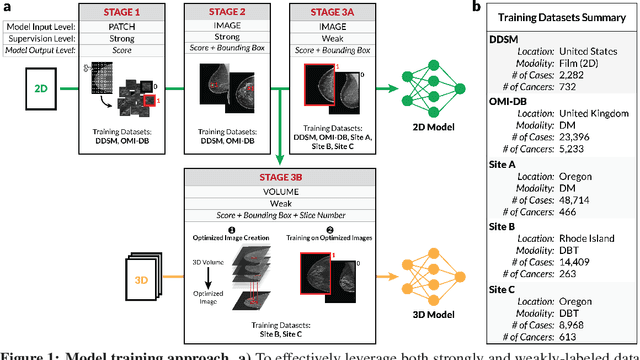
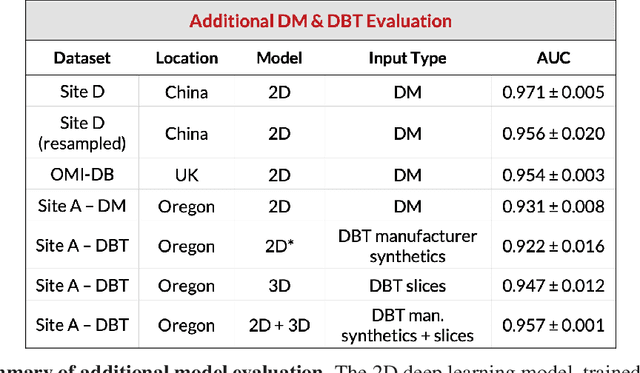
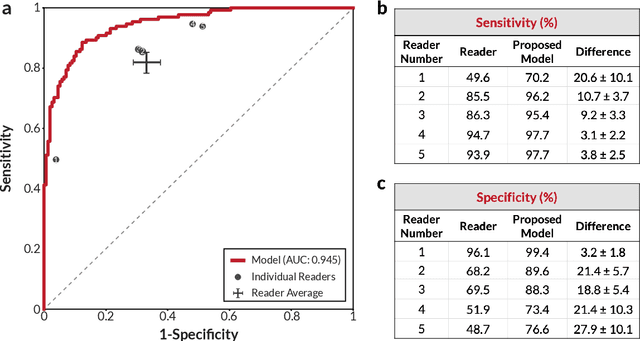
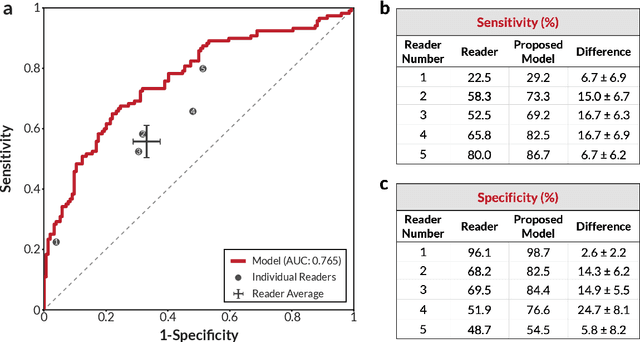
Breast cancer remains a global challenge, causing over 1 million deaths globally in 2018. To achieve earlier breast cancer detection, screening x-ray mammography is recommended by health organizations worldwide and has been estimated to decrease breast cancer mortality by 20-40%. Nevertheless, significant false positive and false negative rates, as well as high interpretation costs, leave opportunities for improving quality and access. To address these limitations, there has been much recent interest in applying deep learning to mammography; however, obtaining large amounts of annotated data poses a challenge for training deep learning models for this purpose, as does ensuring generalization beyond the populations represented in the training dataset. Here, we present an annotation-efficient deep learning approach that 1) achieves state-of-the-art performance in mammogram classification, 2) successfully extends to digital breast tomosynthesis (DBT; "3D mammography"), 3) detects cancers in clinically-negative prior mammograms of cancer patients, 4) generalizes well to a population with low screening rates, and 5) outperforms five-out-of-five full-time breast imaging specialists by improving absolute sensitivity by an average of 14%. Our results demonstrate promise towards software that can improve the accuracy of and access to screening mammography worldwide.