 Add to Chrome
 Add to Firefox
 Add to Edge
GRASS: Gradient-based Adaptive Layer-wise Importance Sampling for Memory-efficient Large Language Model Fine-tuning
Apr 09, 2026
Full-parameter fine-tuning of large language models is constrained by substantial GPU memory requirements. Low-rank adaptation methods mitigate this challenge by updating only a subset of parameters. However, these approaches often limit model expressiveness and yield lower performance than full-parameter fine-tuning. Layer-wise fine-tuning methods have emerged as an alternative, enabling memory-efficient training through static layer importance sampling strategies. However, these methods overlook variations in layer importance across tasks and training stages, resulting in suboptimal performance on downstream tasks. To address these limitations, we propose GRASS, a gradient-based adaptive layer-wise importance sampling framework. GRASS utilizes mean gradient norms as a task-aware and training-stage-aware metric for estimating layer importance. Furthermore, GRASS adaptively adjusts layer sampling probabilities through an adaptive training strategy. We also introduce a layer-wise optimizer state offloading mechanism that overlaps computation and communication to further reduce memory usage while maintaining comparable training throughput. Extensive experiments across multiple models and benchmarks demonstrate that GRASS consistently outperforms state-of-the-art methods, achieving an average accuracy improvement of up to 4.38 points and reducing memory usage by up to 19.97\%.

A Survey on Memory-Efficient Large-Scale Model Training in AI for Science
Jan 21, 2025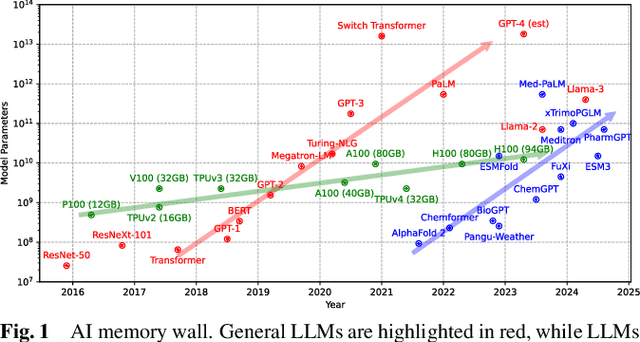
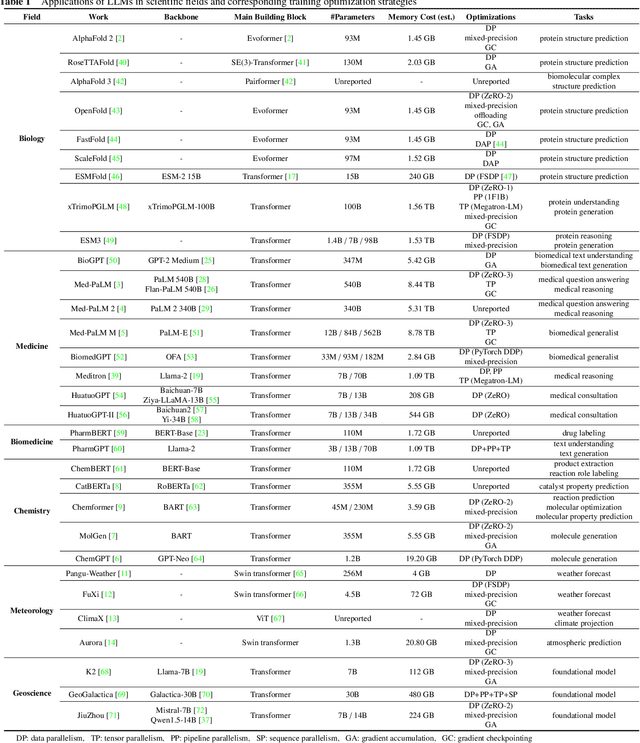


Scientific research faces high costs and inefficiencies with traditional methods, but the rise of deep learning and large language models (LLMs) offers innovative solutions. This survey reviews LLM applications across scientific fields such as biology, medicine, chemistry, and meteorology, underscoring their role in advancing research. However, the continuous expansion of model size has led to significant memory demands, hindering further development and application of LLMs for science. To address this, we review memory-efficient training techniques for LLMs based on the transformer architecture, including distributed training, mixed precision training, and gradient checkpointing. Using AlphaFold 2 as an example, we demonstrate how tailored memory optimization methods can reduce storage needs while preserving prediction accuracy. We also discuss the challenges of memory optimization in practice and potential future directions, hoping to provide valuable insights for researchers and engineers.