 Add to Chrome
 Add to Firefox
 Add to Edge
Utility-Guided Agent Orchestration for Efficient LLM Tool Use
Mar 20, 2026
Tool-using large language model (LLM) agents often face a fundamental tension between answer quality and execution cost. Fixed workflows are stable but inflexible, while free-form multi-step reasoning methods such as ReAct may improve task performance at the expense of excessive tool calls, longer trajectories, higher token consumption, and increased latency. In this paper, we study agent orchestration as an explicit decision problem rather than leaving it entirely to prompt-level behavior. We propose a utility-guided orchestration policy that selects among actions such as respond, retrieve, tool call, verify, and stop by balancing estimated gain, step cost, uncertainty, and redundancy. Our goal is not to claim universally best task performance, but to provide a controllable and analyzable policy framework for studying quality-cost trade-offs in tool-using LLM agents. Experiments across direct answering, threshold control, fixed workflows, ReAct, and several policy variants show that explicit orchestration signals substantially affect agent behavior. Additional analyses on cost definitions, workflow fairness, and redundancy control further demonstrate that lightweight utility design can provide a defensible and practical mechanism for agent control.

Enabling Reconfiguration-Communication Overlap for Collective Communication in Optical Networks
Oct 22, 2025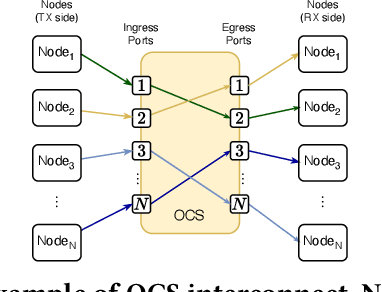
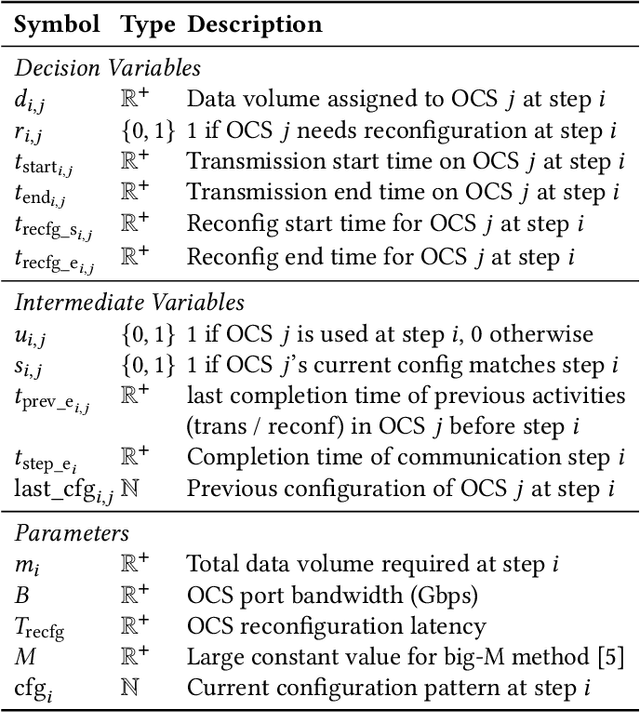
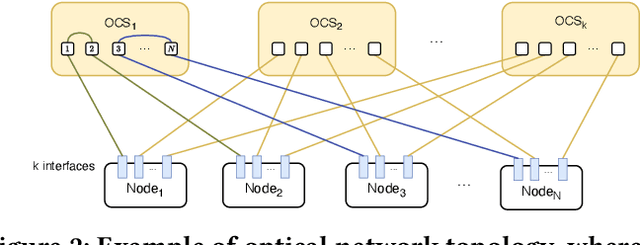
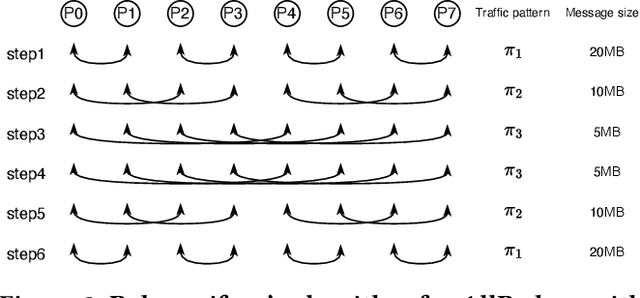
Collective communication (CC) is widely adopted for large-scale distributed machine learning (DML) training workloads. DML's predictable traffic pattern provides a great oppotunity for applying optical network technology. Existing optical interconnects-based CC schemes adopt ``one-shot network reconfiguration'', which provisions static high-capacity topologies for an entire collective operation -- sometimes for a full training iteration. However, this approach faces significant scalability limitations when supporting more complex and efficient CC algorithms required for modern workloads: the ``one-shot'' strategies either demand excessive resource overprovisioning or suffer performance degradation due to rigid resource allocation. To address these challenges, we propose SWOT, a demand-aware optical network framework. SWOT employs ``intra-collective reconfiguration'' and can dynamically align network resources with CC traffic patterns. SWOT incorporates a novel scheduling technique that overlaps optical switch reconfigurations with ongoing transmissions, and improves communication efficiency. SWOT introduce a lightweight collective communication shim that enables coordinated optical network configuration and transmission scheduling while supporting seamless integration with existing CC libraries. Our simulation results demonstrate SWOT's significant performance improvements.