 Add to Chrome
 Add to Firefox
 Add to Edge
Robust Covert Quantum Communication under Bounded Channel Uncertainty
Apr 13, 2026
Covert quantum communication is usually analyzed under idealized assumptions that channel parameters, such as transmissivity and background noise, are perfectly known and constant. In realistic optical links, including satellite, fiber, and free-space systems, these parameters vary because of environmental fluctuations, calibration noise, and estimation errors. We study covert quantum communication over compound quantum optical channels with bounded uncertainty in both transmissivity and thermal noise, and derive guarantees that hold for all admissible channel realizations. We develop a robust framework for certifying both covertness and reliability under uncertainty. A central finding is that robustness cannot be obtained by simply inserting worst-case parameter values into known-channel bounds: the channel realizations that are most adverse for covertness and reliability generally occur at different corners of the uncertainty set. This creates a fundamental trade-off in secure system design. We derive a closed-form lower bound on the worst-case guaranteed number of covert qubits that can be transmitted reliably, identify a sharp feasibility boundary beyond which the guaranteed payload drops to zero, and quantify the security penalty caused by uncertainty. We validate the covertness term with QuTiP simulations of a four-mode bosonic model and combine it with an analytical reliability bound to evaluate the robust payload. Our results move covert quantum communication from nominal perfect-knowledge analysis to certified worst-case operation under uncertainty.

Deep Neural Ranking for Crowdsourced Geopolitical Event Forecasting
Oct 23, 2018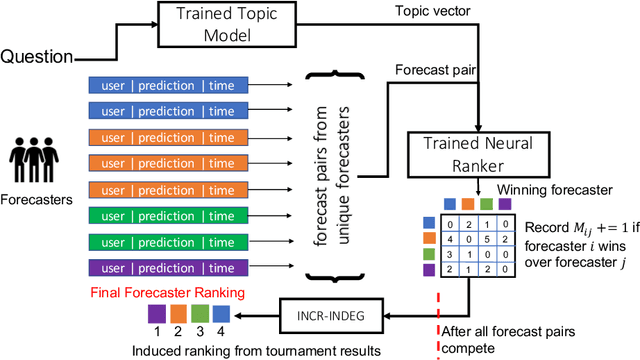
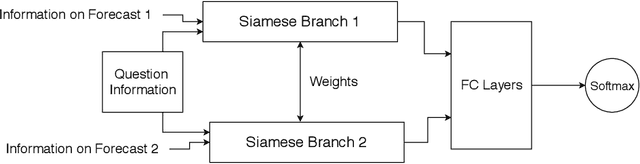
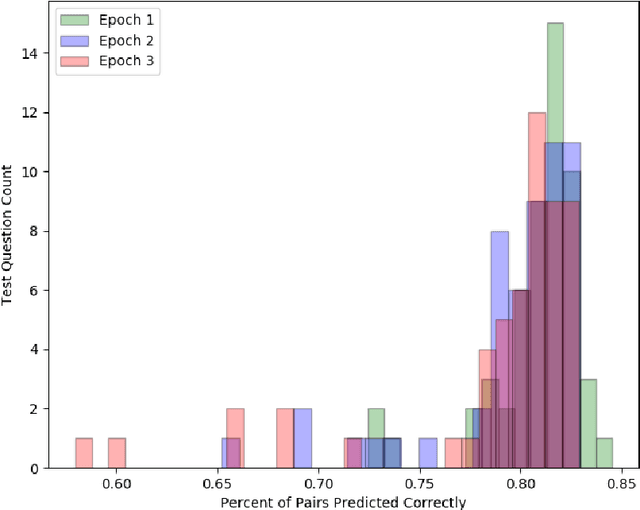
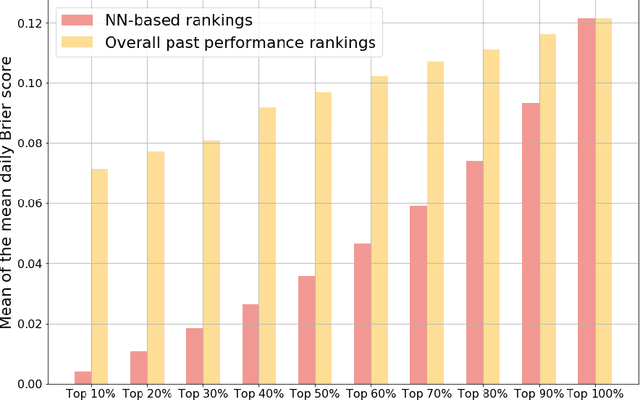
There are many examples of 'wisdom of the crowd' effects in which the large number of participants imparts confidence in the collective judgment of the crowd. But how do we form an aggregated judgment when the size of the crowd is limited? Whose judgments do we include, and whose do we accord the most weight? This paper considers this problem in the context of geopolitical event forecasting, where volunteer analysts are queried to give their expertise, confidence, and predictions about the outcome of an event. We develop a forecast aggregation model that integrates topical information about a question, meta-data about a pair of forecasters, and their predictions in a deep siamese neural network that decides which forecasters' predictions are more likely to be close to the correct response. A ranking of the forecasters is induced from a tournament of pair-wise forecaster comparisons, with the ranking used to create an aggregate forecast. Preliminary results find the aggregate prediction of the best forecasters ranked by our deep siamese network model consistently beats typical aggregation techniques by Brier score.