 Add to Chrome
 Add to Firefox
 Add to Edge
Robust Covert Quantum Communication under Bounded Channel Uncertainty
Apr 13, 2026
Covert quantum communication is usually analyzed under idealized assumptions that channel parameters, such as transmissivity and background noise, are perfectly known and constant. In realistic optical links, including satellite, fiber, and free-space systems, these parameters vary because of environmental fluctuations, calibration noise, and estimation errors. We study covert quantum communication over compound quantum optical channels with bounded uncertainty in both transmissivity and thermal noise, and derive guarantees that hold for all admissible channel realizations. We develop a robust framework for certifying both covertness and reliability under uncertainty. A central finding is that robustness cannot be obtained by simply inserting worst-case parameter values into known-channel bounds: the channel realizations that are most adverse for covertness and reliability generally occur at different corners of the uncertainty set. This creates a fundamental trade-off in secure system design. We derive a closed-form lower bound on the worst-case guaranteed number of covert qubits that can be transmitted reliably, identify a sharp feasibility boundary beyond which the guaranteed payload drops to zero, and quantify the security penalty caused by uncertainty. We validate the covertness term with QuTiP simulations of a four-mode bosonic model and combine it with an analytical reliability bound to evaluate the robust payload. Our results move covert quantum communication from nominal perfect-knowledge analysis to certified worst-case operation under uncertainty.

From Passive Monitoring to Active Defence: Resilient Control of Manipulators Under Cyberattacks
Mar 13, 2026Cyber-physical robotic systems are vulnerable to false data injection attacks (FDIAs), in which an adversary corrupts sensor signals while evading residual-based passive anomaly detectors such as the chi-squared test. Such stealthy attacks can induce substantial end-effector deviations without triggering alarms. This paper studies the resilience of redundant manipulators to stealthy FDIAs and advances the architecture from passive monitoring to active defence. We formulate a closed-loop model comprising a feedback-linearized manipulator, a steady-state Kalman filter, and a chi-squared-based anomaly detector. Building on this passive monitoring layer, we propose an active control-level defence that attenuates the control input through a monotone function of an anomaly score generated by a novel actuation-projected, measurement-free state predictor. The proposed design provides probabilistic guarantees on nominal actuation loss and preserves closed-loop stability. From the attacker perspective, we derive a convex QCQP for computing one-step optimal stealthy attacks. Simulations on a 6-DOF planar manipulator show that the proposed defence significantly reduces attack-induced end-effector deviation while preserving nominal task performance in the absence of attacks.
An Adaptive Data-Enabled Policy Optimization Approach for Autonomous Bicycle Control
Feb 19, 2025This paper presents a unified control framework that integrates a Feedback Linearization (FL) controller in the inner loop with an adaptive Data-Enabled Policy Optimization (DeePO) controller in the outer loop to balance an autonomous bicycle. While the FL controller stabilizes and partially linearizes the inherently unstable and nonlinear system, its performance is compromised by unmodeled dynamics and time-varying characteristics. To overcome these limitations, the DeePO controller is introduced to enhance adaptability and robustness. The initial control policy of DeePO is obtained from a finite set of offline, persistently exciting input and state data. To improve stability and compensate for system nonlinearities and disturbances, a robustness-promoting regularizer refines the initial policy, while the adaptive section of the DeePO framework is enhanced with a forgetting factor to improve adaptation to time-varying dynamics. The proposed DeePO+FL approach is evaluated through simulations and real-world experiments on an instrumented autonomous bicycle. Results demonstrate its superiority over the FL-only approach, achieving more precise tracking of the reference lean angle and lean rate.
Robust Online Epistemic Replanning of Multi-Robot Missions
Mar 01, 2024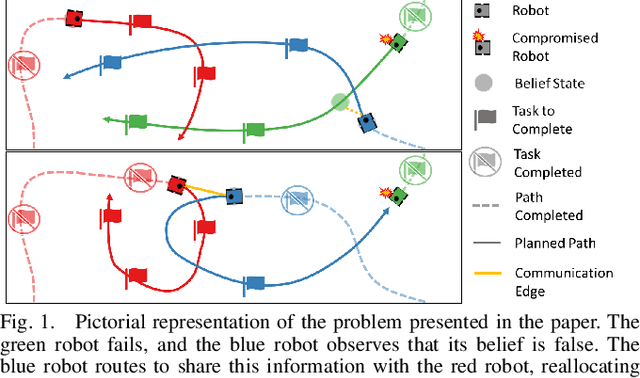
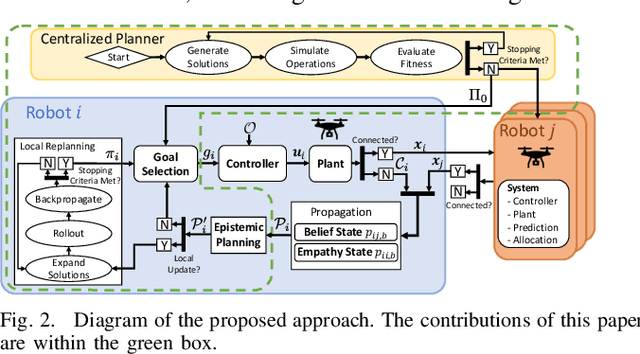
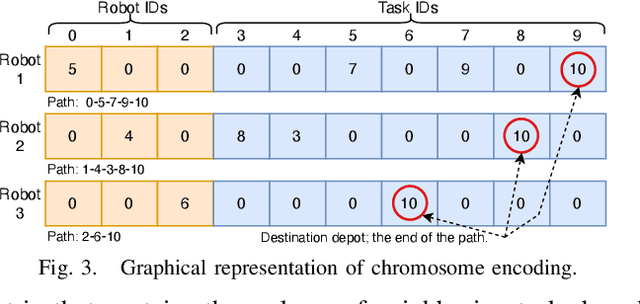
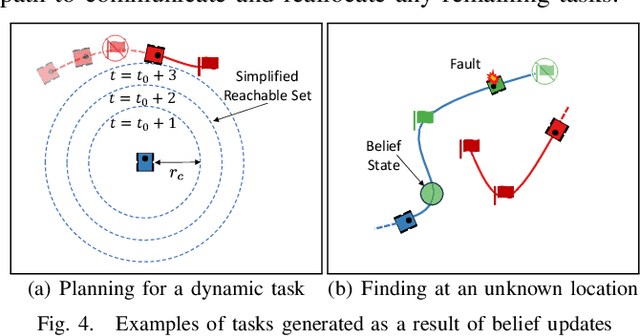
As Multi-Robot Systems (MRS) become more affordable and computing capabilities grow, they provide significant advantages for complex applications such as environmental monitoring, underwater inspections, or space exploration. However, accounting for potential communication loss or the unavailability of communication infrastructures in these application domains remains an open problem. Much of the applicable MRS research assumes that the system can sustain communication through proximity regulations and formation control or by devising a framework for separating and adhering to a predetermined plan for extended periods of disconnection. The latter technique enables an MRS to be more efficient, but breakdowns and environmental uncertainties can have a domino effect throughout the system, particularly when the mission goal is intricate or time-sensitive. To deal with this problem, our proposed framework has two main phases: i) a centralized planner to allocate mission tasks by rewarding intermittent rendezvous between robots to mitigate the effects of the unforeseen events during mission execution, and ii) a decentralized replanning scheme leveraging epistemic planning to formalize belief propagation and a Monte Carlo tree search for policy optimization given distributed rational belief updates. The proposed framework outperforms a baseline heuristic and is validated using simulations and experiments with aerial vehicles.