 Add to Chrome
 Add to Firefox
 Add to Edge
Optimal Post-Training Quantization Scales and Where to Find Them
Jun 09, 2026
Post-training quantization (PTQ) compresses large language models by mapping weights to low-bit representations. The scaling factor that defines the quantization grid is typically chosen using simple, data-free heuristics. In this work, we present PiSO (Piecewise Scale Optimization), an algorithm that leverages calibration data to compute the optimal channel-wise weight scales exactly and efficiently under round-to-nearest quantization. PiSO partitions the scale search space into finitely many intervals on which the objective admits a closed-form minimizer. We extend PiSO to group-wise quantization via principled heuristics and propose effective strategies for interleaving scale optimization with error correction. Experiments on Llama and Qwen models across multiple model sizes and target weight bit-widths demonstrate consistent improvements in perplexity and downstream zero-shot accuracy, both standalone and combined with error correction. In particular, we observe increased benefits as the target bit-width narrows and quantization becomes more challenging.

dMX: Differentiable Mixed-Precision Assignment for Low-Precision Floating-Point Formats
Jun 02, 2026Quantizing large language models (LLMs) to low-precision floating-point representations is central to efficient deployment, yet applying a single bit-width uniformly across all layers is sub-optimal in terms of both performance and accuracy. This work introduces dMX, a differentiable mixed-precision quantization framework for learnable floating-point bit-width assignment. We study its application for the microscaling floating-point (MXFP) family of data types defined by the Open Compute Project (OCP) standard. The per-layer bit-width assignment is formulated as a continuous optimization problem in which each layer's floating-point format format is parameterized by a scalar parameter, folding the multi-variate design space into a single learnable offset. During training this offset takes continuous values, avoiding sudden oscillations between discrete quantization formats. A temperature-based annealing schedule progressively discretizes the learned offsets, ensuring that the final configuration maps to hardware-compatible MXFP formats without abrupt transitions between training and inference behavior. A target-aware regularization term steers the average bit-width toward a user-specified budget, serving as a coarse-grained proxy for inference cost and balancing model quality against deployment efficiency. We performed experiments on different families of LLM, such as Llama, Qwen3, and SmolLM2, evaluating perplexity on WikiText-2 and accuracy on four zero-shot reasoning benchmarks. Across these settings, dMX consistently yields Pareto-dominating models and improves over Kullback-Leibler (KL) divergence-based layer-selection heuristics, efficiently navigating trade-offs between model quality and average bit-width.
MixQuant: Pushing the Limits of Block Rotations in Post-Training Quantization
Jan 29, 2026Recent post-training quantization (PTQ) methods have adopted block rotations to diffuse outliers prior to rounding. While this reduces the overhead of full-vector rotations, the effect of block structure on outlier suppression remains poorly understood. To fill this gap, we present the first systematic, non-asymptotic analysis of outlier suppression for block Hadamard rotations. Our analysis reveals that outlier suppression is fundamentally limited by the geometry of the input vector. In particular, post-rotation outliers are deterministically minimized when the pre-rotation $\ell_1$ norm mass is evenly distributed across blocks. Guided by these insights, we introduce MixQuant, a block rotation-aware PTQ framework that redistributes activation mass via permutations prior to rotation. We propose a greedy mass diffusion algorithm to calibrate permutations by equalizing the expected blockwise $\ell_1$ norms. To avoid adding inference overhead, we identify permutation-equivariant regions in transformer architectures to merge the resulting permutations into model weights before deployment. Experiments show that MixQuant consistently improves accuracy across all block sizes, recovering up to 90% of the full-vector rotation perplexity when quantizing Llama3 1B to INT4 with block size 16, compared to 46% without permutations.
Accumulator-Aware Post-Training Quantization
Sep 25, 2024Several recent studies have investigated low-precision accumulation, reporting improvements in throughput, power, and area across various platforms. However, the accompanying proposals have only considered the quantization-aware training (QAT) paradigm, in which models are fine-tuned or trained from scratch with quantization in the loop. As models continue to grow in size, QAT techniques become increasingly more expensive, which has motivated the recent surge in post-training quantization (PTQ) research. To the best of our knowledge, ours marks the first formal study of accumulator-aware quantization in the PTQ setting. To bridge this gap, we introduce AXE, a practical framework of accumulator-aware extensions designed to endow overflow avoidance guarantees to existing layer-wise PTQ algorithms. We theoretically motivate AXE and demonstrate its flexibility by implementing it on top of two state-of-the-art PTQ algorithms: GPFQ and OPTQ. We further generalize AXE to support multi-stage accumulation for the first time, opening the door for full datapath optimization and scaling to large language models (LLMs). We evaluate AXE across image classification and language generation models, and observe significant improvements in the trade-off between accumulator bit width and model accuracy over baseline methods.
Post-Training Quantization with Low-precision Minifloats and Integers on FPGAs
Nov 21, 2023

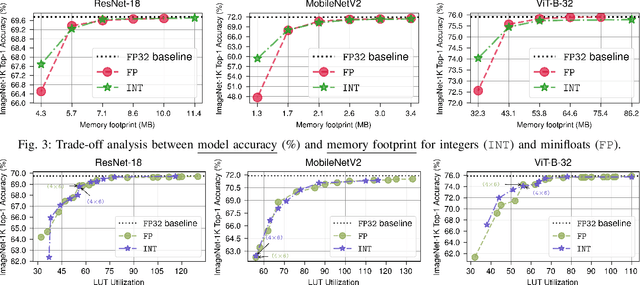

Post-Training Quantization (PTQ) is a powerful technique for model compression, reducing the precision of neural networks without additional training overhead. Recent works have investigated adopting 8-bit floating-point quantization (FP8) in the context of PTQ for model inference. However, the exploration of floating-point formats smaller than 8 bits and their comparison with integer quantization remains relatively limited. In this work, we present minifloats, which are reduced-precision floating-point formats capable of further reducing the memory footprint, latency, and energy cost of a model while approaching full-precision model accuracy. Our work presents a novel PTQ design-space exploration, comparing minifloat and integer quantization schemes across a range of 3 to 8 bits for both weights and activations. We examine the applicability of various PTQ techniques to minifloats, including weight equalization, bias correction, SmoothQuant, gradient-based learned rounding, and the GPTQ method. Our experiments validate the effectiveness of low-precision minifloats when compared to their integer counterparts across a spectrum of accuracy-precision trade-offs on a set of reference deep learning vision workloads. Finally, we evaluate our results against an FPGA-based hardware cost model, showing that integer quantization often remains the Pareto-optimal option, given its relatively smaller hardware resource footprint.