 Add to Chrome
 Add to Firefox
 Add to Edge
The critical slowing down in diffusion models
May 12, 2026
Computational sampling has been central to the sciences since the mid-20th century. While machine-learning-based approaches have recently enabled major advances, their behavior remains poorly understood, with limited theoretical control over when and why they succeed. Here we provide such insight for diffusion models-a class of generative schemes highly effective in practice-by analyzing their application to the $O(n)$ model of statistical field theory in the Gaussian limit $n \to \infty$. In this analytically tractable setting, we show that training a score model with a one-layer network architecture matching the exact solution exhibits a form of critical slowing down in parameter learning. This slowing down also impacts the generation process, indicating that the well-known difficulties of sampling near criticality persist even for learned generative models. To overcome this bottleneck, we demonstrate the power of combining architectural depth with physical locality. We find that using a two-layer architecture drastically reduces the critical slowing down, with the training time scaling logarithmically rather than quadratically with system size. By introducing a local score approximation we show that this acceleration in training time can be achieved without increasing the number of neural network parameters. Taken together, these results demonstrate that diffusion models can overcome the critical slowing down through appropriate architectural design, and establish a controlled framework for understanding and improving learned sampling methods in statistical physics and beyond.

Theory of Speciation Transitions in Diffusion Models with General Class Structure
Feb 04, 2026Diffusion Models generate data by reversing a stochastic diffusion process, progressively transforming noise into structured samples drawn from a target distribution. Recent theoretical work has shown that this backward dynamics can undergo sharp qualitative transitions, known as speciation transitions, during which trajectories become dynamically committed to data classes. Existing theoretical analyses, however, are limited to settings where classes are identifiable through first moments, such as mixtures of Gaussians with well-separated means. In this work, we develop a general theory of speciation in diffusion models that applies to arbitrary target distributions admitting well-defined classes. We formalize the notion of class structure through Bayes classification and characterize speciation times in terms of free-entropy difference between classes. This criterion recovers known results in previously studied Gaussian-mixture models, while extending to situations in which classes are not distinguishable by first moments and may instead differ through higher-order or collective features. Our framework also accommodates multiple classes and predicts the existence of successive speciation times associated with increasingly fine-grained class commitment. We illustrate the theory on two analytically tractable examples: mixtures of one-dimensional Ising models at different temperatures and mixtures of zero-mean Gaussians with distinct covariance structures. In the Ising case, we obtain explicit expressions for speciation times by mapping the problem onto a random-field Ising model and solving it via the replica method. Our results provide a unified and broadly applicable description of speciation transitions in diffusion-based generative models.
High-Dimensional Analysis of Gradient Flow for Extensive-Width Quadratic Neural Networks
Jan 15, 2026We study the high-dimensional training dynamics of a shallow neural network with quadratic activation in a teacher-student setup. We focus on the extensive-width regime, where the teacher and student network widths scale proportionally with the input dimension, and the sample size grows quadratically. This scaling aims to describe overparameterized neural networks in which feature learning still plays a central role. In the high-dimensional limit, we derive a dynamical characterization of the gradient flow, in the spirit of dynamical mean-field theory (DMFT). Under l2-regularization, we analyze these equations at long times and characterize the performance and spectral properties of the resulting estimator. This result provides a quantitative understanding of the effect of overparameterization on learning and generalization, and reveals a double descent phenomenon in the presence of label noise, where generalization improves beyond interpolation. In the small regularization limit, we obtain an exact expression for the perfect recovery threshold as a function of the network widths, providing a precise characterization of how overparameterization influences recovery.
Riemannian Stochastic Interpolants for Amorphous Particle Systems
Dec 18, 2025Modern generative models hold great promise for accelerating diverse tasks involving the simulation of physical systems, but they must be adapted to the specific constraints of each domain. Significant progress has been made for biomolecules and crystalline materials. Here, we address amorphous materials (glasses), which are disordered particle systems lacking atomic periodicity. Sampling equilibrium configurations of glass-forming materials is a notoriously slow and difficult task. This obstacle could be overcome by developing a generative framework capable of producing equilibrium configurations with well-defined likelihoods. In this work, we address this challenge by leveraging an equivariant Riemannian stochastic interpolation framework which combines Riemannian stochastic interpolant and equivariant flow matching. Our method rigorously incorporates periodic boundary conditions and the symmetries of multi-component particle systems, adapting an equivariant graph neural network to operate directly on the torus. Our numerical experiments on model amorphous systems demonstrate that enforcing geometric and symmetry constraints significantly improves generative performance.
Why Diffusion Models Don't Memorize: The Role of Implicit Dynamical Regularization in Training
May 23, 2025Diffusion models have achieved remarkable success across a wide range of generative tasks. A key challenge is understanding the mechanisms that prevent their memorization of training data and allow generalization. In this work, we investigate the role of the training dynamics in the transition from generalization to memorization. Through extensive experiments and theoretical analysis, we identify two distinct timescales: an early time $\tau_\mathrm{gen}$ at which models begin to generate high-quality samples, and a later time $\tau_\mathrm{mem}$ beyond which memorization emerges. Crucially, we find that $\tau_\mathrm{mem}$ increases linearly with the training set size $n$, while $\tau_\mathrm{gen}$ remains constant. This creates a growing window of training times with $n$ where models generalize effectively, despite showing strong memorization if training continues beyond it. It is only when $n$ becomes larger than a model-dependent threshold that overfitting disappears at infinite training times. These findings reveal a form of implicit dynamical regularization in the training dynamics, which allow to avoid memorization even in highly overparameterized settings. Our results are supported by numerical experiments with standard U-Net architectures on realistic and synthetic datasets, and by a theoretical analysis using a tractable random features model studied in the high-dimensional limit.
A Differentiable Rank-Based Objective For Better Feature Learning
Feb 13, 2025In this paper, we leverage existing statistical methods to better understand feature learning from data. We tackle this by modifying the model-free variable selection method, Feature Ordering by Conditional Independence (FOCI), which is introduced in \cite{azadkia2021simple}. While FOCI is based on a non-parametric coefficient of conditional dependence, we introduce its parametric, differentiable approximation. With this approximate coefficient of correlation, we present a new algorithm called difFOCI, which is applicable to a wider range of machine learning problems thanks to its differentiable nature and learnable parameters. We present difFOCI in three contexts: (1) as a variable selection method with baseline comparisons to FOCI, (2) as a trainable model parametrized with a neural network, and (3) as a generic, widely applicable neural network regularizer, one that improves feature learning with better management of spurious correlations. We evaluate difFOCI on increasingly complex problems ranging from basic variable selection in toy examples to saliency map comparisons in convolutional networks. We then show how difFOCI can be incorporated in the context of fairness to facilitate classifications without relying on sensitive data.
Understanding Classifier-Free Guidance: High-Dimensional Theory and Non-Linear Generalizations
Feb 11, 2025Recent studies have raised concerns about the effectiveness of Classifier-Free Guidance (CFG), indicating that in low-dimensional settings, it can lead to overshooting the target distribution and reducing sample diversity. In this work, we demonstrate that in infinite and sufficiently high-dimensional contexts CFG effectively reproduces the target distribution, revealing a blessing-of-dimensionality result. Additionally, we explore finite-dimensional effects, precisely characterizing overshoot and variance reduction. Based on our analysis, we introduce non-linear generalizations of CFG. Through numerical simulations on Gaussian mixtures and experiments on class-conditional and text-to-image diffusion models, we validate our analysis and show that our non-linear CFG offers improved flexibility and generation quality without additional computation cost.
Optimizing Noise Schedules of Generative Models in High Dimensionss
Jan 02, 2025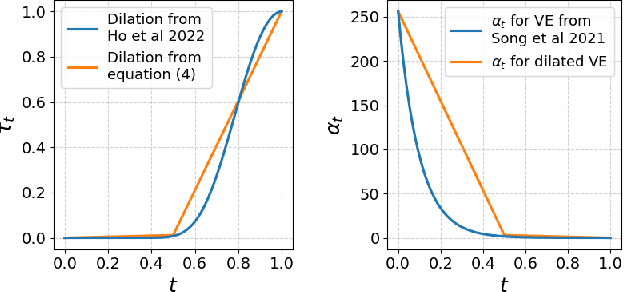
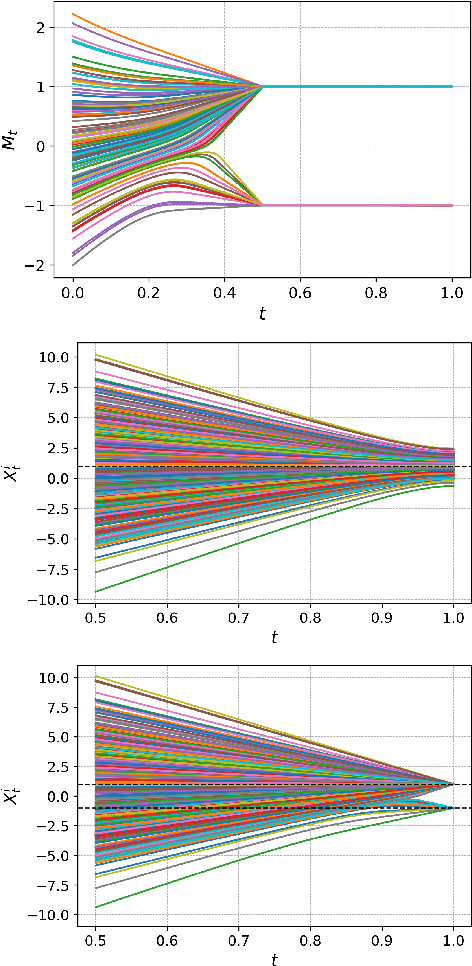
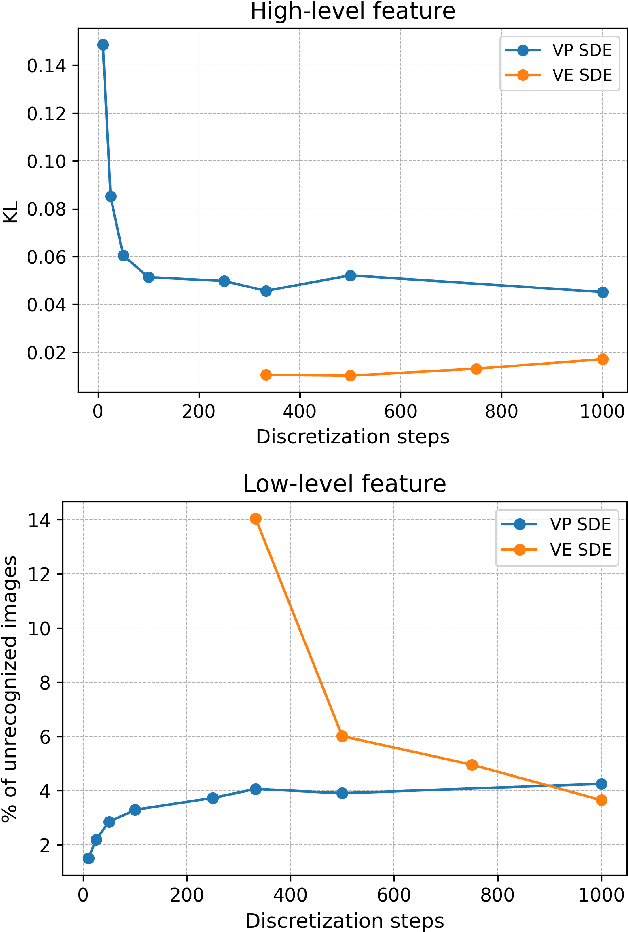

Recent works have shown that diffusion models can undergo phase transitions, the resolution of which is needed for accurately generating samples. This has motivated the use of different noise schedules, the two most common choices being referred to as variance preserving (VP) and variance exploding (VE). Here we revisit these schedules within the framework of stochastic interpolants. Using the Gaussian Mixture (GM) and Curie-Weiss (CW) data distributions as test case models, we first investigate the effect of the variance of the initial noise distribution and show that VP recovers the low-level feature (the distribution of each mode) but misses the high-level feature (the asymmetry between modes), whereas VE performs oppositely. We also show that this dichotomy, which happens when denoising by a constant amount in each step, can be avoided by using noise schedules specific to VP and VE that allow for the recovery of both high- and low-level features. Finally we show that these schedules yield generative models for the GM and CW model whose probability flow ODE can be discretized using $\Theta_d(1)$ steps in dimension $d$ instead of the $\Theta_d(\sqrt{d})$ steps required by constant denoising.
Kernel Density Estimators in Large Dimensions
Aug 11, 2024This paper studies Kernel density estimation for a high-dimensional distribution $\rho(x)$. Traditional approaches have focused on the limit of large number of data points $n$ and fixed dimension $d$. We analyze instead the regime where both the number $n$ of data points $y_i$ and their dimensionality $d$ grow with a fixed ratio $\alpha=(\log n)/d$. Our study reveals three distinct statistical regimes for the kernel-based estimate of the density $\hat \rho_h^{\mathcal {D}}(x)=\frac{1}{n h^d}\sum_{i=1}^n K\left(\frac{x-y_i}{h}\right)$, depending on the bandwidth $h$: a classical regime for large bandwidth where the Central Limit Theorem (CLT) holds, which is akin to the one found in traditional approaches. Below a certain value of the bandwidth, $h_{CLT}(\alpha)$, we find that the CLT breaks down. The statistics of $\hat \rho_h^{\mathcal {D}}(x)$ for a fixed $x$ drawn from $\rho(x)$ is given by a heavy-tailed distribution (an alpha-stable distribution). In particular below a value $h_G(\alpha)$, we find that $\hat \rho_h^{\mathcal {D}}(x)$ is governed by extreme value statistics: only a few points in the database matter and give the dominant contribution to the density estimator. We provide a detailed analysis for high-dimensional multivariate Gaussian data. We show that the optimal bandwidth threshold based on Kullback-Leibler divergence lies in the new statistical regime identified in this paper. Our findings reveal limitations of classical approaches, show the relevance of these new statistical regimes, and offer new insights for Kernel density estimation in high-dimensional settings.
Cascade of phase transitions in the training of Energy-based models
May 23, 2024In this paper, we investigate the feature encoding process in a prototypical energy-based generative model, the Restricted Boltzmann Machine (RBM). We start with an analytical investigation using simplified architectures and data structures, and end with numerical analysis of real trainings on real datasets. Our study tracks the evolution of the model's weight matrix through its singular value decomposition, revealing a series of phase transitions associated to a progressive learning of the principal modes of the empirical probability distribution. The model first learns the center of mass of the modes and then progressively resolve all modes through a cascade of phase transitions. We first describe this process analytically in a controlled setup that allows us to study analytically the training dynamics. We then validate our theoretical results by training the Bernoulli-Bernoulli RBM on real data sets. By using data sets of increasing dimension, we show that learning indeed leads to sharp phase transitions in the high-dimensional limit. Moreover, we propose and test a mean-field finite-size scaling hypothesis. This shows that the first phase transition is in the same universality class of the one we studied analytically, and which is reminiscent of the mean-field paramagnetic-to-ferromagnetic phase transition.