 Add to Chrome
 Add to Firefox
 Add to Edge
In-Context Symbolic Regression for Robustness-Improved Kolmogorov-Arnold Networks
Mar 16, 2026
Symbolic regression aims to replace black-box predictors with concise analytical expressions that can be inspected and validated in scientific machine learning. Kolmogorov-Arnold Networks (KANs) are well suited to this goal because each connection between adjacent units (an "edge") is parametrised by a learnable univariate function that can, in principle, be replaced by a symbolic operator. In practice, however, symbolic extraction is a bottleneck: the standard KAN-to-symbol approach fits operators to each learned edge function in isolation, making the discrete choice sensitive to initialisation and non-convex parameter fitting, and ignoring how local substitutions interact through the full network. We study in-context symbolic regression for operator extraction in KANs, and present two complementary instantiations. Greedy in-context Symbolic Regression (GSR) performs greedy, in-context selection by choosing edge replacements according to end-to-end loss improvement after brief fine-tuning. Gated Matching Pursuit (GMP) amortises this in-context selection by training a differentiable gated operator layer that places an operator library behind sparse gates on each edge; after convergence, gates are discretised (optionally followed by a short in-context greedy refinement pass). We quantify robustness via one-factor-at-a-time (OFAT) hyper-parameter sweeps and assess both predictive error and qualitative consistency of recovered formulas. Across several experiments, greedy in-context symbolic regression achieves up to 99.8% reduction in median OFAT test MSE.

Aligning XAI with EU Regulations for Smart Biomedical Devices: A Methodology for Compliance Analysis
Aug 27, 2024Significant investment and development have gone into integrating Artificial Intelligence (AI) in medical and healthcare applications, leading to advanced control systems in medical technology. However, the opacity of AI systems raises concerns about essential characteristics needed in such sensitive applications, like transparency and trustworthiness. Our study addresses these concerns by investigating a process for selecting the most adequate Explainable AI (XAI) methods to comply with the explanation requirements of key EU regulations in the context of smart bioelectronics for medical devices. The adopted methodology starts with categorising smart devices by their control mechanisms (open-loop, closed-loop, and semi-closed-loop systems) and delving into their technology. Then, we analyse these regulations to define their explainability requirements for the various devices and related goals. Simultaneously, we classify XAI methods by their explanatory objectives. This allows for matching legal explainability requirements with XAI explanatory goals and determining the suitable XAI algorithms for achieving them. Our findings provide a nuanced understanding of which XAI algorithms align better with EU regulations for different types of medical devices. We demonstrate this through practical case studies on different neural implants, from chronic disease management to advanced prosthetics. This study fills a crucial gap in aligning XAI applications in bioelectronics with stringent provisions of EU regulations. It provides a practical framework for developers and researchers, ensuring their AI innovations advance healthcare technology and adhere to legal and ethical standards.
Explainable Artificial Intelligence: a Systematic Review
Jun 04, 2020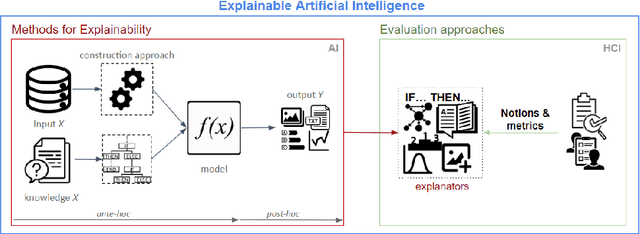
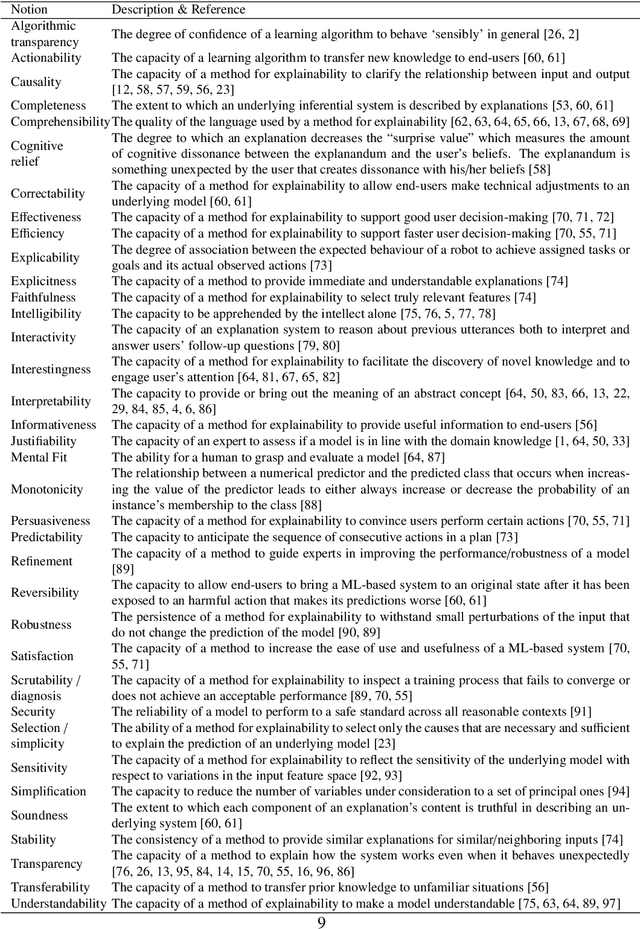
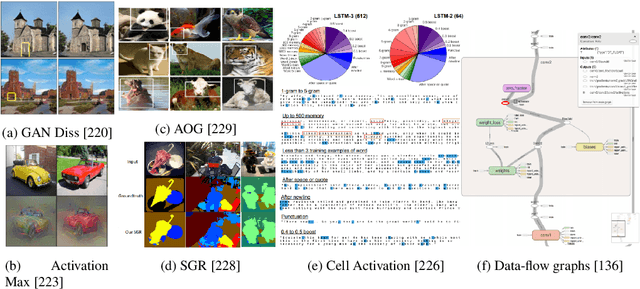
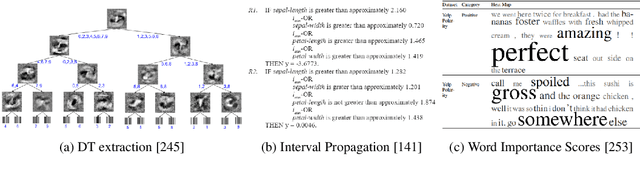
Explainable Artificial Intelligence (XAI) has experienced a significant growth over the last few years. This is due to the widespread application of machine learning, particularly deep learning, that has led to the development of highly accurate models but lack explainability and interpretability. A plethora of methods to tackle this problem have been proposed, developed and tested. This systematic review contributes to the body of knowledge by clustering these methods with a hierarchical classification system with four main clusters: review articles, theories and notions, methods and their evaluation. It also summarises the state-of-the-art in XAI and recommends future research directions.