 Add to Chrome
 Add to Firefox
 Add to Edge
Force Polytope-Based Cant-Angle Selection for Tilting Hexarotor UAVs
Apr 07, 2026
From a maneuverability perspective, the main advantage of tilting multirotor UAVs lies in the dynamic variability of the feasible executable wrench, which represents a key asset for physical interaction tasks. Accordingly, cant-angle selection should be optimized to ensure high performance while avoiding abrupt variations and preserving real-world feasibility. In this context, this work proposes a lightweight control framework for star-shaped interdependent cant-tilting hexarotor UAVs performing interaction tasks. The method uses an offline-computed look-up table of zero-moment force polytopes to identify feasible cant angles for a desired control force and select the optimal one by balancing efficiency and smoothness. The framework is integrated with a geometric full-pose controller and validated through Monte Carlo simulations in MATLAB/Simulink and compared against a baseline strategy. The results show a significant reduction in computation time, together with improved pose-tracking performance and competitive actuation efficiency. A final physics-based simulation of a complete wall inspection task in Simscape further confirms the feasibility of the proposed strategy in interacting scenarios.

Dynamic Control Allocation for Dual-Tilt UAV Platforms
Apr 07, 2026This paper focuses on dynamic control allocation for a hexarotor UAV platform, considering a trajectory tracking task as as case study. It is assumed that the platform is dual-tilting, meaning that it is able to tilt each propeller independently during flight, along two orthogonal axis. We present a hierarchical control structure composed of a high-level controller generating the required wrench for the tracking task, and a control allocation law ensuring that the actuators produce such wrench. The allocator imposes desired first-order dynamics on the actuators set, and exploits system redundancy to optimize the actuators state with respect to a given objective function. Unlike other studies on the subject, we explicitly model actuator saturation and provide theoretical insights on its effect on control performances. We also investigate the role of propeller tilt angles, by imposing asymmetric shapes in the objective function. Numerical simulations are presented to validate the allocation strategy.
Star-shaped Tilted Hexarotor Maneuverability: Analysis of the Role of the Tilt Cant Angles
Aug 22, 2024
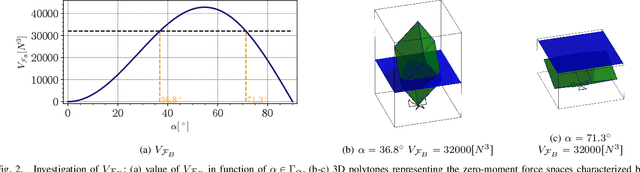
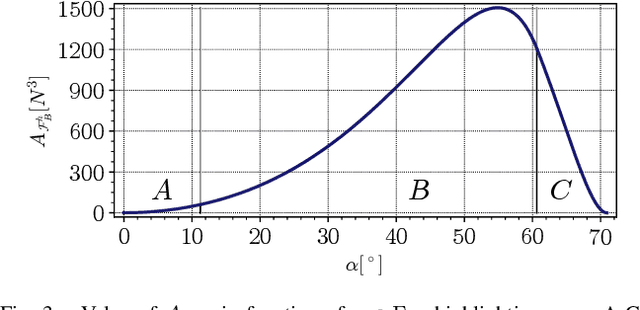
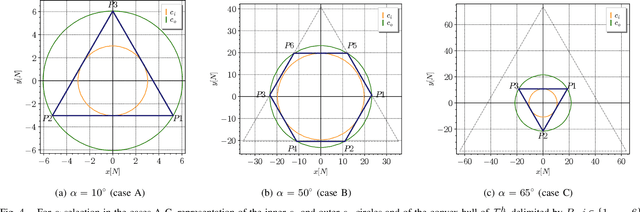
Star-shaped Tilted Hexarotors are rapidly emerging for applications highly demanding in terms of robustness and maneuverability. To ensure improvement in such features, a careful selection of the tilt angles is mandatory. In this work, we present a rigorous analysis of how the force subspace varies with the tilt cant angles, namely the tilt angles along the vehicle arms, taking into account gravity compensation and torque decoupling to abide by the hovering condition. Novel metrics are introduced to assess the performance of existing tilted platforms, as well as to provide some guidelines for the selection of the tilt cant angle in the design phase.
Tag-based Visual Odometry Estimation for Indoor UAVs Localization
Sep 23, 2023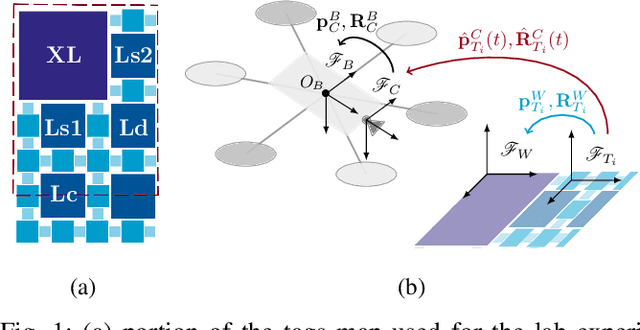
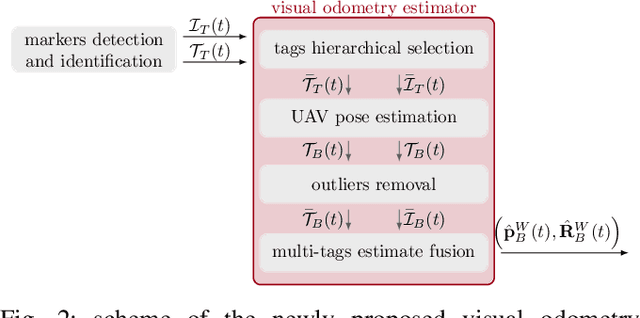
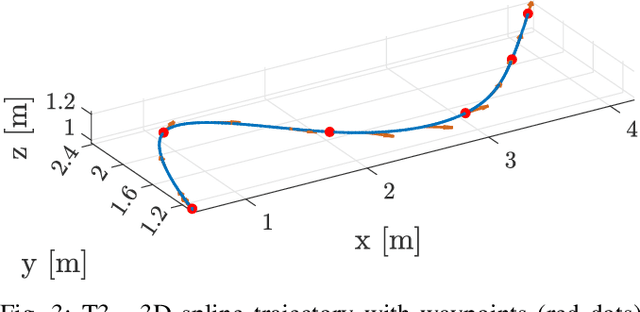
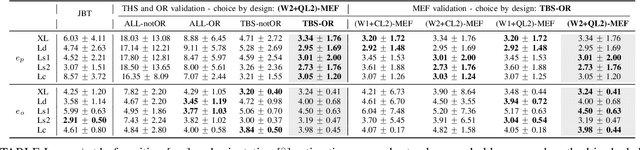
The agility and versatility offered by UAV platforms still encounter obstacles for full exploitation in industrial applications due to their indoor usage limitations. A significant challenge in this sense is finding a reliable and cost-effective way to localize aerial vehicles in a GNSS-denied environment. In this paper, we focus on the visual-based positioning paradigm: high accuracy in UAVs position and orientation estimation is achieved by leveraging the potentials offered by a dense and size-heterogenous map of tags. In detail, we propose an efficient visual odometry procedure focusing on hierarchical tags selection, outliers removal, and multi-tag estimation fusion, to facilitate the visual-inertial reconciliation. Experimental results show the validity of the proposed localization architecture as compared to the state of the art.
Visual Sensor Network Stimulation Model Identification via Gaussian Mixture Model and Deep Embedded Features
Jan 18, 2022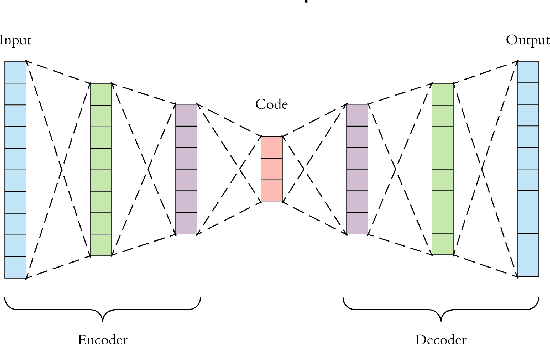
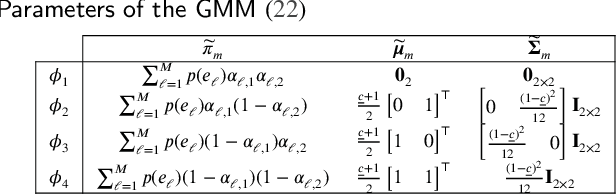
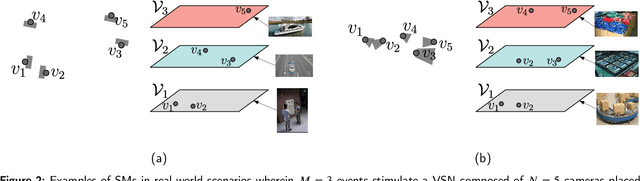
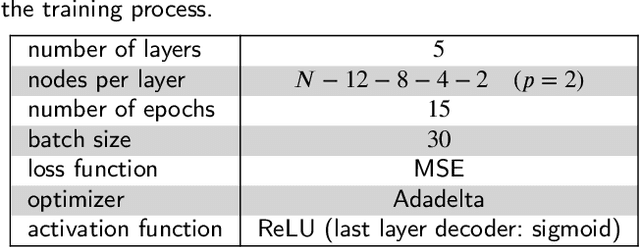
Visual sensor networks constitute a fundamental class of distributed sensing systems, with unique complexity and performance research subjects. One of these novel challenges is represented by the identification of the network stimulation model (SM), which emerges when a set of detectable events trigger different subsets of the cameras. In this direction, the formulation of the related SM identification problem is proposed, along with a proper network observations generation method. Consequently, an approach based on deep embedded features and soft clustering is leveraged to solve the presented identification problem. In detail, the Gaussian Mixture Modeling is employed to provide a suitable description for data distribution and an autoencoder is used to reduce undesired effects due to the so-called curse of dimensionality. Hence, it is shown that a SM can be learnt by solving Maximum A-Posteriori estimation on the encoded features belonging to a space with lower dimensionality. Lastly, numerical results are reported to validate the devised estimation algorithm.