 Add to Chrome
 Add to Firefox
 Add to Edge
A Human-in-the-Loop Deep Learning Framework for Color Reconstruction of Lenticular Films
Aug 05, 2026
Historical lenticular films, such as those created with the Kodacolor process, encode color information in a distinctive spatial format. This structure requires specialized techniques for accurate color reconstruction. While recent signal processing approaches like doLCE and deep learning methods like deep-doLCE have advanced automated color recovery, they often fail with cases such as curved lenticules, low-contrast, or badly captured regions. We propose a human-in-the-loop (HITL) deep learning framework which is designed for color reconstruction in lenticular films. Our approach introduces an editable, vector-based representation of lenticule boundaries, allowing experts to interactively refine boundary positions before color extraction and demosaicing. This decoupled architecture enables targeted corrections and iterative fine-tuning, embedding expert knowledge into the detection model and improving robustness across challenging frames. To preserve image details using information solely present in the original silver emulsion, we merge the reconstructed chrominance with the original film scan's luminance. We evaluate our pipeline on a challenging lenticular film sequence where previous automated approaches fail and the reconstructed colors are not suitable for exhibition. In contrast, our HITL approach successfully produces high-quality, exhibitable color reconstructions with preserved texture. This work is the first to combine expert guidance, editable intermediate representations, and texture-preserving post-processing for lenticular film color reconstruction, advancing the state of the art in this field.

A Deep Learning Approach for Digital ColorReconstruction of Lenticular Films
Feb 10, 2022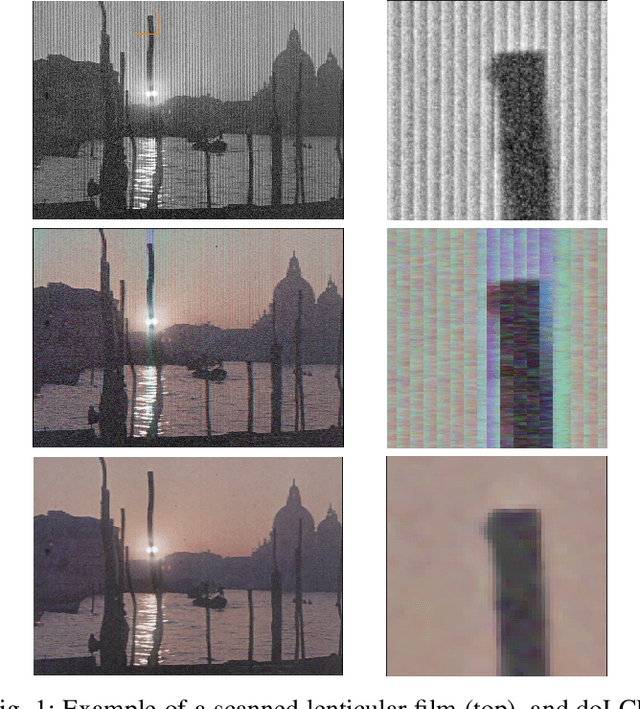
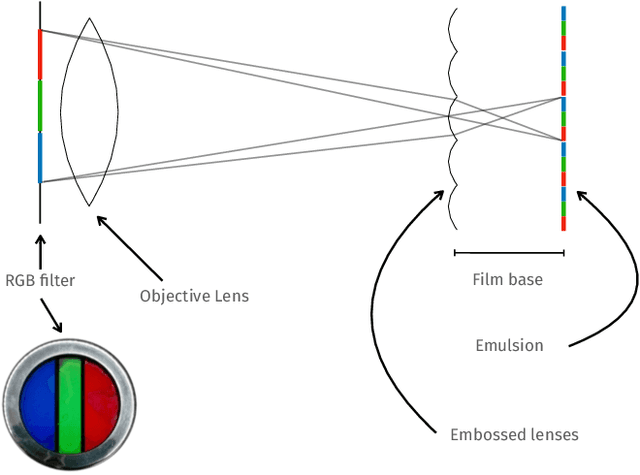
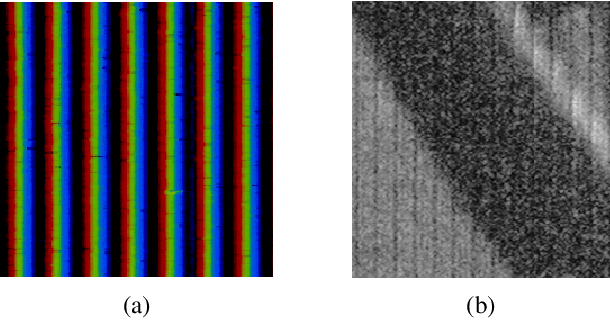
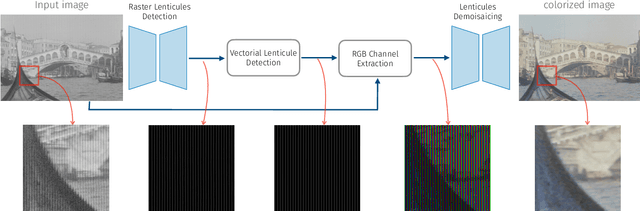
We propose the first accurate digitization and color reconstruction process for historical lenticular film that is robust to artifacts. Lenticular films emerged in the 1920s and were one of the first technologies that permitted to capture full color information in motion. The technology leverages an RGB filter and cylindrical lenticules embossed on the film surface to encode the color in the horizontal spatial dimension of the image. To project the pictures the encoding process was reversed using an appropriate analog device. In this work, we introduce an automated, fully digital pipeline to process the scan of lenticular films and colorize the image. Our method merges deep learning with a model-based approach in order to maximize the performance while making sure that the reconstructed colored images truthfully match the encoded color information. Our model employs different strategies to achieve an effective color reconstruction, in particular (i) we use data augmentation to create a robust lenticule segmentation network, (ii) we fit the lenticules raster prediction to obtain a precise vectorial lenticule localization, and (iii) we train a colorization network that predicts interpolation coefficients in order to obtain a truthful colorization. We validate the proposed method on a lenticular film dataset and compare it to other approaches. Since no colored groundtruth is available as reference, we conduct a user study to validate our method in a subjective manner. The results of the study show that the proposed method is largely preferred with respect to other existing and baseline methods.