 Add to Chrome
 Add to Firefox
 Add to Edge
Conformity Generates Collective Misalignment in AI Agents Societies
May 11, 2026
Artificial intelligence safety research focuses on aligning individual language models with human values, yet deployed AI systems increasingly operate as interacting populations where social influence may override individual alignment. Here we show that populations of individually aligned AI agents can be driven into stable misaligned states through conformity dynamics. Simulating opinion dynamics across nine large language models and one hundred opinion pairs, we find that each agent's behavior is governed by two competing forces: a tendency to follow the majority and an intrinsic bias toward specific positions. Using tools from statistical physics, we derive a quantitative theory that predicts when populations become trapped in long-lived misaligned configurations, and identifies predictable tipping points where small numbers of adversarial agents can irreversibly shift population-level alignment even after manipulation ceases. These results demonstrate that individual-level alignment provides no guarantee of collective safety, calling for evaluation frameworks that account for emergent behavior in AI populations.

Anticipating Innovation Using Large Language Models
May 06, 2026Forecasting innovation, intended as the emergence of new technological combinations, is a fundamental challenge for science and policy. We show that forthcoming combinations leave an early trace in the collective language of patents, with predictive signals detectable even decades in advance. We show that signal is not attributable to any single inventor, but emerges as a collective shift in how technologies are described across thousands of patents. To this end, we introduce TechToken, a transformer-based model that treats technologies, classified by International Patent Classification codes, as words in its vocabulary, learning the language of technologies by embedding these codes during fine-tuning. We define context similarity between code embeddings as a measure of linguistic convergence and show that it accurately predicts first technological combinations. TechToken also improves general representation quality, outperforming state-of-the-art models across different patent-related tasks.
Collective Behavior of AI Agents: the Case of Moltbook
Feb 09, 2026We present a large scale data analysis of Moltbook, a Reddit-style social media platform exclusively populated by AI agents. Analyzing over 369,000 posts and 3.0 million comments from approximately 46,000 active agents, we find that AI collective behavior exhibits many of the same statistical regularities observed in human online communities: heavy-tailed distributions of activity, power-law scaling of popularity metrics, and temporal decay patterns consistent with limited attention dynamics. However, we also identify key differences, including a sublinear relationship between upvotes and discussion size that contrasts with human behavior. These findings suggest that, while individual AI agents may differ fundamentally from humans, their emergent collective dynamics share structural similarities with human social systems.
The emergence of a concept in shallow neural networks
Sep 01, 2021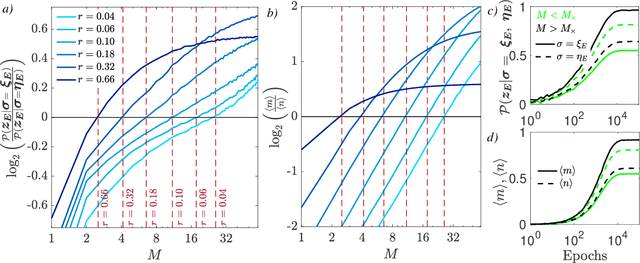
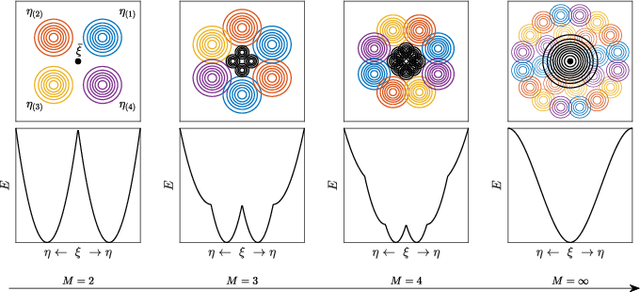
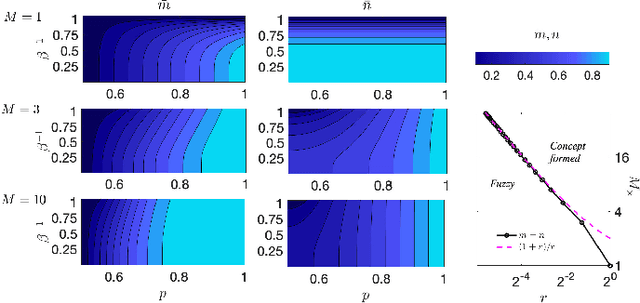
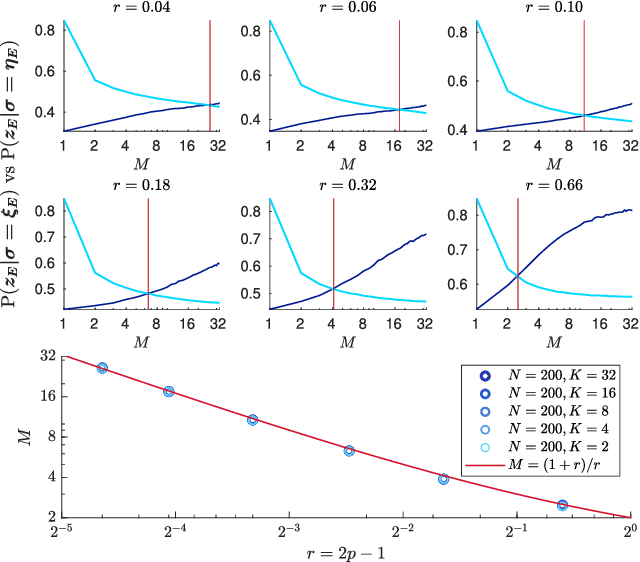
We consider restricted Boltzmann machine (RBMs) trained over an unstructured dataset made of blurred copies of definite but unavailable ``archetypes'' and we show that there exists a critical sample size beyond which the RBM can learn archetypes, namely the machine can successfully play as a generative model or as a classifier, according to the operational routine. In general, assessing a critical sample size (possibly in relation to the quality of the dataset) is still an open problem in machine learning. Here, restricting to the random theory, where shallow networks suffice and the grand-mother cell scenario is correct, we leverage the formal equivalence between RBMs and Hopfield networks, to obtain a phase diagram for both the neural architectures which highlights regions, in the space of the control parameters (i.e., number of archetypes, number of neurons, size and quality of the training set), where learning can be accomplished. Our investigations are led by analytical methods based on the statistical-mechanics of disordered systems and results are further corroborated by extensive Monte Carlo simulations.