 Add to Chrome
 Add to Firefox
 Add to Edge
Anticipating Innovation Using Large Language Models
May 06, 2026
Forecasting innovation, intended as the emergence of new technological combinations, is a fundamental challenge for science and policy. We show that forthcoming combinations leave an early trace in the collective language of patents, with predictive signals detectable even decades in advance. We show that signal is not attributable to any single inventor, but emerges as a collective shift in how technologies are described across thousands of patents. To this end, we introduce TechToken, a transformer-based model that treats technologies, classified by International Patent Classification codes, as words in its vocabulary, learning the language of technologies by embedding these codes during fine-tuning. We define context similarity between code embeddings as a measure of linguistic convergence and show that it accurately predicts first technological combinations. TechToken also improves general representation quality, outperforming state-of-the-art models across different patent-related tasks.

Follow the money: a startup-based measure of AI exposure across occupations, industries and regions
Dec 06, 2024
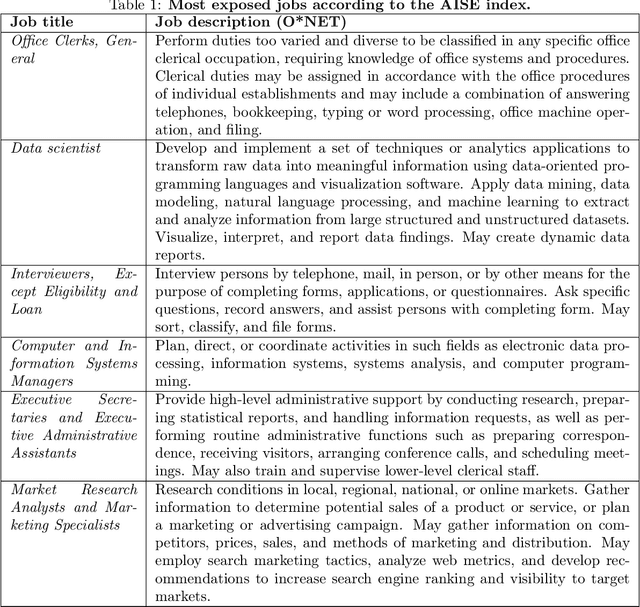

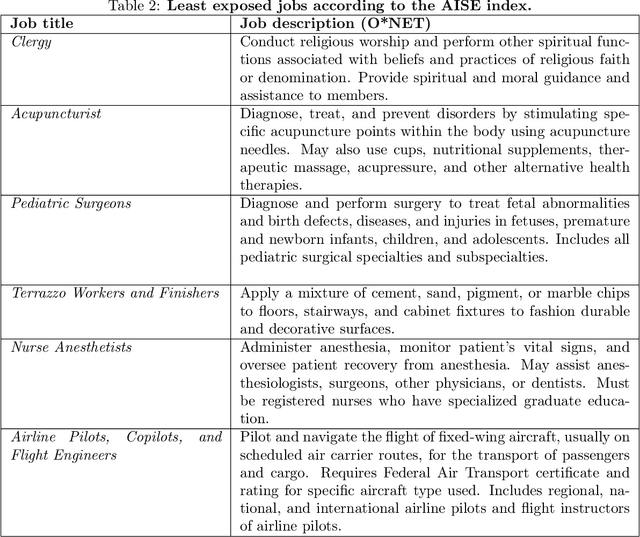
The integration of artificial intelligence (AI) into the workplace is advancing rapidly, necessitating robust metrics to evaluate its tangible impact on the labour market. Existing measures of AI occupational exposure largely focus on AI's theoretical potential to substitute or complement human labour on the basis of technical feasibility, providing limited insight into actual adoption and offering inadequate guidance for policymakers. To address this gap, we introduce the AI Startup Exposure (AISE) index-a novel metric based on occupational descriptions from O*NET and AI applications developed by startups funded by the Y Combinator accelerator. Our findings indicate that while high-skilled professions are theoretically highly exposed according to conventional metrics, they are heterogeneously targeted by startups. Roles involving routine organizational tasks-such as data analysis and office management-display significant exposure, while occupations involving tasks that are less amenable to AI automation due to ethical or high-stakes, more than feasibility, considerations -- such as judges or surgeons -- present lower AISE scores. By focusing on venture-backed AI applications, our approach offers a nuanced perspective on how AI is reshaping the labour market. It challenges the conventional assumption that high-skilled jobs uniformly face high AI risks, highlighting instead the role of today's AI players' societal desirability-driven and market-oriented choices as critical determinants of AI exposure. Contrary to fears of widespread job displacement, our findings suggest that AI adoption will be gradual and shaped by social factors as much as by the technical feasibility of AI applications. This framework provides a dynamic, forward-looking tool for policymakers and stakeholders to monitor AI's evolving impact and navigate the changing labour landscape.