 Add to Chrome
 Add to Firefox
 Add to Edge
Formalisms for Robotic Mission Specification and Execution: A Comparative Analysis
Mar 16, 2026
Robots are increasingly deployed across diverse domains and designed for multi-purpose operation. As robotic systems grow in complexity and operate in dynamic environments, the need for structured, expressive, and scalable mission-specification approaches becomes critical, with mission specifications often defined in the field by domain experts rather than robotics specialists. However, there is no standard or widely accepted formalism for specifying missions in single- or multi-robot systems. A variety of formalisms, such as Behavior Trees, State Machines, Hierarchical Task Networks, and Business Process Model and Notation, have been adopted in robotics to varying degrees, each providing different levels of abstraction, expressiveness, and support for integration with human workflows and external devices. This paper presents a systematic analysis of these four formalisms with respect to their suitability for robot mission specification. Our study focuses on mission-level descriptions rather than robot software development. We analyze their underlying control structures and mission concepts, evaluate their expressiveness and limitations in modeling real-world missions, and assess the extent of available tool support. By comparing the formalisms and validating our findings with experts, we provide insights into their applicability, strengths, and shortcomings in robotic system modeling. The results aim to support practitioners and researchers in selecting appropriate modeling approaches for designing robust and adaptable robot and multi-robot missions.

RobEthiChor: Automated Context-aware Ethics-based Negotiation for Autonomous Robots
Jul 30, 2025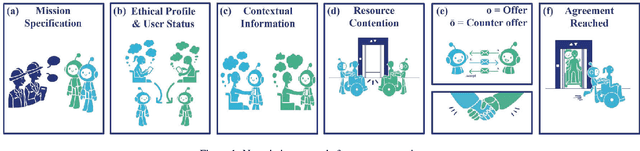

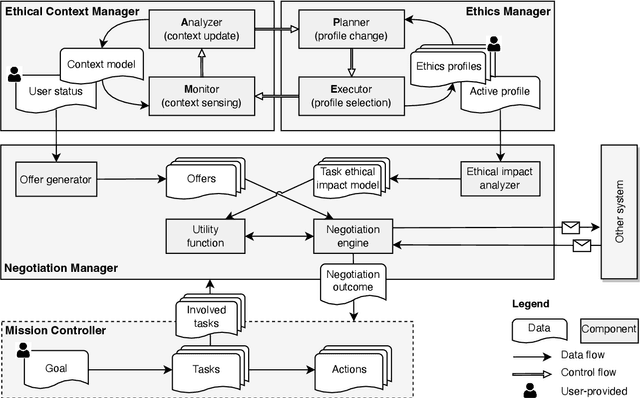
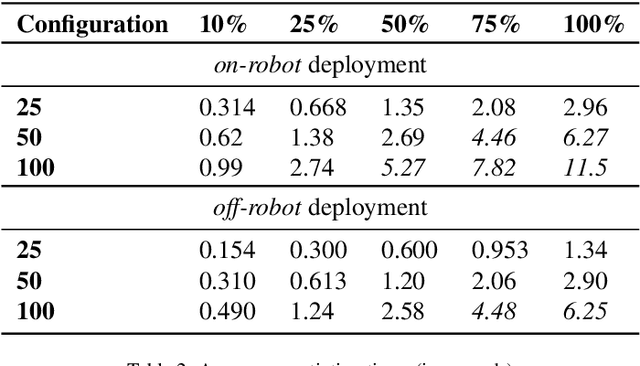
The presence of autonomous systems is growing at a fast pace and it is impacting many aspects of our lives. Designed to learn and act independently, these systems operate and perform decision-making without human intervention. However, they lack the ability to incorporate users' ethical preferences, which are unique for each individual in society and are required to personalize the decision-making processes. This reduces user trust and prevents autonomous systems from behaving according to the moral beliefs of their end-users. When multiple systems interact with differing ethical preferences, they must negotiate to reach an agreement that satisfies the ethical beliefs of all the parties involved and adjust their behavior consequently. To address this challenge, this paper proposes RobEthiChor, an approach that enables autonomous systems to incorporate user ethical preferences and contextual factors into their decision-making through ethics-based negotiation. RobEthiChor features a domain-agnostic reference architecture for designing autonomous systems capable of ethic-based negotiating. The paper also presents RobEthiChor-Ros, an implementation of RobEthiChor within the Robot Operating System (ROS), which can be deployed on robots to provide them with ethics-based negotiation capabilities. To evaluate our approach, we deployed RobEthiChor-Ros on real robots and ran scenarios where a pair of robots negotiate upon resource contention. Experimental results demonstrate the feasibility and effectiveness of the system in realizing ethics-based negotiation. RobEthiChor allowed robots to reach an agreement in more than 73\% of the scenarios with an acceptable negotiation time (0.67s on average). Experiments also demonstrate that the negotiation approach implemented in RobEthiChor is scalable.