 Add to Chrome
 Add to Firefox
 Add to Edge
Z-PEFT: Zero-shot Backdoor Detection in Parameter-Efficient Fine-Tuning via Canonical Spectral Signatures
Aug 03, 2026
Parameter-Efficient Fine-tuned (PEFT) models are frequently downloaded from open repositories by practitioners. This widespread practice creates a significant attack surface, as malicious actors can publish backdoored models that induce specific behaviors in response to predefined triggers. We study the problem of weight-space backdoor detection, where a detector classifier predicts whether a model is malicious using only its weights, enabling a lightweight safety mechanism. Most existing methods are designed and evaluated in a closed-world setting, where the detector is trained and tested on the same attack type. In contrast, we evaluate backdoor detection under novel conditions, including previously unseen attacks and datasets. We propose Z-PEFT, a lightweight meta-classifier that relies exclusively on layer-wise spectral measures for classification. Our experiments show that strong performance in the closed-world setting does not necessarily translate to high accuracy in zero-shot backdoor detection. Among weight-space detectors, Z-PEFT achieves the best performance while maintaining low and scalable computational cost.

Preventing Latent Rehearsal Decay in Online Continual SSL with SOLAR
Apr 12, 2026This paper explores Online Continual Self-Supervised Learning (OCSSL), a scenario in which models learn from continuous streams of unlabeled, non-stationary data, where methods typically employ replay and fast convergence is a central desideratum. We find that OCSSL requires particular attention to the stability-plasticity trade-off: stable methods (e.g. replay with Reservoir sampling) are able to converge faster compared to plastic ones (e.g. FIFO buffer), but incur in performance drops under certain conditions. We explain this collapse phenomenon with the Latent Rehearsal Decay hypothesis, which attributes it to latent space degradation under excessive stability of replay. We introduce two metrics (Overlap and Deviation) that diagnose latent degradation and correlate with accuracy declines. Building on these insights, we propose SOLAR, which leverages efficient online proxies of Deviation to guide buffer management and incorporates an explicit Overlap loss, allowing SOLAR to adaptively managing plasticity. Experiments demonstrate that SOLAR achieves state-of-the-art performance on OCSSL vision benchmarks, with both high convergence speed and final performance.
Replay-free Online Continual Learning with Self-Supervised MultiPatches
Feb 13, 2025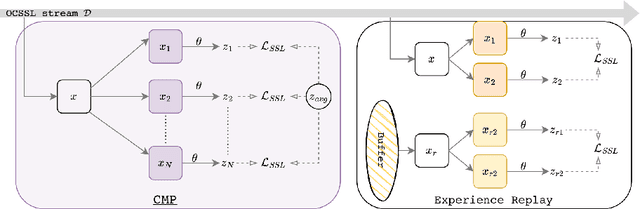
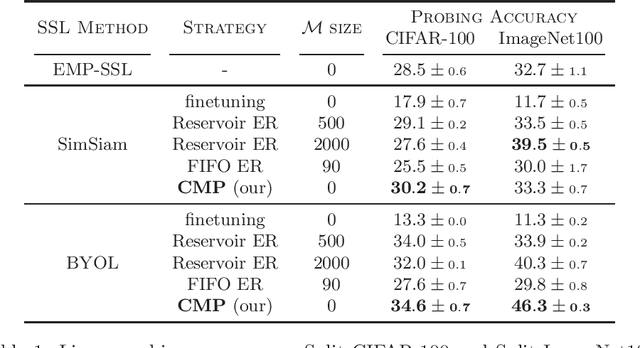
Online Continual Learning (OCL) methods train a model on a non-stationary data stream where only a few examples are available at a time, often leveraging replay strategies. However, usage of replay is sometimes forbidden, especially in applications with strict privacy regulations. Therefore, we propose Continual MultiPatches (CMP), an effective plug-in for existing OCL self-supervised learning strategies that avoids the use of replay samples. CMP generates multiple patches from a single example and projects them into a shared feature space, where patches coming from the same example are pushed together without collapsing into a single point. CMP surpasses replay and other SSL-based strategies on OCL streams, challenging the role of replay as a go-to solution for self-supervised OCL.
PD-L1 Classification of Weakly-Labeled Whole Slide Images of Breast Cancer
Apr 15, 2024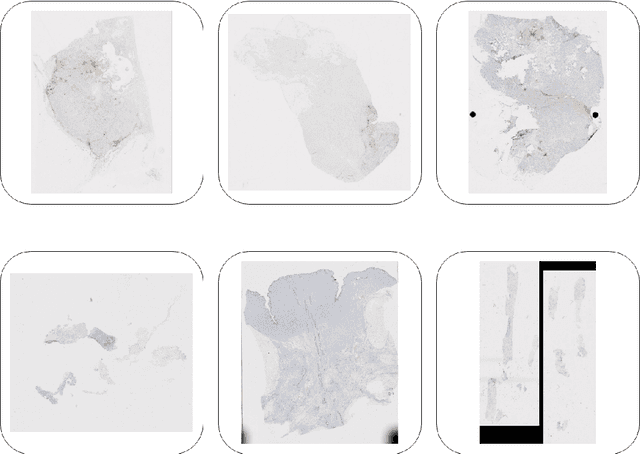
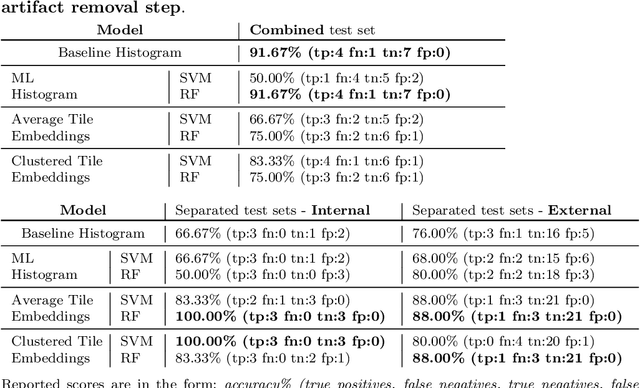
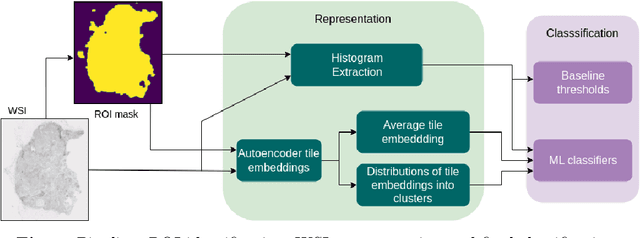
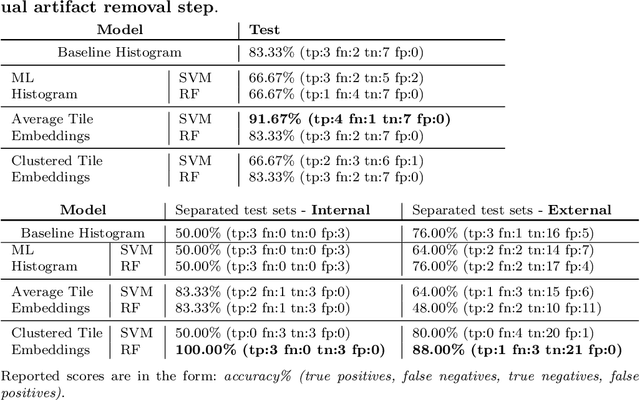
Specific and effective breast cancer therapy relies on the accurate quantification of PD-L1 positivity in tumors, which appears in the form of brown stainings in high resolution whole slide images (WSIs). However, the retrieval and extensive labeling of PD-L1 stained WSIs is a time-consuming and challenging task for pathologists, resulting in low reproducibility, especially for borderline images. This study aims to develop and compare models able to classify PD-L1 positivity of breast cancer samples based on WSI analysis, relying only on WSI-level labels. The task consists of two phases: identifying regions of interest (ROI) and classifying tumors as PD-L1 positive or negative. For the latter, two model categories were developed, with different feature extraction methodologies. The first encodes images based on the colour distance from a base color. The second uses a convolutional autoencoder to obtain embeddings of WSI tiles, and aggregates them into a WSI-level embedding. For both model types, features are fed into downstream ML classifiers. Two datasets from different clinical centers were used in two different training configurations: (1) training on one dataset and testing on the other; (2) combining the datasets. We also tested the performance with or without human preprocessing to remove brown artefacts Colour distance based models achieve the best performances on testing configuration (1) with artefact removal, while autoencoder-based models are superior in the remaining cases, which are prone to greater data variability.